
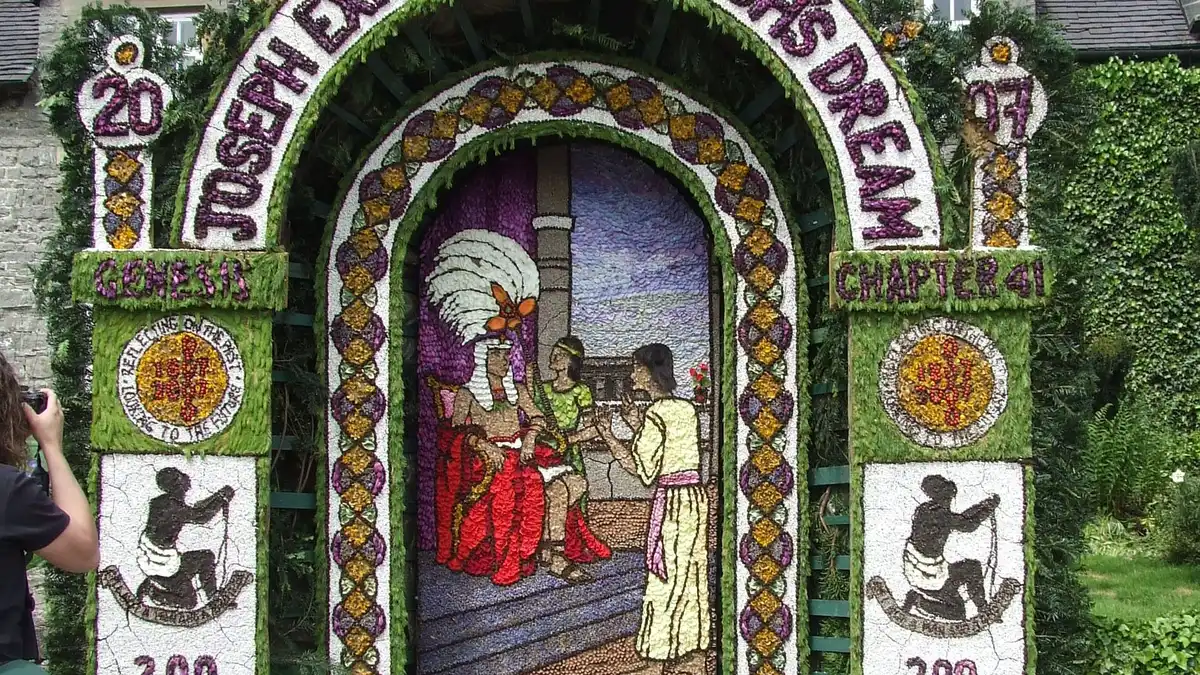
Well dressing is one of the oldest village customs in England, and it makes a wonderful theme for a very large party. In the Peak District, villagers press petals, leaves and moss onto boards spread with wet clay, building bright pictures that stand beside the village wells through the summer. The work is slow, sociable and hands-on, which is exactly what a crowd of 572 players needs: something to do together, something to look at, and something to laugh about while the clay dries.
This guide turns that custom into a full day for 572 players. The crowd splits into 44 crews of 13, and each crew moves through nine games that all borrow their kit from the well-dressing yard: clay boards, petals, moss, buckets, water and timber frames. Nothing here needs rare equipment or a lengthy rehearsal.
The nine games below work for a mixed crowd of all ages. Strong arms help with the bucket carry, sharp eyes help with the petal counts, and steady hands help with the clay weighing. Every game gives each crew a tally, and the tallies add up across the day, so the steadiest crew wins.
Key Takeaways
- 572 players split into 44 crews of 13, so every game runs with the same small crew all day.
- All nine games use well-dressing kit: clay boards, petals, moss, buckets, water and timber frames.
- Each game takes about ten minutes, and a crew learns the rules in about a minute.
- Tallies from all nine games add up, so steady crews beat one-game wonders.
- Wet clay, fresh petals and a dry store for finished boards are the three things to arrange before the day.
How 572 Players Fit Into One Day
Forty-four crews of 13 sound like a lot of people to move around a village green, and it is. The trick is to keep each crew together from the opening welcome to the closing tally, and to let the crews move while the kit stays put. Each of the nine games has its own patch of ground with its boards, buckets and tally sheets already laid out. A crew walks to a patch, plays for ten minutes, records its tally, and walks on to the following patch.
The day runs in three blocks of three games, with a break between blocks for food, water and a look at the finished boards. A host with a loud voice and a big clock keeps the blocks on time, and each crew carries a single tally sheet that a helper signs at every patch. The tally sheet is the heart of the day: it holds the crew name, the nine tallies, and the running total, and it is the one thing no crew is allowed to lose. Print 44 sheets, one per crew, and keep ten extras in the host tent for the crews that fold theirs into paper hats.
Helpers matter more than heroes here. Each patch needs one helper who knows the game, watches the clock, and writes the tally in plain digits. Nine helpers mind the nine patches, and three more helpers float between patches with extra petals, fresh water and dry cloths. That is twelve helpers for 572 players, and it leaves the host free to welcome late arrivals and keep the mood warm.
The Nine Well-Dressing Games
Each game below uses the same simple pattern: a short briefing, ten minutes of play, and a tally that any helper can record in seconds. The games run in any order, and the order on the day is the order the crews meet them as they walk the green. Read the briefing aloud, show one quick example with real kit, and let the crew begin. The best crews talk while they work, share the fiddly jobs, and keep one eye on the clock.
1. Petal Layer Count
Petal Layer Count is the gentlest opening game, and it teaches the skill every well dresser needs: laying petals in even layers so the clay beneath never shows through. Each crew gets a small board spread with wet clay and a tray of petals in three shades. The crew presses the petals onto the board in layers, one shade at a time, until the board is filled edge to edge. The helper counts the layers by lifting a corner of the work and looking at the edge, then records the number of full, even layers.
Scoring rewards care over speed. A crew earns two points for each full, even layer, and loses one point for each bare patch the helper can see. The lesson lands quickly: slow hands and a shared plan beat a rush every time, and the finished board looks good enough to stand beside the well.
2. Clay Board Sort
Clay Board Sort is a sorting game with a muddy twist. Each crew gets a heap of clay lumps in mixed sizes and a row of boards marked small, middle and large. The crew sorts the lumps onto the boards marked for each size, one lump at a time, with each player handling only the lumps that come to their own end of the heap.
The helper checks the three boards at the end of ten minutes and awards one point for each lump on its correct board. A crew that talks as it sorts will finish with most lumps in the right place, while a silent crew will find its boards mixed. The ploughing-match games in our party games for 568 players run on the same rotation idea, with small crews moving from one post to the following one, and the same habit of talking while working wins there too.
3. Well Water Scoop
Well Water Scoop is the wettest game of the day, and the one the crowd gathers to watch. A basin of water stands at each patch, with a row of marked jars on a low bench beside it. Each crew member scoops water with a small cup, carries it to the jars, and pours it into the jar marked with their crew colour.
The helper reads the water level in the crew jar at the end of ten minutes and awards one point for each full mark the water reaches. A careful walker with a steady cup can be worth more than a hurried runner with a shaking hand, and crews soon learn to send their calmest members on the water run. Lay dry cloths under the jars before the game begins, and keep an extra bucket of water beside the basin so the basin never runs dry mid-game.
4. Moss Bed Count
Moss Bed Count is a calm counting game, and it suits the crews that like to work with their eyes wide and their voices low. Each crew gets a shallow tray lined with damp moss and a handful of small white pebbles. The crew presses the pebbles into the moss in neat rows, counting aloud as each pebble sinks in, until the tray is full. The helper then lays a cloth over the tray, lifts it away, and asks the crew to write down how many pebbles they pressed in.
Scoring is simple: one point for each ten pebbles in the tray, and three bonus points if the written count agrees with the helper count exactly. The counting aloud is the whole secret, because a crew that counts together keeps one shared number, while a crew that counts in silence ends up with thirteen different answers.
5. Petal Pile Sort
Petal Pile Sort is the fastest game of the nine, and it fills the patch with colour. Each crew gets a mixed heap of petals in five shades and five shallow bowls. The crew sorts the heap shade by shade, one petal at a time, until each bowl holds a single shade. Hands move quickly, petals drift across the grass, and the crew that sorts in a tidy line from heap to bowl will finish well before the crew that chases petals across the grass.
The helper weighs each bowl at the end of ten minutes and awards one point for each bowl that holds only one shade, with a bonus point for the heaviest single-shade bowl on the patch. A bowl with a single stray petal of the wrong shade earns nothing, so the last minute of the game is always the same: thirteen players leaning over five bowls, lifting out the one petal that does not belong.
6. Well Bucket Carry
Well Bucket Carry is the strongest test of teamwork in the whole day. Each crew gets a bucket of water and a path marked with two turning posts about twenty paces apart. Two players carry the bucket between them, one on each handle, walking the path and turning at each post. At each post they hand the bucket to the following two players, and the bucket keeps moving until the ten minutes end. The water level is marked on the inside of the bucket, and the helper reads it at the end.
The crew earns one point for each full circuit of the path, and loses one point for each finger-width the water has dropped below its starting mark. The Highland ceilidh games in our party games for 566 players keep the same big-crowd rhythm, with music and stepping carrying the day, and the same gentle handover matters there too.
7. Clay Lump Weigh
Clay Lump Weigh is a guessing game with a muddy answer. Each crew gets a balance scale, a pile of clay lumps in mixed sizes, and a target weight written on a slate. The crew lifts lumps by hand, guesses their weight, and adds them to the scale until the beam balances at the target. The crew may test as many lumps as it likes, but only the lumps on the scale when the helper calls time will count.
Scoring is kind to near misses. A crew that lands within a finger-width of the target on the scale earns ten points, within two finger-widths earns six, and within three earns three. Hands learn quickly: after two or three tries, most players can feel the difference between a small lump and a heavy one, and the crew starts calling the weights aloud before the scale confirms them.
8. Flower Stalk Count
Flower Stalk Count is a memory game dressed as flower work. Each crew gets a bundle of flower stalks tied with twine and a tally sheet. The crew unties the bundle, counts the stalks one by one, and reties it, then the helper hides the bundle behind a cloth and asks the crew to write down the count from memory. The crew may count the stalks as many times as it likes while the bundle is in view, but once the cloth drops, the talking stops.
The crew earns one point for each ten stalks in the bundle, and five bonus points if the written count is exactly right. The trap is the retie: a crew that ties the bundle loosely will drop stalks on the grass, and every dropped stalk is a stalk the count forgets. Work on a cloth, not on bare grass, and appoint one player to hold the twine while another ties the knot.
9. Board Frame Carry
Board Frame Carry is the closing game, and it is the one the whole village comes to watch. Each crew gets a timber frame holding a finished clay board, the picture pressed from petals and leaves. Four players lift the frame, one at each corner, and carry it along a short path to the display stand beside the well. The rest of the crew walks alongside, calling out low branches, uneven ground and tight turns. The frame must arrive upright, the picture must stay whole, and the crew must lower it gently onto the stand.
The helper awards ten points for a frame that arrives with its picture unharmed, five points if only a small patch needs repair, and nothing if the board slips from the frame. When the last frame stands beside the well, the village has nine new pictures to admire, and every crew has helped to put one there.
At a Glance
The table below sums up the nine games so a host can brief helpers in a single look. The sheep-shearing games in our party games for 564 players use the same tally sheets and small crews, so the two days share a kit list, and a helper who has worked one day can work the other without a fresh briefing.
| Game | Crew | Kit | Minutes |
|---|---|---|---|
| Petal Layer Count | 13 | Clay board, petal trays | 10 |
| Clay Board Sort | 13 | Clay lumps, marked boards | 10 |
| Well Water Scoop | 13 | Basin, cups, marked jars | 10 |
| Moss Bed Count | 13 | Moss tray, white pebbles | 10 |
| Petal Pile Sort | 13 | Mixed petals, five bowls | 10 |
| Well Bucket Carry | 13 | Bucket, two turning posts | 10 |
| Clay Lump Weigh | 13 | Balance scale, clay lumps | 10 |
| Flower Stalk Count | 13 | Flower stalks, twine, cloth | 10 |
| Board Frame Carry | 13 | Timber frame, clay board | 10 |
Before the Day Checklist
- Soak the boards and mix the clay the evening before, so the clay is pliable and workable at dawn.
- Gather petals, sort them by shade, and keep them cool and damp in lidded trays until play begins.
- Print 44 tally sheets plus ten extras, with a pencil tied to each sheet so none walks away.
- Lay out extra buckets of water, dry cloths and clean cups at every patch before the crews arrive.
- Mark the paths, turning posts and display stands with flags, and walk each path once to lift away loose stones.
- Ready a dry store for finished boards, with timber battens to keep the boards upright and apart.
Frequently Asked Questions
How long does a well-dressing party day last?
Nine games at ten minutes each give ninety minutes of play, and three blocks with two breaks between them stretch the day to about four hours from the opening welcome to the closing tally. That pace leaves room for a slow lunch and a good look at the pictures beside the well.
What happens when rain soaks the boards?
Rain is the one thing a host cannot plan away, so the day needs a rain plan. Move the petal and clay games beneath a tarpaulin, keep the bucket games outside, and lay tarpaulins over the finished boards. Wet clay still takes petals, and a damp board can be dried beneath a tarpaulin once the rain passes.
Can children join in with the petal work?
Children are welcome in every game, and the petal games suit them best. Petal Layer Count and Petal Pile Sort need small fingers and sharp eyes, and children often beat the adults at both. A crew with children in it should put the children in charge of the tally sheet, because they guard it well.
How many helpers does each crew need?
Each crew needs no helper of its own. Nine helpers mind the nine patches, three more float between patches with extra petals, fresh water and dry cloths, and the host keeps the day on time. That is twelve helpers for 572 players. A crew of 13 can also name its own captain, and the captain carries the tally sheet, calls the crew to each patch, and settles small arguments before they reach the helper.
What do we do with the boards after the day ends?
The finished boards stand beside the well for the rest of the week, so the village can enjoy them. Keep them beneath a tarpaulin when rain threatens, and lift them into the dry store at night. Petal pictures fade in strong sun, so a shaded place beside the well is better than a sunny one. When the week ends, the clay can be scraped off the boards, the boards washed, and the clay mixed again for the following year.
Can the nine games run indoors?
Most of them can. Petal Layer Count, Clay Board Sort, Moss Bed Count, Petal Pile Sort, Clay Lump Weigh and Flower Stalk Count all run happily on trestle tables in a hall. Well Water Scoop and Well Bucket Carry need a floor that can get wet, so they suit a barn or a roofed yard. Board Frame Carry needs a wide path and a display stand, and it works indoors if the hall has room for a slow walk with a frame.
The Bottom Line
A well-dressing day gives 572 players something rare: a whole day of games that leave something beautiful behind. Forty-four crews of 13, nine games, one tally sheet per crew, and a row of petal pictures beside the well at the end of it. Arrange the clay, the petals and a dry store before the day, trust the helpers to keep the tallies honest, and let the crews do the rest. The pictures will still be there a week later, and the crews will still be talking about them.


