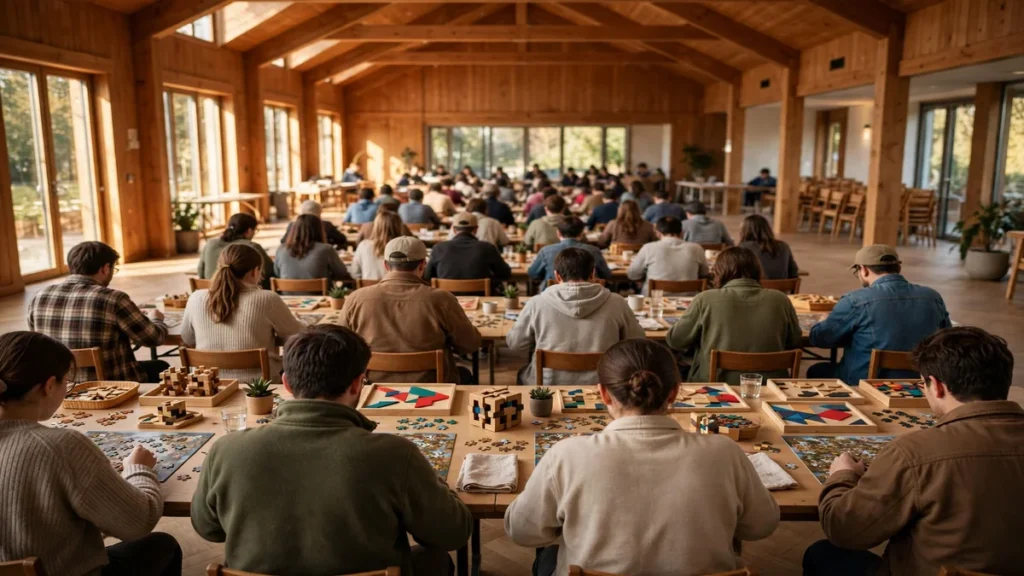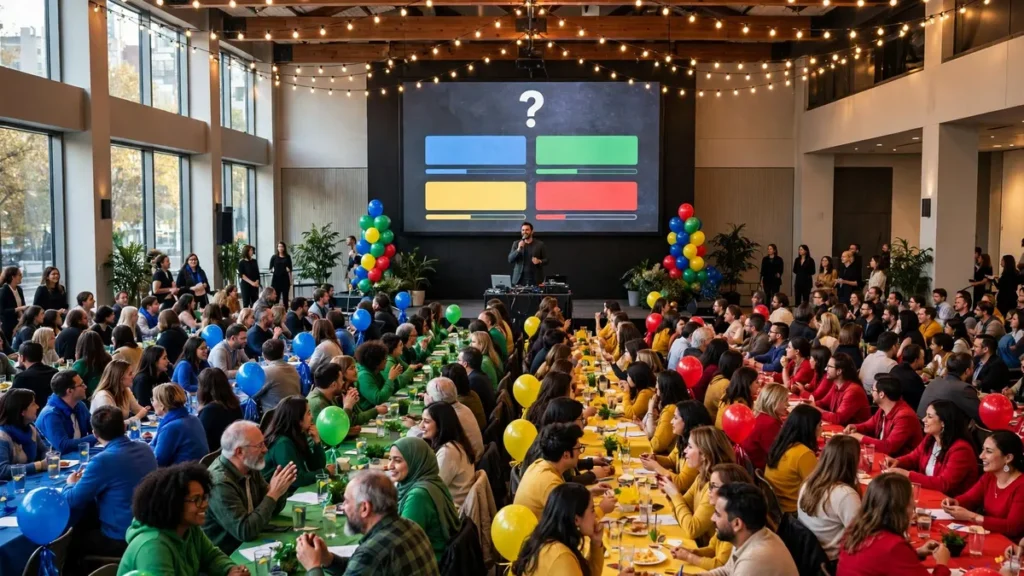
The best party games for 316 players are the ones that give every guest something to do at the same time, without long queues, confusing rules, or a small group performing on stage while everyone else watches from their seats. A crowd of three hundred and sixteen is not simply a bigger version of a dinner party. It is a small town gathered in one hall for an evening, and the games that work at that scale are built around teams, simple signals, and actions that hundreds of people can take in seconds.
Planning for 316 guests changes every practical decision a host has to make. You need a room where teams can sit together and still see a stage or a large screen, a sound system that reaches the back row without echo, and a scoring system that helpers can update without stopping the fun. The games in this guide were chosen because they pass those tests, and because they work for mixed ages, mixed abilities, and guests who have never met each other before the evening begins.
This guide gives you ten complete games, a comparison table to help you choose, a planning checklist, and answers to the questions hosts ask most often. Each game includes the setup, the team size that works best, and the time it takes. Use the whole list for a full evening, or pick three or four games for a shorter party and save the rest for next time.
Key takeaways
- Divide 316 players into 14 teams, with eight teams of 23 and six teams of 22, so every guest has a team, a seat, and a job to do.
- Choose games with one clear action per round, such as hunting, drawing, dancing, or building, so hundreds of people can play at once.
- Use a large screen, a strong microphone, and printed score sheets to keep instructions visible and scoring simple.
- Mix quiet thinking games with loud active games so energy rises and falls through the evening.
- Plan one host, two scorekeepers, and at least eight helpers, and rehearse the first game before guests arrive.
How to Choose Games for 316 Players
A good game for three hundred and sixteen players passes four simple tests. First, everyone can take part in the same round. Second, the rules can be explained in less than one minute. Third, the result can be counted quickly. Fourth, the game still feels fair when one team is louder, faster, or more confident than the others. If a game fails any of those tests, save it for a smaller gathering where it can shine properly.
The number 316 also shapes the team maths in a useful way. Fourteen teams give every team enough people to split jobs between searching, drawing, performing, and cheering, while keeping each team small enough for a captain to organise. Eight teams of twenty-three and six teams of twenty-two add up to exactly three hundred and sixteen, so nobody sits out and nobody has to join a team that is already too big. If you prefer larger teams, four teams of seventy-nine work for relay games, but they are much harder to manage in quiz rounds. Fourteen teams is the sweet spot for most parties, and it is the team size used throughout this guide.
Think about the room before you pick your games. A hall with a flat floor suits relays and building games, while a room with fixed tables suits drawing, memory, and voting games. Check the sound system early, because a host who cannot be heard at the back will lose the crowd in the first five minutes. Hosts planning a slightly smaller crowd can borrow the same team structure from the best party games for 314 players, which uses a very similar hall layout and scoring system.
Best Party Games for 316 Players at a Glance
| Game | Best Team Size | Time | Energy | Main Equipment |
|---|---|---|---|---|
| Giant Scavenger Hunt Sprint | 14 teams | 30 minutes | High | Clue lists, hidden items, timers |
| Team Lip Sync Showdown | 14 teams | 30 minutes | High | Song clips, stage, microphones |
| Human Pictionary Chain | 14 teams | 25 minutes | Medium | Word cards, whiteboards, markers |
| Mass Musical Statues | Individual | 20 minutes | High | Music, speakers, open floor |
| Giant Dice Dash | 14 teams | 25 minutes | Medium | Giant foam dice, score sheets |
| Memory Wall Challenge | 14 teams | 25 minutes | Low | Picture boards, answer sheets, timers |
| Newspaper Fashion Runway | 14 teams | 30 minutes | Medium | Newspapers, tape, scissors, runway |
| Crowd Story Chain | 14 teams | 20 minutes | Low | Prompt cards, microphones, screen |
| Giant Jenga Tower Challenge | 14 teams | 25 minutes | Medium | Giant blocks, tables, timers |
| Team Talent Relay Finale | Top 6 teams | 30 minutes | High | Stage, props, scorecards, prizes |
The 10 Best Party Games for 316 Players
These ten games were picked to cover a full evening: fast and slow, loud and quiet, thinking and moving. Run them in the order below for a natural rise and fall of energy, or shuffle them to suit your crowd. Every game works with fourteen teams of twenty-two or twenty-three players.
1. Giant Scavenger Hunt Sprint
Give every team the same list of twenty everyday items to find inside the venue, such as a red pen, a left shoe, a photo of a pet, or a coin from a certain year. Teams send runners to a central table while the rest of the team searches bags, pockets, and jackets at their tables. Each correct item earns one point, and the first team to find fifteen items earns a five-point bonus. The sprint works because the whole hall is moving at once, yet the rules fit in a single sentence.
Set clear boundaries before you start, and ban anything valuable, fragile, or borrowed without permission. Place two helpers at the check-in table so teams are not stuck in a queue, and use a large timer on the screen so everyone can see how long is left. Keep the round to thirty minutes, including scoring, and announce the running totals after every five items so the trailing teams stay motivated. This is the best opener on the list because it wakes the room up and gets strangers talking within minutes.
2. Team Lip Sync Showdown
Each team picks one famous song and performs it on stage without singing a word, using props, costumes, and dance moves instead. Teams get ten minutes to plan at their tables, then ninety seconds each on stage while the rest of the hall votes with coloured cards. The judges score energy, creativity, and how well the whole team joins in, rather than how well anyone can mime. With fourteen teams, the show takes about thirty minutes including introductions and voting.
3. Human Pictionary Chain
Human Pictionary Chain turns drawing into a relay. Each team lines up in a row, and the first player sees a word card, draws it on a small whiteboard, and shows it to the next player, who draws what they think they saw for the player behind them. The drawing travels down the whole line of twenty-two or twenty-three players, and the last player shouts out the final guess. Teams score points when the final guess matches the original word, and bonus points when the chain stays close to the starting word.
4. Mass Musical Statues
Mass Musical Statues takes a childhood favourite and scales it up for a whole hall. The music plays, all three hundred and sixteen guests dance where they stand or in the aisles, and when the music stops everyone must freeze completely. Helpers walk the floor and tap out anyone who wobbles, giggles, or keeps moving, and the last guests still standing win points for their teams. Play five rounds with different styles of music, from pop to classical to film themes, so every age group gets a song they enjoy.
5. Giant Dice Dash
Giant Dice Dash is a race built around oversized foam dice. Each team stands in a line, and the first player rolls two giant dice, adds the numbers together, and runs to the scoring table to record the total before tagging the next player. The team must reach an agreed target, such as five hundred, before the time runs out, and every roll is called out loud so the crowd can follow the race. The dice are light and soft, so the game is safe even when the hall is crowded and the pace is fast.
6. Memory Wall Challenge
Memory Wall Challenge tests how much a team can remember together. Cover a large board with thirty pictures of everyday objects, animals, places, and famous faces, show it to the whole hall for exactly sixty seconds, then cover it and hand every team an answer sheet. Teams have five minutes to write down as many items as they can remember, earning one point per correct item and losing a point for each wrong guess. The team with the longest accurate list wins the round, and you can run three rounds with different boards.
Pick pictures that are clear and familiar, and mix easy items with a few tricky ones so the scores spread out. Show the board on the big screen as well as on a printed board at the front, so guests at the back can see it just as well as those at the front. Ban phones during the viewing minute, and collect the answer sheets promptly so teams cannot keep adding items after time is called. The game is quiet, calm, and fair, which makes it a perfect breather after a loud relay, and it rewards teamwork because different people remember different pictures. For another calm team format that works at this scale, see the best party games for 312 players, which includes a similar memory round with its own scoring twist.
7. Newspaper Fashion Runway
Newspaper Fashion Runway gives every team a stack of old newspapers, a roll of tape, and a pair of scissors, and twenty minutes to design an outfit for one volunteer model. Teams can build hats, capes, dresses, or full suits, and they must name their creation before the model walks the runway. Judges score originality, how well the outfit holds together, and the model's walk, while the audience votes for a crowd favourite. The runway walk at the end takes about ten minutes for all fourteen teams.
8. Crowd Story Chain
Crowd Story Chain builds one long story from the whole hall. The host reads the first sentence, then each team adds one sentence in turn, with the story shown on the big screen so everyone can follow it. Teams have thirty seconds to agree on their sentence when their turn comes, and the host can throw in a surprise prompt, such as a storm, a lost key, or a talking animal, every five turns to keep the story moving. After fourteen rounds, the host reads the complete story aloud and the hall votes for the funniest sentence.
9. Giant Jenga Tower Challenge
Giant Jenga Tower Challenge puts a huge block tower on every team table and turns careful hands into a team sport. One player at a time removes a block and places it on top, while the rest of the team watches, advises, and holds its breath. Teams earn one point for every block they move safely, and the round ends for a team when its tower falls. The team with the tallest standing tower after twenty-five minutes wins, with bonus points for the most blocks moved without a collapse.
Use the same number of blocks for every team, and place each tower on a flat, steady table away from the aisles so passing guests cannot bump it. Give teams a practice round of five minutes so everyone understands the rules, and station a helper at each table to count blocks and watch for wobbles. The game is quiet enough to follow a loud round, yet tense enough to hold the room's attention, and it works for all ages because success depends on a steady hand rather than speed or strength.
10. Team Talent Relay Finale
Team Talent Relay Finale closes the evening with the six highest-scoring teams taking the stage in turn. Each team has three minutes to show a short talent that uses at least five members, such as a group dance, a comedy sketch, a human pyramid, or a medley of songs. The other teams judge each act with scorecards, and the host adds the finale points to the evening totals before announcing the winners. The finale takes about thirty minutes including judging and the prize ceremony.
Warn the top teams at least an hour before the finale so they have time to prepare, and give each team a rehearsal slot of five minutes on the stage. Keep the three-minute limit strict with a visible countdown, and have the prizes ready at the side of the stage so the ceremony runs smoothly. A finale that celebrates the whole evening, rather than a single winner, leaves everyone in a good mood, and it gives the quieter teams one last chance to shine. For more finale ideas that suit a crowd of this size, the best party games for 310 players includes a closing ceremony format that adapts well to fourteen teams.
Planning Checklist for a 316-Player Party
- Book a hall that seats 316 guests at fourteen team tables, with a stage, a large screen, and a flat open floor for relays.
- Recruit one host, two scorekeepers, and at least eight helpers, and give every helper a written job and a team colour.
- Prepare fourteen team packs with answer sheets, pens, scorecards, and a printed schedule of the evening.
- Test the microphone, speakers, and screen the day before, and keep spare batteries, cables, and markers on hand.
- Buy prizes for the winning team, the funniest team, and the best-dressed team, so more than one team goes home happy.
- Rehearse the first game with your helpers before guests arrive, and print a one-page rules sheet for every table.
Frequently Asked Questions
How many teams should 316 players be divided into?
Fourteen teams is the best split for 316 players. Eight teams of twenty-three and six teams of twenty-two add up to exactly three hundred and sixteen, so every guest has a team and a job. Fourteen teams are small enough for a captain to organise and large enough to split jobs between playing, scoring, and cheering.
How long does a party for 316 players take?
A full evening with all ten games takes about four hours, including a break for food and the prize ceremony. A shorter party of two hours works well with three or four games, such as the scavenger hunt, the lip sync showdown, the memory wall, and the talent finale. Add thirty minutes at the start for seating and introductions, and fifteen minutes at the end for prizes and photos.
What equipment do I need for 316 players?
You need a large screen, a strong microphone and speakers, fourteen team tables, printed answer sheets and scorecards, and the props for your chosen games, such as giant dice, block sets, newspapers, and word cards. You also need timers, pens, prizes, and a first aid kit. Most items are cheap and reusable, so borrow what you can from friends, schools, or community halls before buying anything new.
Can children play these party games?
Yes, all ten games work for mixed ages with small adjustments. Give children simpler words in the drawing chain, shorter sentences in the story chain, and lighter roles in the relays, such as rolling the dice or holding the scorecard. Keep the music family friendly, check that props are safe for small hands, and seat families together so parents can help younger players.
How do I keep scoring fair with 316 players?
Use two scorekeepers who work independently and compare totals after every game, and show the running scores on the big screen so every team can see them. Give each team a printed scorecard that a helper signs after every round, and keep a master sheet at the scoring table. Clear rules, identical equipment, and visible scores prevent most arguments before they start.
What if my venue is smaller than expected?
Run the quiet table games first, such as the memory wall, the story chain, and the drawing chain, and save the active games for a garden, car park, or second room. Split the fourteen teams into two groups of seven and run the same game in two sessions, or swap a relay for a seated game that needs no floor space. Always visit the venue before the party and measure the floor so you know exactly what fits.
The Bottom Line
The best party games for 316 players are the ones that let all three hundred and sixteen guests play at once, with clear rules, fair teams, and a mix of loud and quiet rounds. Split the crowd into fourteen teams, prepare your equipment the day before, rehearse the first game with your helpers, and keep the scores visible on a big screen. Do that, and your giant party will feel like a celebration, not a crowd, from the first game to the final prize.