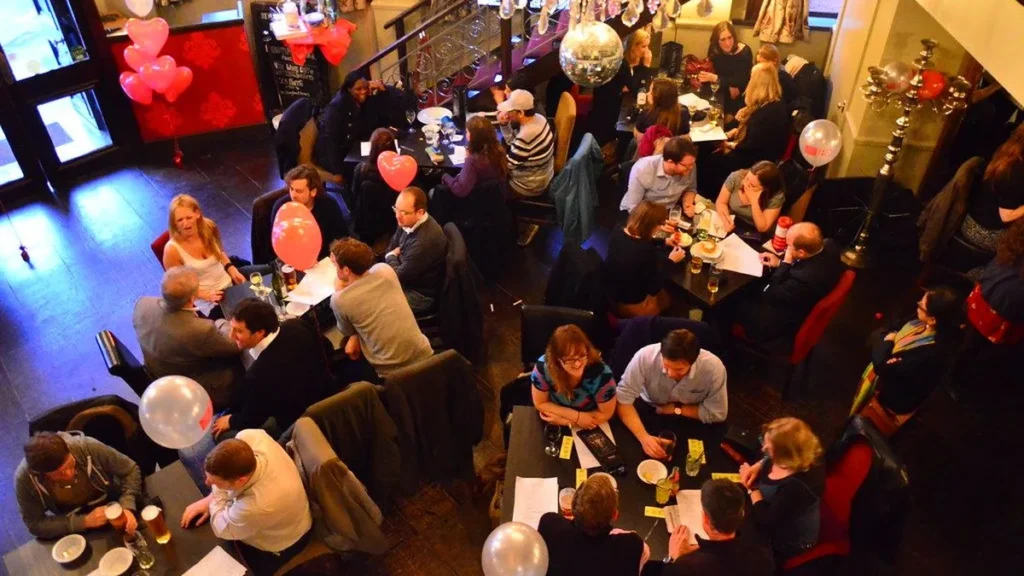
Finding the best party games for 113 players starts with one honest fact: no single party game seats 113 people around one table. A group this large is a whole event, closer to a small conference or a school hall full of guests, and it needs a plan that treats it that way. The games that work at this size are built for teams, rotations, and whole-room play, not for everyone sitting in a circle waiting for a turn.
The good news is that a group of 113 can be more fun than a group of 12, because the energy in the room is bigger and the competition between teams gets loud in the best way. Split the crowd into teams of eight to twelve, run several games at once across different stations, and bring everyone together for big whole-room rounds between rotations. Nobody sits out for long, and every team has a real chance to win.
This guide covers the formats that work for 113 players, the best games for a crowd this size, a comparison table, a tournament plan, and a checklist that keeps the night running smoothly. Whether this is a company party, a family reunion, or a wedding reception, you will find a setup that fits your space and your guests.
Key takeaways
- No single game seats 113 players: split the crowd into teams of eight to twelve and run games in parallel.
- Whole-room games such as trivia, bingo, and charades relays bring all 113 guests together at once.
- Keep every round short, ten to fifteen minutes, so no team waits long between turns.
- Use one visible scoreboard and one confident host to keep the event moving.
- Test your sound system, seating, and game supplies before guests arrive: small problems become big ones at this scale.

Why 113 Players Changes the Game
A party of 113 people behaves differently from a party of twenty, and the games have to change with it. At a small gathering, one game can carry the whole evening: everyone plays, everyone watches, and the room stays together naturally. At 113, that breaks down fast. A single game with one turn at a time would leave most guests watching strangers play for an hour.
Space matters too: teams need room to spread out and talk without shouting over each other. Sound matters even more. A host with a normal speaking voice cannot reach 113 people in a hall, so a microphone and speakers are part of the game equipment. Supplies scale as well: one deck of cards is a bottleneck, while ten copies of the same game let ten teams play at once.
No Single Game Seats 113 People
Every classic party game has a natural limit. Board games seat four to eight, and card games seat even fewer. Even lively games such as charades or Pictionary work best with ten to twenty people in one room. Beyond that, turns get slow, attention drifts, and the people at the back stop feeling like players and start feeling like an audience. For 113 players, these games need to be played in parallel, with many copies running at the same time and a shared scoreboard tying the results together.
The honest approach is to stop looking for one game that fits everyone and start building a format that fits the games you already love. Pick games that scale by adding tables, teams, or rounds, and the number 113 stops being a problem and becomes the reason the night feels like a real event.
The Three Formats That Actually Work
Three formats handle a crowd of 113 well, and most great large parties mix all three: team play, where guests are divided into teams that compete across the whole evening; station rotation, where teams move from one game table to the next on a timer; and whole-room play, where all 113 guests play the same game at the same time, with a host calling questions or prompts from the front.
Team play builds rivalry and gives shy guests a small group to belong to. Station rotation keeps energy high because nobody does the same thing for more than fifteen minutes. Whole-room play creates the shared moments people remember. If you are planning a party for a slightly smaller crowd, the ideas in our guide to party games for 111 players use the same team and rotation thinking.
The Best Party Games for 113 Players
The games below were chosen for three reasons: they scale to a crowd of 113 without losing their fun, they need little specialist equipment, and they work for mixed ages and groups of people who may not know each other well. Each one works as a whole-room game, as a station, or as part of a team tournament.
| Game | Players per round | Setup time | Best for | Energy level |
|---|---|---|---|---|
| Trivia Tournament | All 113 at once | 30 minutes | Mixed-age crowds | High |
| Giant Pictionary | All 113 at once | 15 minutes | Creative groups | High |
| Charades Relay | All 113 at once | 10 minutes | High-energy crowds | Very high |
| Bingo Bonanza | All 113 at once | 20 minutes | Relaxed, mixed ages | Medium |
| Scavenger Hunt | Teams of 8 to 12 | 45 minutes | Active, outdoor venues | Very high |
| Two Truths and a Lie | Teams of 8 to 12 | 5 minutes | Ice-breaking | Medium |
| Minute to Win It Stations | Teams of 8 to 12 | 40 minutes | Competitive crowds | Very high |
| Murder Mystery in Teams | Teams of 8 to 12 | 60 minutes | Evening events | Medium |
1. Trivia Tournament
Trivia is the safest and most flexible whole-room game for 113 players, and it should be the backbone of almost any large party. Every team gets an answer sheet, the host reads the questions over a microphone, and all teams answer at the same time. Nobody waits for a turn, nobody is put on the spot alone, and a quiet team can beat a loud team on knowledge alone.
Plan five rounds of ten questions, mixing general knowledge, music, food, sport, and questions about the guests themselves. Keep the questions fair for a mixed crowd, and add a picture round and a music round so different kinds of knowledge get a chance to shine. Score after every round and read out the top five teams, because a visible leaderboard keeps the competition alive.
2. Giant Pictionary
Giant Pictionary takes the classic drawing game and blows it up for a crowd. One player from each team draws on a large whiteboard, flip chart, or projected screen while teammates shout guesses. With a big board and a microphone, the whole room can follow along, and the drawings become a show in themselves. Bad drawings are part of the fun and usually get the biggest laughs of the night.
Run it as a relay so every team member draws at least once. Give each artist sixty seconds and keep the words simple and visual, such as animals, films, and everyday objects. If you have a projector, draw on a tablet and show it on the big screen so guests at the back can see every line.
3. Charades Relay
Charades works for 113 players when it becomes a relay rather than a single long queue. Each team forms a line, and players take turns acting out a word while the clock runs. When a team guesses correctly, the next player steps forward immediately. The team that guesses the most words in five minutes wins the round.
Use a prepared set of cards with films, songs, books, and everyday actions, sorted into easy, medium, and hard piles so teams can choose their risk level. A host with a stopwatch keeps the rounds tight. Charades is loud, physical, and funny, which makes it a great second-half game once guests have relaxed.
4. Bingo Bonanza
Bingo is the quiet champion of large-group parties because it scales perfectly. Every guest gets a card, the caller reads the numbers, and all 113 people play at the same time with no waiting at all. It needs almost no explanation, so grandparents and children can play alongside colleagues and strangers.
Make it your own by replacing numbers with words, pictures, or facts about the guests or the occasion. A wedding bingo card can feature moments such as the first dance, while a company party card can feature office jokes and team names. Offer small prizes for a line, two lines, and a full house, and keep the pace brisk so the game never drags.
5. Scavenger Hunt
A scavenger hunt is ideal for a large venue because it sends teams off in different directions instead of crowding one room. Give each team a list of twenty to thirty items or tasks to find, photograph, or perform, with a strict time limit of forty-five minutes. Teams earn points for each completed item, with bonus points for the funniest photos.
Design the list for your venue. Indoor hunts can include finding a guest wearing a certain colour, while outdoor hunts can use landmarks and street features. A photo-based hunt works especially well because teams return with a gallery of memories to show on a screen during the results. Keep teams within a defined area and make sure every task is safe.
6. Two Truths and a Lie
Two Truths and a Lie is the best ice-breaker on this list, and it costs nothing at all. Each player states two true facts and one false fact, and their team has to guess which statement is the lie. Played inside teams of eight to twelve, it gets strangers talking within minutes and produces surprising revelations that guests remember long after the party.
For a crowd of 113, run it as a team competition. Each team plays internally for ten minutes, then nominates its best set of statements to present to the whole room. The room votes on the lie, and the team with the most convincing liar wins bonus points. Encourage statements that are specific and personal rather than vague.
7. Minute to Win It Stations
Minute to Win It games are short, silly challenges that take sixty seconds each, such as stacking cups, moving cookies from forehead to mouth, or bouncing ping pong balls into cups. Set up eight to ten stations and let teams rotate through them on a timer. Each station needs a simple task, a few cheap supplies, and one volunteer to run it and record the score.
This format is perfect for 113 players because every station runs at the same time and every team is busy at every moment. The challenges are physical and visual, which keeps spectators entertained, and the sixty-second limit keeps the energy high. If you enjoy this style of play, our guide to board games for large groups covers more tabletop options that scale well as a quieter station alongside the noisy ones.
8. Murder Mystery in Teams
A murder mystery sounds like a small-group game, but it works beautifully for 113 players when each team investigates the same mystery in parallel. Give every team the same clues, suspect profiles, and evidence sheets, and let them work together to solve the case before the other teams do. The team that names the culprit, the motive, and the method first wins.
Choose a mystery kit written for large groups, or write a simple one yourself with ten suspects and a clear chain of clues. Add a few volunteers in character to hand out clues and answer questions in role. The game runs for about an hour and works best as the main event of an evening party. Keep the story light and fun rather than dark, especially if children are present.
How to Run a 113-Player Tournament
A good tournament turns eight separate games into one event. Start by dividing 113 guests into ten teams of eleven, with one team of twelve, and give each team a name, a colour, and a captain. Colour-coded wristbands or stickers make it easy for guests to find their team.
Plan the evening in blocks. Open with a whole-room game such as trivia, move into station rotations for the middle of the night, and finish with a whole-room finale such as the charades relay or the murder mystery reveal. Announce the schedule at the start, and put it on a large board or screen where everyone can see it.
Setting Up Teams That Work
The best teams mix people up rather than keeping existing friendship groups together. Mix ages, mix departments at a work party, and mix families at a reunion, because mixed teams talk more and play better. Keep teams between eight and twelve people so everyone gets a turn, and place one confident, sociable person on each team as a captain who can encourage quieter members.
Let teams choose their own names at the start, because naming a team is the first bonding moment of the night. Give each captain a score sheet and a pen, and make the captain responsible for handing it in after every round. This simple system saves the host from chasing scores and keeps the tournament honest.
Rotation and Scoring
For station rotations, give each team fifteen minutes per station and a two-minute changeover, announced by a bell or a whistle. Ten stations is two and a half hours, a full evening, so choose six to eight stations for a shorter night. Keep the scoring simple: ten points for first place at a station, eight for second, six for third, and so on, so every team earns something at every game.
Put the scoreboard where everyone can see it and update it after every round. A whiteboard, a flip chart, or a projected spreadsheet all work. Reading out the top three teams after each block builds suspense and keeps trailing teams fighting. Award a small prize to the winning team, and a fun prize for the last-placed team as well, because a wooden spoon award keeps the bottom of the table smiling. Clever thinking games also deserve a place in the mix, and our list of mind games for adults has puzzle and logic options that work well as a quiet station between the louder physical games.
Party Planning Checklist
Use this checklist in the week before the party.
- Confirm the guest count and the venue layout. Count chairs, tables, and floor space for 113 people plus team stations, and make sure there is room to move safely.
- Book the sound system and test it. A microphone, speakers, and a backup battery are essential, and the host should test them in the empty hall before guests arrive.
- Prepare ten team kits. Each kit needs a score sheet, pens, a team colour badge, and the game rules, so teams can start without waiting.
- Buy or print enough supplies for every station. Count cards, answer sheets, bingo cards, and game pieces for 113 players, then add ten percent extra for spares.
- Brief your volunteers and your host. Every station needs one person who knows the rules and the scoring, and the host needs the full schedule and the team list.
- Plan prizes, food, and breaks. Schedule a food break halfway through, keep water available at every station, and have small prizes ready for round winners and the overall champions.
Frequently Asked Questions
Can one game really work for 113 players?
Yes, but only whole-room games such as trivia, bingo, and giant Pictionary, where everyone plays at the same time. Table games need to be played in parallel across many tables, with teams competing for a shared score. The format matters more than the game itself.
How many teams should 113 players be split into?
Ten teams work best: nine teams of eleven and one team of twelve. Teams of eight to twelve are small enough for everyone to take part. Avoid teams smaller than six, because they run out of ideas, and teams larger than fifteen, because quiet guests stop contributing.
How long should a party for 113 players last?
Plan for three to four hours of games, including a food break in the middle. Shorter than two hours feels rushed, because setup and team formation take time. Longer than four hours risks tired guests, so finish with a high-energy finale and the prize ceremony while the mood is strong.
What equipment do I need for 113 players?
The essentials are a microphone and speakers, a visible scoreboard, printed answer and score sheets, pens, team colour badges, and enough copies of each game for parallel play. Add a projector for drawing rounds, and a bell or whistle for rotation signals.
What if some guests do not want to play?
Give them a useful role instead of leaving them on the sidelines. Non-players make excellent scorekeepers, station volunteers, photographers, and judges for creative rounds. A guest who keeps score is still part of the event, and many join in once they see how much fun the teams are having.
How much will party games for 113 players cost?
A simple evening using printed games, trivia, bingo, and charades can cost very little beyond the venue and the sound system. Game kits, a murder mystery pack, prizes, and decorations will raise the budget, but most of the cost at this scale is the venue, food, and sound, not the games.
The Bottom Line
The best party games for 113 players are not the games with the biggest boxes or the longest rules. They are the games that let all 113 guests play at the same time, together in one room or in teams across many tables, with short rounds, a clear scoreboard, and a host who keeps the energy up. Split the crowd into teams, mix whole-room games with station rotations, and finish with a finale that brings everyone back together. Do that, and 113 players will feel like an advantage, not a problem.