Buying a gift for a child should be simple, yet anyone who has stood in a toy aisle for twenty minutes knows it is anything but. There are too many choices, too many age labels, and too many toys that look exciting in the box and end up forgotten in a corner by the following weekend. The best gifts for kids are the ones that get played with again and again, the ones that spark a little imagination, build a skill, or bring the whole family together around the table.
This guide rounds up ten gifts that do exactly that. Every pick has been chosen because it is durable, genuinely fun, and good value for the price, with options to suit younger children and older ones alike. Whether you are shopping for a birthday, Christmas, or just because, these are the presents children actually remember.
We have kept the list practical too. Each gift comes with honest pros and cons, a rough price range, and tips on choosing the right version for the child’s age. If you are buying for a newborn or a baby, our guide to the best gifts for new parents is a better starting point, while this list focuses on toddlers through to pre-teens.
Key takeaways
- The best gifts for kids combine fun with learning, creativity, or family time.
- Always check the age guidance on the box, and buy a size up when in doubt.
- Open-ended toys such as building blocks and art sets get far more play than single-use gadgets.
- Board games and puzzles are excellent gifts because the whole family can enjoy them together.
- Price ranges in this guide are approximate, so check current pricing before you buy.
Best gifts for kids at a glance
| Gift | Best for ages | Price range | Why kids love it |
|---|---|---|---|
| Jigsaw puzzle | 4–10 | £5–£20 | Quiet focus and a real sense of achievement |
| Board game | 5–12 | £10–£35 | Family game nights and friendly competition |
| Building blocks | 3–10 | £15–£50 | Endless building and rebuilding |
| Art set | 4–12 | £10–£30 | Drawing, painting and messy creativity |
| Story book | 3–11 | £5–£15 | Bedtime stories and a love of reading |
| Science kit | 7–12 | £15–£35 | Hands-on experiments and big questions |
| Soft toy | 0–8 | £8–£25 | Comfort, cuddles and imaginary adventures |
| Bike helmet | 3–12 | £15–£40 | Safe cycling and scooting |
| Outdoor game | 5–12 | £10–£30 | Fresh air, running and garden play |
| Personalised backpack | 4–11 | £15–£35 | School, trips and a name they can spot |
1. Jigsaw puzzle
A good jigsaw puzzle is one of the most underrated gifts for kids. It costs very little, it keeps a child happily occupied for hours, and finishing it brings a genuine sense of pride. Puzzles build patience, concentration and problem-solving, and they work just as well as a quiet solo activity or a shared project with a parent or sibling.
Choose the piece count by age: 24 to 60 pieces for ages four to six, 100 pieces for ages six to eight, and 200 to 500 pieces for older children who are ready for a real challenge. Look for sturdy cardboard, bright artwork, and themes the child already loves, from animals and dinosaurs to maps and space.
Pros: affordable, calming, builds focus and spatial thinking, easy to wrap and post.
Cons: pieces can get lost, and younger children may need help to start.
2. Board game
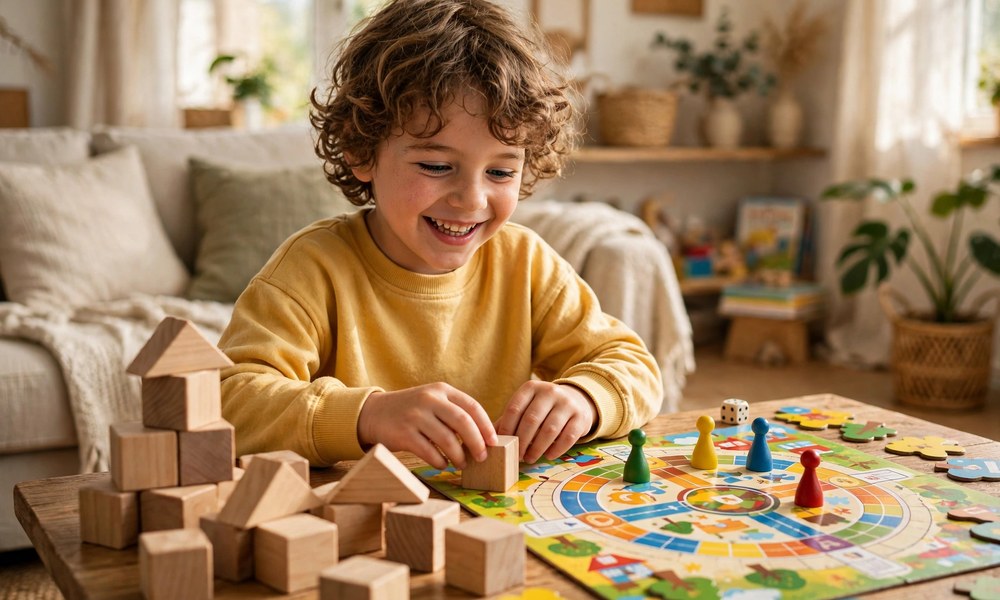
Board games are the gift that keeps on giving, because they are really a gift for the whole family. A great board game turns an ordinary evening into a game night, teaches children to take turns, handle winning and losing gracefully, and think a few moves ahead. If you want more ideas for family play, our roundup of the best gift ideas for puzzle lovers includes several games that work brilliantly for children too.
For younger players, look for simple rules and short rounds of ten to twenty minutes. Older children enjoy strategy games, word games and cooperative games where everyone wins or loses together. Classic games rarely disappoint, but do check the recommended age on the box, as a game that is too hard will sit on the shelf.
Pros: brings the family together, teaches turn-taking and strategy, huge choice of themes.
Cons: small pieces can be fiddly for very young children, and some games need an adult to explain the rules first.
3. Building blocks
Building blocks are the ultimate open-ended toy. There is no right way to play with them, no batteries, and no screen, just a box of pieces and a child’s imagination. One day they are a castle, the next a spaceship, then a whole city. Blocks develop fine motor skills, spatial awareness and early maths, and they grow with the child for years.
Wooden blocks are beautiful and durable for toddlers, while interlocking brick sets suit children aged five and up who want to follow instructions and build detailed models. A generous starter set is usually better value than a small themed kit, because it gives children more freedom to invent.
Pros: lasts for years, encourages creativity, no screens or batteries, suits a wide age range.
Cons: sets can be pricey, and pieces end up all over the floor.
4. Art set
Every child should have an art set. A good one bundles crayons, coloured pencils, felt tips, watercolours and paper into a tidy case, so creativity is always within reach. Drawing and painting help children express feelings they cannot yet put into words, and they build the fine motor control that later helps with handwriting.
Look for washable felt tips and paints if you value your furniture, and a case with compartments so everything has a home. Add a sketchbook or a pad of thick paper, because children go through paper fast when they are inspired.
Pros: encourages self-expression, quiet and absorbing, easy to top up with new supplies.
Cons: can be messy, and cheaper sets sometimes have felt tips that dry out quickly.
5. Story book
A beautiful story book is a gift that outlasts almost any toy. The right book at the right age can start a lifelong love of reading, and the ritual of a bedtime story is something children remember long after the toy has been outgrown. Picture books suit ages three to six, early chapter books suit ages six to eight, and illustrated novels and adventure series suit ages nine and up.
Personalised books, where the child becomes the hero of the story, make an especially memorable present. A book token tucked inside also works well, letting the child choose their own next adventure.
Pros: builds vocabulary and imagination, creates bedtime routines, lasts for years.
Cons: choosing the right reading level takes a little thought, and tastes vary.
6. Science kit
Science kits turn curiosity into hands-on fun. Whether it is growing crystals, building a volcano, making slime, or launching a rocket, these kits let children experiment, observe and ask big questions. They are ideal for children aged seven and up who love to know how things work.
Check what is included before you buy: the best kits contain everything needed, with clear instructions and real results. Avoid kits that need lots of extra household items, and always supervise experiments involving chemicals or heat.
Pros: sparks curiosity, teaches the scientific method, genuinely exciting results.
Cons: some kits are single-use, and mess is almost guaranteed.
7. Soft toy
A soft toy is a classic for a reason. For younger children it is a comfort object, a bedtime companion and a friend for imaginary games. For older children, a well-chosen plush of a favourite animal or character can still be treasured. Quality matters here: look for soft, washable fabric, secure stitching and no small parts that could come loose.
If you are buying for a baby or toddler, choose a toy designed for that age group, with embroidered features rather than buttons. A soft toy paired with the matching story book makes a lovely themed gift set.
Pros: comforting and cuddly, encourages imaginative play, suitable from birth.
Cons: can be hard to wash, and children often already own several.
8. Bike helmet
A bike helmet may not be the most exciting gift in this list, but it is one of the most useful, and children love picking one in their favourite colour or with a fun design. A well-fitting helmet is essential for cycling and scooting, and a bright, comfortable one is far more likely to actually be worn.
Measure the child’s head before ordering, and look for adjustable straps, good ventilation and a safety certification mark. Letting the child choose the colour or pattern makes them much more enthusiastic about wearing it.
Pros: genuinely keeps children safe, practical, and kids enjoy choosing the design.
Cons: sizing can be tricky online, and children outgrow helmets quickly.
9. Outdoor game
Outdoor games get children off screens and into the fresh air. A garden game such as giant dominoes, a skittles set, a swing ball, or a simple ball and catching set can fill a whole afternoon, and they are perfect for birthday parties and family gatherings too.
Choose games that suit the space available: a small garden suits compact games, while a park or large garden can handle bigger sets. Durable, weather-resistant materials are worth paying a little extra for.
Pros: encourages active play, great for parties, works for siblings and friends together.
Cons: weather-dependent, and some sets need storage space.
10. Personalised backpack
A personalised backpack is a practical gift with a personal touch. Children use it for school, nursery, sleepovers and days out, and having their name embroidered on it means it is easy to spot and less likely to be lost. Look for padded straps, a sturdy zip and a size that fits the child, not one they will grow into in three years.
Pair it with a matching lunch bag or water bottle for a complete set, or fill it with a few small surprises such as a notebook, a pencil case or a favourite snack. If you are also shopping for the adults in the family, our guide to the best gifts for mums has plenty of ideas for the same occasion.
Pros: useful every day, personal and hard to lose, good value.
Cons: you need the correct spelling of the name, and sizes vary between brands.
How to choose the best gift for a child
Start with the child’s age and interests rather than the toy aisle. A child who loves drawing will get far more from an art set than from the latest gadget, and a child who loves animals will treasure a nature book or a plush toy. Ask the parents if you are unsure, especially about what the child already owns and whether there are any allergies or sensitivities to consider.
Check the age guidance on the packaging, and be honest about how much assembly or supervision a gift needs. The best gifts are the ones that can be played with straight away, without a parent spending an hour reading instructions first.
Finally, think about longevity. The gifts in this list were chosen because they last: they can be played with in different ways, passed down to a sibling, or enjoyed by the whole family. A toy that is still being used a year later was money well spent.
Checklist: before you buy a gift for a child
- Check the recommended age range on the box.
- Ask the parents what the child already has and what they would love.
- Choose open-ended toys that can be played with in many ways.
- Check for small parts if the gift is for a child under three.
- Look for durable materials that survive daily play.
- Keep the receipt in case the gift needs to be exchanged.
Frequently asked questions
What is the best gift for a child who has everything?
Experiences and open-ended toys work best. An art set, a science kit or a board game offers something new every time it is used, and a personalised gift such as a backpack or a book feels special even when the toy box is already full.
How much should I spend on a gift for a child?
There is no right amount. The gifts in this guide range from around £5 to £50, and the best gift is the one that suits the child, not the most expensive one. A thoughtful £10 puzzle often beats a £50 toy that is played with once.
Are educational toys actually fun for kids?
Yes, when they are well designed. Building blocks, science kits and puzzles are all educational, but children experience them as play. The trick is to choose toys where the learning is hidden inside the fun, not a lesson dressed up as a game.
What gifts are best for a five-year-old?
Five-year-olds love building blocks, simple board games, art sets, story books and outdoor games. Look for toys with a recommended age of four to six, and avoid anything with very small pieces or complicated rules.
What gifts are best for a ten-year-old?
Ten-year-olds enjoy strategy board games, science kits, bigger jigsaw puzzles, art supplies and outdoor games they can play with friends. They also appreciate more grown-up gifts such as a personalised backpack or a good adventure book series.
Should I buy a gift card instead?
A gift card can be a good fallback when you do not know the child well, but a chosen gift usually feels more thoughtful. If you do go for a card, pair it with a small present such as a book or a puzzle so there is something to open.
Bottom line
The best gifts for kids are the ones that get played with, not just admired. A jigsaw puzzle, a board game, a set of building blocks or an art set will all bring more joy than the flashiest toy on the shelf, because they invite children to create, imagine and play together. Pick one gift from this list that matches the child’s age and interests, check the price range, and you will have a present they genuinely love.
Note: Prices are approximate and change often, so check current pricing before you buy, and always follow the age guidance on the packaging.