
Fifty people, a table full of dice, and one shared goal: keep everyone playing at the same time. The best dice games for 50 players do exactly that. They use simple rules, short rounds, and team or station play so nobody waits long for a turn, nobody needs to memorise a thick rulebook, and the whole room stays in the game from the first roll to the last.
Dice games suit very large groups because the equipment is cheap, the rules travel well, and a single host can explain most of these games in under two minutes. That matters when fifty people are settling into chairs and waiting for the fun to start.
This guide covers twelve games that genuinely work at this scale, with honest notes on how many dice and tables each one needs, how long a round takes, and how to set the room up so fifty players never turn into fifty spectators. If your group is one player short, the best dice games for 49 players use almost the same setups, so you can borrow ideas from both lists and adjust the table count by one.
Key takeaways
- Choose games with short turns and simultaneous play, so fifty people roll, score, and cheer at the same time instead of waiting in a long line.
- Split fifty players into tables of four to six, run the same game at every table, and rotate winners upward after each round.
- Plan on three dice per player for most games, plus printed score sheets, pencils, and one dice tray or cup per table.
- Keep scoring visible with a simple points system and small prizes, and skip any version that involves betting or money.
- Allow ninety minutes for a full session: ten minutes to set up, sixty minutes of play across three or four rounds, and twenty minutes for a final and prizes.
Why Dice Games Work So Well for 50 Players
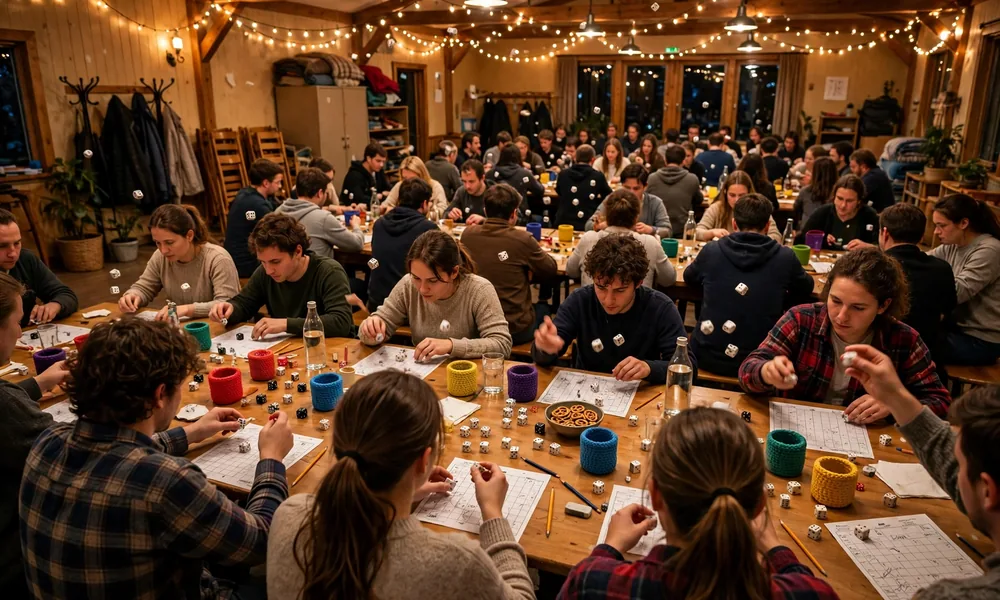
Large group games often fail for the same reason: too much waiting. A game built for six players becomes a slow queue when fifty people try to play it in one circle. Dice games avoid that problem because most of them can run in parallel: ten tables of five can all roll at once, and the room fills with noise and laughter within minutes.
Dice also level the playing field. Age and experience matter far less when a roll decides the outcome, so a first-time player can win a round after hearing the rules once. That fairness keeps large mixed groups engaged, including guests who would normally sit out a strategy game.
The third advantage is cost and setup. Dice, cups, score sheets, and pencils are all you need for most of the games below. There is no board to pass around and no single piece of equipment that fifty people must share.
How to Run Dice Games for 50 Players Without Chaos
Good organisation matters more than the choice of game. Fifty players need a clear structure, and the simplest one is stations. Set up ten tables of five, place a dice tray, a cup, and score sheets on every table, and assign each player a starting table. Every table plays the same game at the same time, and the host calls the start and end of each round.
Rotation keeps the event social. After each round, the winners at each table move one table up. This classic tournament style, borrowed from Bunco, means everyone meets new opponents and the final round naturally brings the strongest players together.
Sound and timing need a plan too. Announce the round length before you start, give a two-minute warning, and collect scores at the end of each round. When the best dice games for 48 players are played the same way, the only real difference is one fewer table, which shows how well this station format scales up and down.
What You Need for 50 Players
Start with the dice. Most games below need three dice per player, so 150 dice covers the whole room with spares. Buy them in mixed colours so each table has its own colour and stray dice are easy to return. Add one dice cup per table, or use small bowls as dice trays to keep rolls on the table and off the floor.
Print score sheets generously. Fifty players go through sheets quickly, especially in games like Yahtzee and Farkle where every round needs a fresh card. Print at least three sheets per player, keep spares at the host table, and bring twice as many pencils as you think you need.
Finally, prepare a visible scoreboard. A whiteboard or a projected slide works well. List the table winners after each round and keep a running total for the final, so everyone can see the standings.
Setting Up the Room
Arrange tables with space to walk between them. The host needs to reach every table to answer questions, collect scores, and hand out prizes. Leave a clear path down the middle of the room and keep the prize table and scoreboard near the front.
Seat mixed groups together on purpose. Put experienced players with beginners and mix ages at each table. Mixed tables play better, teach faster, and keep the mood friendly when the dice do not cooperate.
Test the noise level before guests arrive. Fifty people rolling dice and cheering is loud, but the host still needs to be heard. A portable speaker, a bell, or a hand-clap signal agreed in advance will keep rounds starting together.
The 12 Best Dice Games for 50 Players
Each game below is rated for a fifty-player room, with the dice, time, and setup it needs. All twelve use points or tokens for scoring, never money, so they work for family nights, school events, office parties, and community fundraisers alike.
1. Bunco
Bunco is the classic large-group dice game, and it was practically designed for fifty players. Players sit in groups of four at twelve or thirteen tables, roll three dice, and try to match the target number for the round. The head table rings a bell to start and stop each round, winners move up, and the whole room rotates together.
You need three dice per table, a bell, and a simple score sheet for each player. A full game takes about ninety minutes across six rounds, and the rules take two minutes to explain. Bunco works so well at this scale because every table plays at once and the bell keeps fifty people in sync.
2. Left Center Right
Left Center Right, often called LCR, is a fast elimination game played with three special dice and a handful of tokens per player. Each player rolls on their turn, passes tokens left, right, or to the centre depending on the dice, and the last player holding tokens wins the table. It is simple, quick, and very easy to run at ten tables at once.
Give every player three tokens and each table one set of LCR dice. A table round takes about ten minutes, so you can run three or four rounds in an hour. LCR is ideal as a warm-up because the rules fit in one sentence and nobody needs a score sheet.
3. Yahtzee Tournament
Yahtzee becomes a strong fifty-player game when it is run as a tournament. Every table plays a standard game of Yahtzee at the same time, using five dice and a printed score card per player. After each game, the top scorer at each table moves up, and the room plays two or three games in a session.
You need five dice and a score card per player, plus a pencil for each seat. A single game takes about thirty minutes, so plan two games per evening with a short break between them. Yahtzee rewards a little planning as well as luck, which gives thoughtful players a fair chance.
4. Farkle
Farkle is a push-your-luck game in which players roll six dice, bank scoring combinations, and decide whether to risk another roll for more points or stop and keep what they have. At fifty players, run it at tables of five, with each table playing its own race to ten thousand points. The decisions are quick, the turns are short, and the groans when someone rolls a Farkle and loses the turn are heard across the room.
Six dice per table is enough, since only one player rolls at a time, plus a score sheet for each player. A table game takes about thirty minutes. Farkle is a good middle-of-the-evening game because it keeps everyone watching the current roller.
5. Ten Thousand
Ten Thousand, also known as Zilch, is a close cousin of Farkle with six dice and a points target of ten thousand. Players roll, set aside scoring dice, and choose whether to keep rolling. The difference is in the scoring combinations, which reward straights and three pairs, so players who know Farkle will pick it up in a minute and enjoy the variation.
Run it exactly like Farkle: tables of five, six dice per table, and a score sheet each. A game takes twenty-five to thirty minutes, and because the two games share the same equipment, you can switch between rounds without buying anything new.
6. Dice Bingo
Dice Bingo gives fifty players a shared, simultaneous game with no waiting at all. The host rolls two large dice at the front, calls the total, and every player marks that number on their own bingo card. First to complete a row, column, or full card calls out and wins the round.
Print a varied bingo card for each player and bring two large dice for the host. A round takes about fifteen minutes, and you can play three rounds with different winning patterns. Dice Bingo is the best choice when your group includes very young players or guests who prefer a calm game.
7. Roll and Write: Qwixx Style
Roll-and-write games let all fifty players play from a single roll. The host rolls the dice, announces the result, and every player writes it on their own sheet at the same time. Qwixx-style games use coloured dice and number rows, and players choose which rows to fill, so there is a real decision on every turn even though everyone shares the same dice.
You need one set of coloured dice for the host and a printed sheet per player. A game takes about twenty minutes. This format suits the largest groups because adding players costs nothing but paper, and nobody ever waits for a turn.
8. Sevens
Sevens is a quick dice game where players roll and try to avoid, or collect, the number seven depending on the house rules you choose. In the version that works best for fifty players, each table rolls two dice in turn, scores a point for every seven rolled, and the highest total after ten rounds wins the table. It is fast, loud, and easy to explain.
Two dice per table and a simple tally sheet are all you need, and a round takes about ten minutes. Sevens works well as a short filler between longer games, or as a quick tie-breaker.
9. Ship, Captain, Crew
Ship, Captain, Crew is a five-dice game with a clear goal: roll a six for the ship, a five for the captain, and a four for the crew, then use the remaining two dice as your cargo score. Players get three rolls per turn, and the highest cargo wins the round. The theme is easy to remember, the target numbers are easy to call out, and the three-roll structure keeps turns short.
Five dice per table and a tally sheet per player cover it, and a table round takes about fifteen minutes. Play three rounds and add the scores together for a table champion. This game suits mixed-age groups well because the rules are visual and the scoring is simple.
10. Seven Eleven Doubles
Seven Eleven Doubles is a high-energy party game for tables of five or six. One player rolls two dice while the others pass a cup around the table; if the roller scores a seven, an eleven, or doubles, the cup stops and that player drinks or, in a family version, takes a forfeit token. For a fifty-player family event, replace drinks with points: the player holding the cup when the roll lands scores, and the table total decides the winner.
Two dice and one cup per table are enough, and a round takes about ten minutes. Keep this game light and short, and make the family points version the default so every guest can join in comfortably.
11. Greed
Greed is another six-dice scoring game, similar to Farkle but with its own points table and a stronger reward for rolling several of a kind. Players roll, bank points, and decide how far to push their luck. The name sounds competitive, but at a family table it plays as a cheerful risk-taking game, and the decisions spark plenty of table talk.
Six dice per table and a score sheet per player are all you need, and a game takes about thirty minutes. Greed pairs well with Farkle in a two-game evening: play one, take a break, then play the other.
12. Dice Relay Race
A dice relay turns rolling into a team sport. Split each table of five into a team, set a target such as rolling every number from one to six in order, and have players take turns rolling one die each. The first team to finish the sequence wins the heat, and the fastest teams meet in a final. It is noisy, physical, and a great way to end the night.
One die per player and a simple checklist per team are enough, and a full relay with heats and a final takes about twenty minutes. End the evening with the relay final in front of the whole room, and the event finishes on a high note.
Best Dice Games for 50 Players Comparison Table
Use this table to pick your lineup: short games suit warm-ups, while the thirty-minute games anchor the evening.
| Game | Dice per table | Time per round | Best for |
|---|---|---|---|
| Bunco | 3 | 15 minutes | Full-evening tournament |
| Left Center Right | 3 | 10 minutes | Warm-up |
| Yahtzee Tournament | 5 per player | 30 minutes | Thoughtful players |
| Farkle | 6 | 30 minutes | Push-your-luck fun |
| Ten Thousand | 6 | 30 minutes | Farkle variation |
| Dice Bingo | 2 for host | 15 minutes | All ages together |
| Roll and Write | Host set | 20 minutes | Simultaneous play |
| Sevens | 2 | 10 minutes | Quick filler |
| Ship, Captain, Crew | 5 | 15 minutes | Mixed-age tables |
| Seven Eleven Doubles | 2 | 10 minutes | High energy |
| Greed | 6 | 30 minutes | Risk-taking tables |
| Dice Relay Race | 1 per player | 20 minutes | Grand finale |
Planning Checklist for 50 Players
Work through this list the week before the event.
- Count the players and set up ten tables of five, with a spare table ready in case extra guests arrive.
- Buy or borrow 150 dice in table colours, plus one cup or tray and a pencil for every seat.
- Print three score sheets per player for the games you have chosen, and keep spares at the host table.
- Choose a three-game lineup: one short warm-up, one thirty-minute main game, and one fast finale.
- Prepare a visible scoreboard, a bell or speaker for the host, and small prizes for table winners and the overall champion.
- Pair your dice rounds with other group games for variety, and look at the best party games for 49 players for ideas that sit well alongside a dice tournament.
Frequently Asked Questions
How many dice do I need for 50 players?
Plan on about 150 dice in total, which is three per player. Most games use fewer dice per table because only one player rolls at a time, but having three per player covers Yahtzee and the relay, with spares for dice that roll under tables.
What is the best dice game for a group of 50 beginners?
Bunco is the best choice for beginners because the rules take two minutes to explain, every table plays at the same time, and the rotation means beginners sit with experienced players who can help. Left Center Right is a close second and works well as a ten-minute warm-up before Bunco starts.
How long does a dice games night for 50 players take?
Allow ninety minutes to two hours. Ten minutes covers welcome and seating, sixty minutes covers three or four rounds of play, and twenty minutes covers a final, prizes, and photos.
Can children play these dice games with adults?
Yes, most of them work well for mixed ages. Dice Bingo, Sevens, and Ship, Captain, Crew need almost no reading or maths, while Yahtzee and Farkle suit children aged eight and up. Seat children with adults at first, and choose the points version of every game.
Do I need special dice for 50 players?
No, standard six-sided dice cover eleven of the twelve games here. Only Left Center Right needs its special printed dice, and those are inexpensive and widely available. For every other game, plain dice in different colours per table are the simplest and cheapest option.
What prizes work well for dice game winners?
Keep prizes small, fun, and equal across tables: a bag of sweets, a small trophy, a funny certificate, or first choice at the snack table. Give a prize to every table winner each round, not just the overall champion, so the whole room stays motivated.
Bottom Line
The best dice games for 50 players are the ones that let everyone roll at once, keep the rules short, and turn fifty strangers or friends into ten lively tables. Start with Bunco or Left Center Right, anchor the middle of the evening with Yahtzee or Farkle, and finish with a dice relay final in front of the whole room. Bring plenty of dice, print more score sheets than you need, and let the host keep the rounds moving.


