Four hundred and fifty-five players in one room sounds like a crowd that would swallow any game whole, yet dice-rolling party games handle it well. The secret is the same one that makes every huge-group dice night work: nobody plays as one giant group. The crowd splits into dozens of small tables, every table rolls the same game at the same time, and one shared scoreboard turns seventy-six separate games into a single event that everyone can follow from across the hall.
This guide gives you nine dice-rolling party games built for exactly that format. Each one is a classic parlour game where the dice do the deciding: they pass chips around the table, set the target, or end a turn without warning. Every game takes about fifteen minutes, needs nothing more than dice and a score sheet, and can be explained in under a minute.
All nine games are played for points only, with no money changing hands at any table. Chips, when a game uses them, are plain point counters handed out at the start of the round and returned at the end. If you can roll a die and add up a small score, you can play every game on this list, and so can the other 454 people in the room.
Key takeaways
- Split 455 players into 75 tables of six plus one table of five, so every player has a seat and a turn.
- Run nine fifteen-minute rounds on one shared clock, with every table playing the same party game at the same time.
- Keep score in points only, with plain point chips where a game needs them and no money involved anywhere.
- Give every table the same kit: dice, a score sheet, a pencil, and one printed rules card for the round in progress.
- Rotate the top two scorers from each table after every round, so the night stays mixed and friendly.
How 455 Players Fit Into One Night
The first job is the arithmetic, and it is simpler than it looks. Seventy-five tables of six players gives you 450 players, and one table of five gives you the last five. That is 76 tables in total, which sounds like a lot until you remember that every table is doing the same thing at the same time. One host with a whistle can run the whole room, because nobody needs individual instructions once the first round has started.
Each round lasts fifteen minutes, and there are nine rounds, one for each game. That makes two hours and fifteen minutes of play, plus short breaks, so plan for a three-hour evening. The best score at each table wins the round, and ties are settled by total points across all nine games. The table of five sits nearest the host, so the host can keep an eye on the smallest table without walking the whole hall.
The games below were picked because they share three traits that matter at this scale. They are quick to learn, they give every player something to do on every turn, and they create the small surprises that keep a whole hall laughing at the same moment. If your crowd would rather have a sporting theme, the sports-themed dice games for 453 players run the same table format as a one-day sports festival.
The Nine Games at a Glance
| Game | What the dice do | Points to win the round | Time |
|---|---|---|---|
| Dice LCR | Pass point chips left, centre, or right | Last player holding chips | 15 minutes |
| Dice Beat That | Build the biggest number you can | Most round wins | 15 minutes |
| Dice Roll and Write | Fill a score sheet from shared rolls | Highest sheet total | 15 minutes |
| Dice Stuck in the Mud | Keep rolling until the fives and twos stop you | Highest kept total | 15 minutes |
| Dice Going to Boston | Keep your best die, roll the rest again | Highest three-die total | 15 minutes |
| Dice Drop Dead | Lose dice on every two or five | Highest total before the dice run out | 15 minutes |
| Dice Martinetti | Climb from one to twelve in order | First to reach twelve | 15 minutes |
| Dice Help Your Neighbour | Pass dice to the player beside you | Most points after six turns | 15 minutes |
| Dice One Four Twenty-Four | Keep a one and a four, then score the rest | Highest total over six turns | 15 minutes |
Setting Up 76 Tables
A night this size is won or lost before the first die is rolled. The games are simple, so the work goes into the room: enough tables, identical kits, and helpers who can answer a question without stopping the whole hall.
Count the Tables First
Before you book the hall, count the tables, the chairs, and the space between them. Seventy-six tables need a large hall, a school gym, or a community centre with a flat floor and room to walk between the rows. Leave a clear aisle down the middle, put the scoreboard where everyone can see it, and number every table from one to seventy-six. Print a seating list in advance, so players find their first table without a queue at the door.
Give Every Table the Same Kit
Every table gets the same kit, packed in a labelled bag or box: dice, two pencils, a score sheet, a set of plain point chips, and one printed rules card for the round in progress. The host hands out a fresh rules card at the start of each round, and the old card goes back in the bag. Print the score sheets in advance with the table number, the nine game names, and space for six names. The scorer is the player sitting nearest the host side of the table, and the job passes to the next player each round.
Appoint a Floor Captain
A floor captain looks after a block of about ten tables. With 76 tables, you need eight floor captains, and each one wears a bright badge or sash so players can spot them from across the room. The captain answers questions, settles friendly disputes about a roll, hands out spare dice, and collects the score sheets at the end of each round. Give them a short briefing before the doors open, and show them where the spare kits, the water, and the first aid box are kept.
The 9 Dice-Rolling Party Games for 455 Players
Each game below follows the same pattern: a quick explanation and the one rule that makes it work. Play them in the order listed, or let each table start on a different game and rotate. A different flavour of the same format, built around acting and guessing instead of rolling, is the set of party and guessing dice games for 452 players, where the dice pick the actor, the word, or the time limit.
1. Dice LCR
Dice LCR, short for Left Centre Right, is the liveliest opener on the list, and it needs no board at all. Each player starts with three plain point chips. On your turn, roll three dice: every L means pass one chip to the player on your left, every C means put one chip in the centre pot, and every R means pass one chip to the player on your right. A dot means you keep your chips. If you have fewer than three chips, roll only as many dice as you have chips left.
The round ends when one player holds all the chips still in play, and that player takes the table points. Every table erupts at a different moment, and a player who looked finished can be handed chips by a neighbour two turns later. Keep the chips as plain counters, never money, and count the centre pot back in at the end of the round so nothing is lost.
2. Dice Beat That
Dice Beat That is a pure numbers game, and it takes about thirty seconds to teach. Each player rolls two dice and puts them together to make the biggest two-digit number they can, so a three and a six become sixty-three, not thirty-six. The highest number at the table wins the turn and scores a point. After six turns each, the most points wins the round.
The trick is that every roll is a small decision. A one and a six can be sixty-one or sixteen, and players who arrange their dice badly lose turns they should have won. That keeps everyone watching every roll, even when it is not their turn. There is nothing to set up and nothing to argue about: the numbers speak for themselves, and the round ends exactly when the sixth turn is done.
3. Dice Roll and Write
Dice Roll and Write turns the whole table into scorekeepers at once. The host, or one player per table, rolls two dice, and every player writes the result into their own score sheet, choosing where it goes. Each sheet has nine boxes in a row, and the aim is to finish with the best pattern: pairs together, runs in order, and the biggest numbers in the boxes worth the most points.
The fun is that everyone works from the same rolls, so the whole table groans or cheers together, yet every sheet ends up different. One player chases a run of consecutive numbers, another stacks pairs, and a third plays safe in the middle boxes. After nine shared rolls, add up the sheets: the highest total wins the round. Print the sheets in advance with the boxes already drawn.
4. Dice Stuck in the Mud
Dice Stuck in the Mud is the simplest game on the list, and the one that produces the loudest groans. Each player rolls five dice and sets aside every five and every two, because those dice are stuck in the mud and cannot be rolled again. Roll the remaining dice, set aside any new fives and twos, and keep going until every die is stuck or you choose to stop and bank your score.
Only the dice that are not stuck count, so the decision is always the same: stop now with a safe total, or roll again for more and risk getting stuck with nothing new to add. Players who stop early watch nervously while braver players chase them. A full round fits easily into fifteen minutes, and the game needs no equipment beyond the dice themselves.
5. Dice Going to Boston
Dice Going to Boston is a three-roll game of small choices. Each player rolls three dice, keeps the highest one, and rolls the other two again. Then they keep the highest of those two and roll the last die once more. Add up the three dice you end with: the highest total at the table wins the turn.
It sounds gentle, and then the second roll ruins everything: a player keeps a six, rolls a one and a two, and ends with a miserable total while the next player calmly rolls three fours. The game teaches itself in one demonstration round, which is why it works so well as the middle game of the night. Six turns each, one point per turn won, and the most points takes the round.
6. Dice Drop Dead
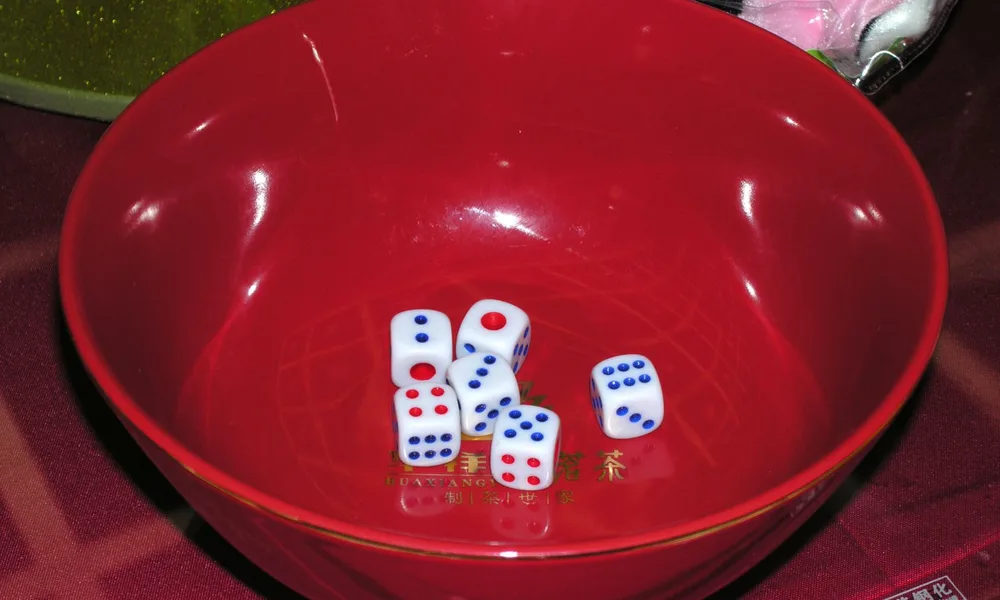
Dice Drop Dead is the most dramatic game of the evening: roll five dice, lose every die that shows a two or a five, and add up the rest. Keep rolling your surviving dice until none are left, and your total is the sum of every roll along the way. The catch is that a bad first roll can wipe out three dice at once, and then the whole turn is over in seconds.
That swing is the point. A player who scores forty points on a lucky run watches the next player score nothing at all, and the table cannot look away. Because turns are short, everyone gets several turns inside the fifteen minutes. Bring spare dice: with 76 tables, a few are guaranteed to roll under a table and stay there.
7. Dice Martinetti
Dice Martinetti is a climbing game, and the calmest on the list after the noise of Drop Dead. Each player rolls three dice and tries to make the numbers one to twelve in order. You need a one first, then a two, then a three, and so on, using the dice you rolled: a single roll can give you up to three numbers in a row, but only if they come in the right order.
The first player to reach twelve wins the round, and the game rewards patience over luck. A player stuck on seven for four turns straight is a familiar sight, and the cheer when they finally roll it carries across the hall. If a round runs long, call it at fifteen minutes and award the table to the player furthest up the ladder.
8. Dice Help Your Neighbour
Dice Help Your Neighbour is the kindest game of the night, and the silliest. Each player rolls one die, and instead of keeping the result, they pass the die to the player on their left, who rolls it and keeps the score. Then the die comes back, and the next player rolls for their right-hand neighbour. After six turns each, the highest total wins the round.
The twist is that every roll is a small gift or a small disaster handed to someone else. Players cheer for their neighbour’s good rolls and groan theatrically at bad ones, which makes it the best game on the list for tables of strangers who have only just met. Use one die per table for this game, passed hand to hand, so the pace stays quick and the die never gets lost in a pile of spares.
9. Dice One Four Twenty-Four
Dice One Four Twenty-Four is the closer, and it earns the spot. Each player rolls six dice and must set aside a one and a four before anything else counts. Once both are saved, the remaining four dice are added up for the score. If a player never rolls a one and a four, the turn scores nothing.
The first rolls decide everything, and the whole table watches the dice settle: a one on the first roll brings a cheer, a four on the second brings a bigger one, and a turn that ends without either brings a groan the whole hall can hear. Six turns each, highest total wins the round, and the game is a fine finish because it gives every player one last chance to catch the leader. If your crowd fancies taking the same idea outside, the lawn-style dice games for 451 players turn the table format into an afternoon on the village green.
Your 455-Player Checklist
- Book a hall that fits 76 tables with a clear aisle down the middle and a visible scoreboard.
- Pack 76 identical kits: dice, two pencils, a score sheet, plain point chips, and a printed rules card per round.
- Print the seating list and number every table from one to seventy-six before the doors open.
- Brief eight floor captains, one per block of about ten tables, and give each one a bright badge.
- Set one shared clock for nine fifteen-minute rounds, with short breaks and a three-hour finish in mind.
- Agree the tie-break in advance: total points across all nine games, then a single roll-off.
Frequently Asked Questions
Can 455 players really play dice games at the same time?
Yes, because the crowd never plays as one group. With 75 tables of six and one table of five, every table plays the same game on the same clock, and one host with a whistle runs the whole hall. The shared scoreboard makes it feel like one event rather than 76 separate ones.
How many dice do we need for 455 players?
Plan for about five dice per table, which is roughly 380 dice, plus spares. Most games on this list use three to five dice per player in turn, not all at once, so one set per table is enough. Bring at least fifty spare dice.
What if a table has only three or four players?
Every game on this list works with three or four players as well as six. Shorten nothing: the rounds still last fifteen minutes, and the table simply gets more turns each. Seat smaller groups nearest the host so the floor captain can check on them easily.
How long does the whole night take?
Nine rounds of fifteen minutes make two hours and fifteen minutes of play. Add short breaks between rounds and time for the final scoreboard, and the evening runs to about three hours. Start on time, because a late start squeezes the last game.
Do players need to know the party games already?
No. Every game here can be explained in under a minute, and the printed rules card at each table covers the rest. The floor captains know all nine games, so any table that gets stuck can ask without stopping the hall.
Are the party games played for money?
No. Every game in this guide is played for points only, and chips are plain point counters handed out at the start of a round and returned at the end. No money changes hands at any table.
The Bottom Line
Nine dice-rolling party games, 76 tables, one shared clock, and a hall full of players who all get to roll. That is the whole recipe for 455 players: small tables, short rounds, plain point chips, and games anyone can learn in under a minute. Pick your hall, pack the kits, brief the captains, and let the dice do the rest.


