The best dice games for 187 players are not played around a single table. They are played as a festival: many small tables, short rounds, clear scores, and a host who keeps everyone moving. With 187 players, the game itself matters less than the system around it, because a great dice game for six people can turn into a long queue and a bored crowd if you try to scale it up without a plan.
This guide ranks ten dice games that genuinely work at this size, explains how to run them in stations, and gives you a scoring system, a timetable, and a checklist one host team can follow. Every game uses ordinary dice, paper score sheets, and small prizes, so you can run the evening in a school hall, a community centre, a large garden, or a company event space.
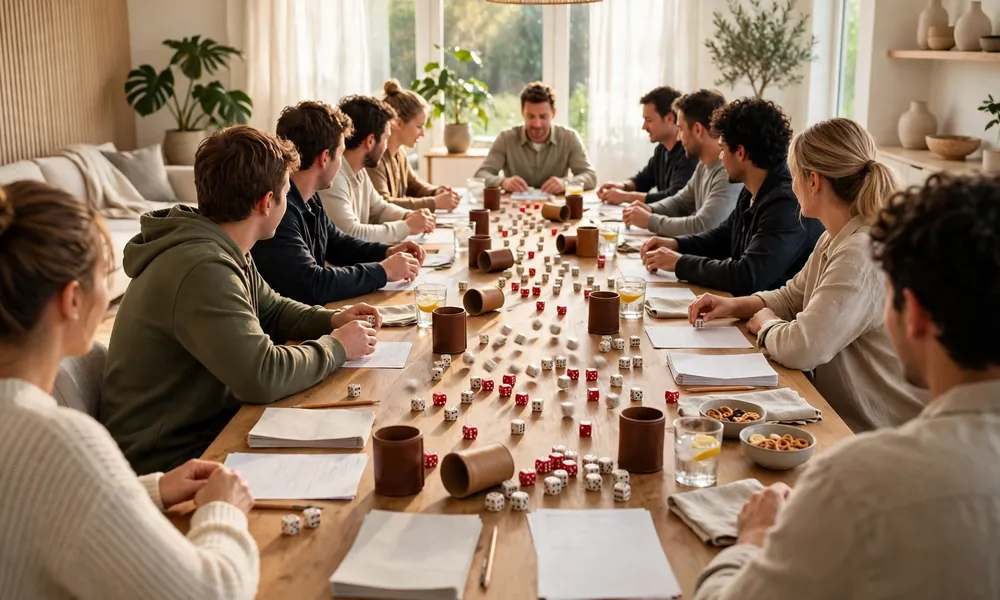
The secret is rotation. Split players into small groups of four to eight, give each group a table and a game, and rotate every fifteen minutes. Nobody waits long, everybody plays every game, and the final scores decide the winners. The best dice games for 187 players are quick to learn, quick to score, and fun even when you lose a round.
Key takeaways
- Split 187 players into small groups of four to eight and rotate them between game stations every fifteen minutes.
- Choose games that take five minutes to learn and score with simple points, not long rules or complex turns.
- Use one score sheet per group, one scorekeeper per table, and a central leaderboard everyone can see.
- Keep rounds short, start on time, and announce the next rotation clearly so nobody is left waiting.
- End with a short final round for the top groups, then hand out small prizes and celebrate every table.
The Best Dice Games for 187 Players at a Glance
Use this table to pick your line-up. The games at the top are the easiest to run at scale, so if this is your first large event, start with the first four and add the rest only if you have enough tables and helpers.
| Game | Players per table | Round length | Best for |
|---|---|---|---|
| Farkle | 4 to 6 | 15 minutes | Risk and reward decisions |
| Bunco | 4 per table | 15 minutes | Fast, noisy, social play |
| Tenzi | 4 to 8 | 10 minutes | Speed and quick reactions |
| Left Center Right | 5 to 8 | 10 minutes | Simple luck and laughter |
| Yahtzee style | 4 to 6 | 15 minutes | Strategy and score sheets |
| Liar’s Dice | 4 to 6 | 15 minutes | Bluffing and reading people |
| Dice Bingo | 6 to 8 | 15 minutes | Quiet focus and mixed ages |
| Pig | 4 to 6 | 10 minutes | Quick decisions for children |
| Sevens Relay | 6 to 8 | 10 minutes | Teams and movement |
| Roll and Move | 4 to 6 | 15 minutes | Families and mixed groups |
How to Run Dice Games for 187 Players
A group of 187 players needs structure before it needs games. Start by counting your space, not your players. A school hall with thirty tables holds thirty groups of six or seven, while a smaller room with twelve tables means bigger groups or two sessions. Walk the room first, place the tables with space between them, and put a numbered sign on every table.
Assign each player a group number and a colour when they arrive. A coloured wristband, a sticker, or a name badge works well, and it stops the confusion that eats up the first twenty minutes of most large events. Each group stays together for the whole evening, which builds team spirit and means the scorekeeper always knows who is who. If you have mixed ages, balance the groups so every table has a mix of confident players and quieter ones, and put at least one adult or older teenager in every group of children.
Keep the timetable visible. Write the rotation order on a large board, print it on the back of every score sheet, and announce each move with a bell, a whistle, or a short piece of music. Fifteen minutes per station is the sweet spot: long enough to finish a real game, short enough that a dull game never drags. Allow two minutes to move between tables, and build in a ten-minute break halfway through for drinks, snacks, and a look at the leaderboard.
The station model that works
The station model is simple. Each table runs one game, and each group visits every station in turn. With ten games and thirty groups, three groups share a station at different times, so you need three copies of each game set. Dice are cheap, and you can ask families to bring a set from home. Label every set with the station number so pieces do not wander.
Give every station a host or a printed instruction card. The host explains the game in two minutes, watches the first round, and then steps back. The instruction card should fit on one page, use large print, and show the scoring with a worked example. If a game needs a scorekeeper, choose one player per group and rotate the job, so the same person is not stuck writing while everyone else plays. The best dice games for 185 players use the same station idea, and they are a good place to borrow extra game ideas if you want to swap one of these ten for something different.
Scoring that stays fair at scale
Fair scoring is what turns a fun evening into a real competition. Use the same points system at every station: ten points for first place in the group, seven for second, five for third, three for fourth, and one point for everyone who finishes the round. That way a group that wins a fast game earns the same as a group that wins a slow one, and nobody is punished for being sent to a harder table.
Collect score sheets after every rotation, not at the end of the night. One volunteer at a central table updates a leaderboard while the next round plays. If a sheet is missing, use the average of that group’s other rounds rather than zero, because a lost sheet should never ruin a team’s evening. Announce the top five groups after the break.
The Ten Best Dice Games for 187 Players
These ten games were chosen because they are quick to teach, work with ordinary dice, and stay fun when played several times in one evening.
1. Farkle
Farkle is the best all-round dice game for a large event because every turn is a decision. Players roll six dice, set aside scoring dice, and choose whether to bank their points or roll again and risk losing them all. For 187 players, use a target of 500 points per round instead of the usual 10,000, so a round fits inside fifteen minutes. Give each table six dice, a cup, and a printed scoring card: ones score 100, fives score 50, and three of a kind score 100 times the face value.
2. Bunco
Bunco is loud, fast, and perfect for large groups because it needs almost no thinking. Four players sit at a table in two pairs, and everyone rolls three dice at once trying to roll the target number for the round: ones in round one, twos in round two, and so on up to six. Each matching die scores a point, three of a kind scores five, and three of the target number, a Bunco, scores twenty-one. When the bell rings, the winning pair stays and the losing pair moves on. Bunco is the best station for breaking the ice, because nobody needs to know the rules in advance.
3. Tenzi
Tenzi is a speed game, and speed is exactly what a large event needs. Every player gets ten dice and a cup, and on the word go everyone rolls at once, keeping the dice that show their chosen number and re-rolling the rest until all ten match. The first player to finish shouts Tenzi and wins the round. A round takes two or three minutes, so you can play four or five rounds inside one fifteen-minute station, and every round feels like a fresh start. Tenzi works for children as young as six and adults alike, which makes it ideal for a mixed-age crowd of 187. Keep spare dice at the station, because dice bounce off tables at speed, and use a tray or a shallow box to stop them rolling onto the floor.
4. Left Center Right
Left Center Right, often called LCR, is the simplest game on this list and one of the most popular. Each player starts with three tokens, rolls three dice marked L, C, R, and dots, and passes tokens left, right, or to the centre according to the roll. A dot means keep your token. The last player holding tokens wins. The game needs no score sheet, no maths, and no decisions, which makes it a perfect rest station between harder games. For 187 players, use coloured counters or dried beans instead of small chips, because they are easier to see and harder to lose. Play two or three short games per station visit, and award the station points to the winner of the final game.
5. Yahtzee Style Roll and Score
A Yahtzee style game brings real strategy to the evening. Each player rolls five dice up to three times per turn, trying to fill a score sheet with combinations such as three of a kind, a full house, a straight, and five of a kind. Print the sheet clearly with large boxes, and give every player their own sheet and pencil. In the short version, play six rounds instead of thirteen, which keeps a full game inside fifteen minutes. This station suits older children and adults best. If you want more board-style variety alongside the dice, the best board games for 185 players show how the same station system works for board games at almost the same group size.
6. Liar’s Dice
Liar’s Dice is a bluffing game that turns a quiet table into a lively one. Each player rolls five dice under a cup, looks at them in secret, and bids on how many of a certain number are showing across the whole table. The next player must raise the bid or challenge it, and the dice are revealed to settle the argument. For a large event, keep bidding simple: allow bids on quantity only, and limit each round to six bids before a challenge must be made. Liar’s Dice is the best station for teenagers and adults who enjoy a game with a social edge.
7. Dice Bingo
Dice Bingo is the calmest game on this list, and every large event needs one calm station. Each player has a bingo card with numbers from two to twelve, the host rolls two dice and calls the total, and the first to complete a row, a column, or a full card wins. The game needs no skill, so grandparents, young children, and first-time players all have the same chance. For 187 players, run it as a whole-room game during the break, with one caller, a microphone, and a big display board.
8. Pig
Pig is a one-die game that teaches risk in the simplest possible way. A player rolls a single die and adds the result to their turn total, choosing to roll again or bank the points. Roll a one and the turn total is lost. First to 100 points wins, or first to 50 in the short version. The rules fit in two sentences, which makes Pig the best first station for young children and the best game to teach a brand-new volunteer host. Use a large foam die at this station so the whole table can see the roll, and keep a running total on a small whiteboard so nobody has to remember the score. Pig also works as a warm-up game while late arrivals are still finding their groups.
9. Sevens Relay
Sevens Relay adds movement to a dice evening, which matters when 187 people have been sitting for an hour. Split each group into two relay teams. The first player runs to the dice table, rolls two dice, and scores if the total is seven. If not, they run back and tag the next player. The first team to roll three sevens wins the heat. The game is simple, noisy, and physical, and it works best in a hall with a clear running lane and a soft floor. Keep the relay short, two minutes per heat, and run three heats per station visit. Sevens Relay is the station to place near the door or the edge of the room, where the movement will not disturb the quieter games.
10. Roll and Move
Roll and Move is a board-free adventure game you can build yourself. Draw a track of thirty squares on a large sheet of paper, mark five squares as challenges, and let players roll one die to move a counter along the track. Landing on a challenge square means answering a question, doing a silly task, or rolling again, and the first counter to the end wins. Theme the challenges to your event: a school night uses maths questions, a family party uses funny dares, and a work event uses quiz questions about the team. For a quiz-flavoured finish, the best trivia games for 185 players pair well with this station, because their questions can be reused as challenge squares.
Planning the Timetable for 187 Players
Be realistic about time. Choose six stations for a two-hour evening, or eight for a three-hour event, and build the timetable backwards from the finish: fifteen minutes for the final round and prize giving, ten minutes for welcome and grouping, and a ten-minute break in the middle. Print the timetable on every score sheet and stick to it, because one late station delays every group behind it. For the final, invite the top four groups to one table for a short Farkle or Tenzi final while the rest of the room watches, then announce the winner and hand out prizes straight away.
Your Dice Games Checklist for 187 Players
Use this checklist in the week before your event, and tick each item off as you finish it.
- Book the room and count the tables: Confirm thirty tables, enough chairs for 187 players, and space between tables for movement.
- Print score sheets and station cards: Print one score sheet per group per station, plus spare copies and pencils.
- Prepare the dice sets: Count, label, and pack one set per station, with spare dice for Tenzi and Pig.
- Assign groups and colours: Make a group list, prepare wristbands or badges, and plan the rotation order.
- Brief your volunteers: Give every station host a one-page instruction card and a two-minute practice run.
- Set up the leaderboard: Prepare a large board, a central scoring table, and a bell or whistle for rotations.
Frequently Asked Questions
Can 187 people really play dice games together?
Yes, if you use stations. No single dice game seats 187 players, but ten stations of six to eight players each can host the whole group at once, and rotation means everyone plays every game. The station system is the whole answer.
How long does a dice games evening for 187 players take?
Plan two to three hours. A two-hour evening fits five or six fifteen-minute stations plus welcome, break, and prize giving. A three-hour event fits eight stations comfortably. Do not try to fit ten stations into two hours.
What age group suits these dice games?
Most of these games suit ages six and up. Pig, Left Center Right, and Dice Bingo are best for younger children, while Farkle, Liar’s Dice, and the Yahtzee style game suit older children, teenagers, and adults. Mixed-age groups work well if every table has an adult or older teenager to help.
How many dice do I need for 187 players?
Allow at least 300 dice in total, with more for Tenzi, which needs ten dice per player. Borrow dice from families, buy a bulk pack, and count them before and after the event. Dice trays and shallow boxes reduce losses.
Do I need a prize for every player?
No. Give a small prize to every member of the winning group, plus fun prizes for best team name, loudest table, and most sporting group. Small sweets, certificates, and a funny trophy are enough, and they keep the focus on playing rather than winning.
What if some players have never played a dice game before?
Start them at Pig or Left Center Right, which take two minutes to learn. Put a printed instruction card on every table, give every station a host for the first round, and pair new players with confident ones. Nobody should sit out because they do not know the rules.
The Bottom Line
The best dice games for 187 players are the ones that are quick to learn, quick to score, and fun in short rounds, played in small groups that rotate between stations. Farkle, Bunco, Tenzi, and Left Center Right should be your first four choices, with the other six added when you have the tables, the dice, and the volunteers to run them. Split the room into groups, keep the rounds to fifteen minutes, score fairly, and finish with a final everyone can watch. Do that, and 187 players will leave asking when the next dice night is.