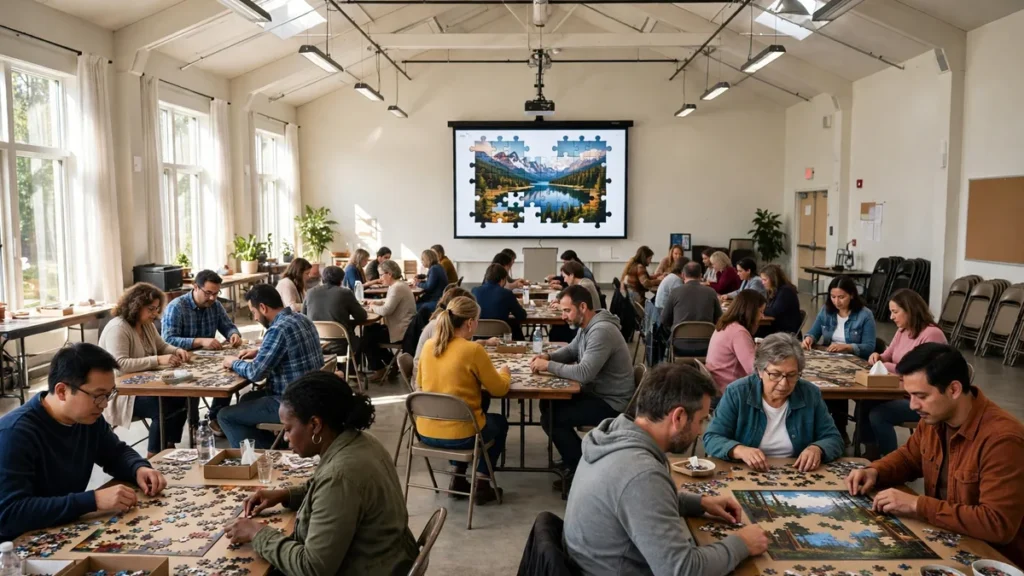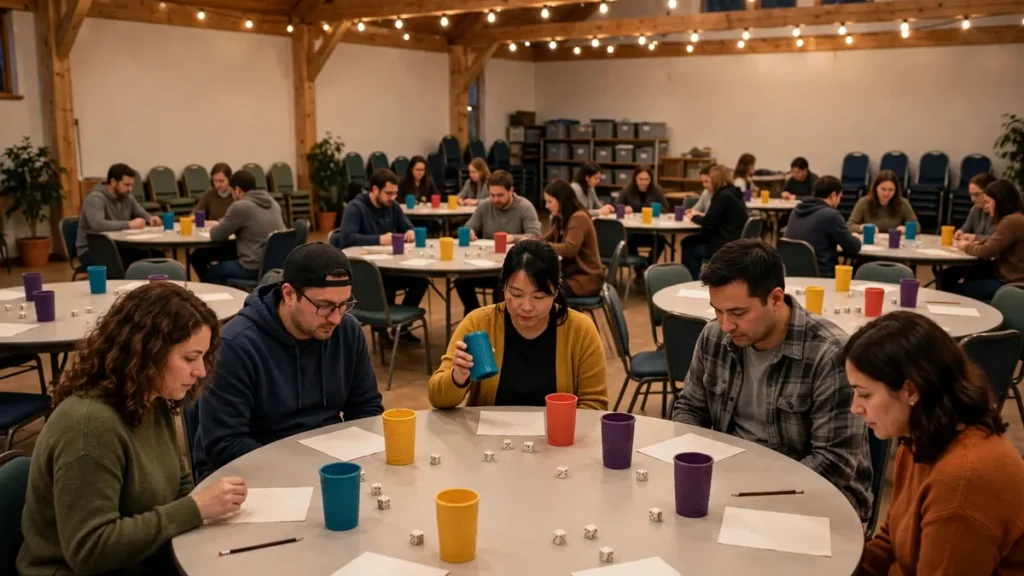
Finding the best dice games for 134 players starts with an honest fact: no single dice game seats 134 people around one table. Dice games are built for small circles of just a handful of players, and a group of 134 needs a different plan. That does not mean dice games are off the table for a huge gathering. It means the games have to be organised in teams, across many tables, or as whole-room events where everyone rolls at the same time.
A group of 134 is a full school year group, a large wedding reception, a company away day, or a community hall packed with neighbours. The best dice games for 134 players are the ones that scale without losing their pace: quick turns, simple rules, visible scores, and a format that keeps every person involved instead of watching from the side.
This guide explains the three formats that make dice games work for 134 players, reviews the strongest games for each format, and gives you a ready-to-use checklist for running the night. If you have run a smaller version of this night before, the companion guide to dice games for 132 players shows how the same ideas work with a nearly identical group size.
Key takeaways
- No dice game seats 134 players at one table, so plan for teams, multiple tables, or a whole-room format.
- Bunco, Tenzi, and Farkle are the strongest choices for very large groups because their rules are simple and their turns are fast.
- Split 134 players into teams of four to seven, with one table per team and a shared scoreboard.
- Use a tournament or relay format when you want a single winner from the whole room.
- Buy or borrow at least one set of five dice per table, plus spare dice, score sheets, and pencils for every player.
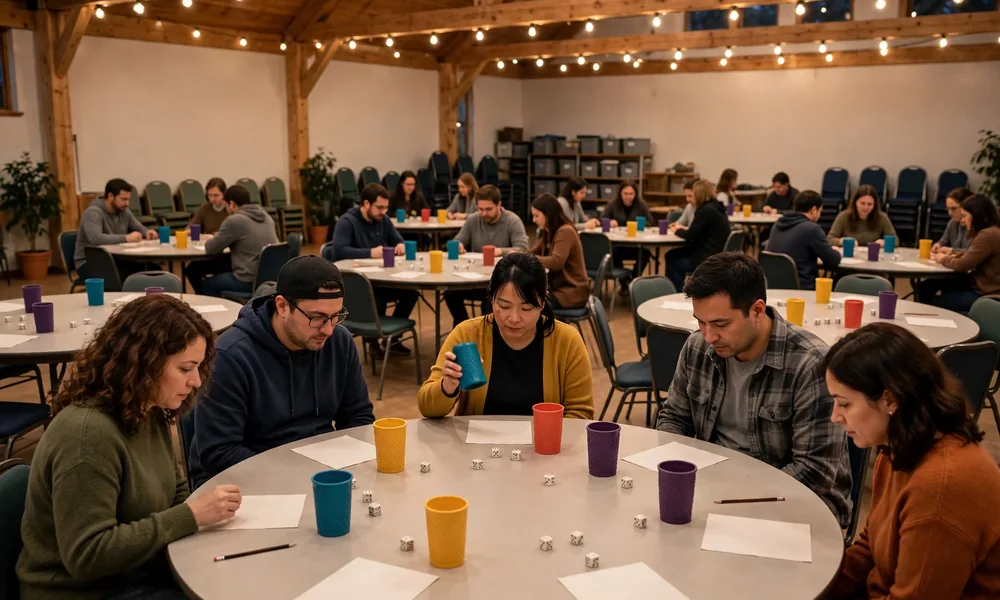
Why 134 players changes everything
Most dice games assume a small table. Four people roll, chat, and keep score together, and the game moves because everyone can see the dice. With 134 players, that intimacy disappears. Nobody can see one set of dice, nobody can hear one set of rules, and a single slow turn holds up the whole room. The organiser’s job is not to find a magic game for 134 people. It is to build a structure in which many small games add up to one big event.
The first decision is team size. Teams of four to seven work best. Four is fast and sociable, six or seven still works when the game is simple, and anything above eight starts to drag because players wait too long between turns. With 134 players, teams of six give you 22 teams with two players left over, while teams of seven give you 19 teams with one player left over. Make two teams slightly larger, or give the spare players a host or scorekeeper role. The second decision is the room: roughly 20 to 25 tables, plus space for a scoreboard and a central area where the host can be seen and heard.
The three formats that work for 134 players
Every successful large-group dice night uses one of three formats, and the best nights often combine two of them. The format decides how winners are found, how long the night lasts, and how much equipment you need. Choose the format before you choose the games, because a game that is perfect for team tables can be a poor fit for a whole-room event.
Team tables with a shared scoreboard
This is the simplest and most reliable format. Each team plays the same game at its own table, and after each round the team scores are written on a shared scoreboard at the front of the room. The team with the highest total at the end of the night wins. Nobody needs to move, the host only needs to announce the start and end of each round, and every player stays involved for the whole session. This format suits Bunco, Farkle, and team Yahtzee particularly well, because all three produce a clear team score after each round.
Tournament brackets and relay play
A tournament format works when you want a single champion from the whole room. With 134 players, a straight knockout needs too many rounds, so use a points-based first stage: every team plays three or four short rounds, the top eight teams by total points advance to quarter-finals, and the winners move on to a semi-final and a final in front of the whole room. In relay play, each team member takes one turn in sequence, and the team score is the sum of every member’s turn. If your group also enjoys other kinds of group play, the ideas in our guide to party games for 133 players pair well with a dice tournament, because they use the same team sizes and the same kind of room layout.
Whole-room simultaneous play
In a whole-room game, every player rolls at the same time on the host’s signal. Tenzi is the classic example: every player gets ten dice, the host calls a target number, and everyone rolls as fast as they can to match it. Dice bingo works the same way, with the host rolling two large dice at the front and every player marking the matching numbers on a card. Whole-room games need the least equipment per player and the most host energy. The host must be loud, clear, and quick, and a microphone is essential for 134 people.
Best dice games for 134 players compared
The table below compares the strongest dice games for a group of 134, judged on learning time, pace, equipment, and how well each game fits the three formats above. Use it to pick your main game and your backup game, then read the reviews that follow for the detail you need to run each one.
| Game | Best format | Learning time | Dice per team | Why it works for 134 |
|---|---|---|---|---|
| Bunco | Team tables | 2 minutes | 3 | Fast rounds, simple scoring, built for many tables |
| Tenzi | Whole room | 1 minute | 10 per player | Everyone rolls at once, instant excitement |
| Farkle | Team tables, relay | 3 minutes | 6 | Push-your-luck tension, easy team scoring |
| Left Center Right | Team tables | 2 minutes | 3 | Quick eliminations, great as a warm-up |
| Dice Bingo | Whole room | 2 minutes | 2 at the front | One host roll reaches all 134 players |
Bunco: the classic large-group dice game
Bunco is the game most large-group organisers reach for first, and for good reason: it was designed for many tables playing at once. Each table has four players, split into two partnerships, and the game is played in rounds. In each round, players roll three dice and try to roll the number of that round. Rolling the round number scores a point, rolling three of the round number scores five points, and rolling three of a kind of any other number scores five points as a Bunco. The round ends when one table reaches 21 points, a bell rings, and everyone moves on to the next round.
For 134 players, use teams of four where you can, and make a few tables of six by running two games of three at the same table. You will need three dice per table, a score sheet per player, and a bell or a whistle for the host. Bunco’s real strength at this scale is its rhythm: rounds last about ten minutes, the bell keeps every table in step, and partners change between rounds in the classic version, so players meet new people throughout the night.
Tenzi: the fastest whole-room game
Tenzi is the simplest game on this list and the fastest to start. Every player gets ten dice and a cup or a small tray. The host calls out a target number from one to six, and on the signal everyone rolls all ten dice as fast as they can. After each roll, players set aside the dice that match the target and re-roll the rest. The first player to get all ten dice showing the target number shouts Tenzi, and the host checks the dice before declaring a winner.
A whole-room Tenzi round takes about two minutes, which makes it ideal as an opener. It needs no explanation beyond a thirty-second demonstration, and it works for every age and every level of experience. The challenge for 134 players is equipment: ten dice per player means 1,340 dice. Dice are cheap in bulk. If buying that many dice is too much, run Tenzi in heats of about 22 players, with the heat winners meeting in a final. Tenzi also works as a team relay, with each member rolling in turn and the team’s time the sum of every member’s finishing time.
Farkle: push-your-luck scoring for teams
Farkle is a push-your-luck dice game played with six dice. On a turn, a player rolls all six dice and sets aside scoring combinations: ones are worth 100 points, fives are worth 50, three of a kind is worth 100 times the face value, and a straight or three pairs scores 1,500. The player can bank the points or roll the remaining dice again to try to add more. If a roll scores nothing, the player loses everything from that turn.
For a group of 134, Farkle works best as a team game with a fixed number of rounds instead of a race to 10,000. Give each team six rounds, with a different team member rolling in each round, and add the six scores together for the team total. This keeps every team finishing at roughly the same time, which matters when you have 22 tables to keep in step. Farkle’s appeal is the decision in every roll: bank a safe score or risk it all for more.
Left Center Right: the perfect warm-up
Left Center Right, often shortened to LCR, is played with three dice marked L, C, R, and dots, and a small pile of tokens per player. On a turn, a player rolls up to three dice and passes tokens left, right, or to the centre according to the dice. The last player holding any tokens wins the pot. A full game takes about ten minutes, and the rules can be explained in under two minutes.
For 134 players, LCR is best used as a warm-up rather than the main event, because players are eliminated one by one and the losers have nothing to do while the last few players finish. Run it at team tables with small prizes for each table winner, and use it to settle people in while latecomers arrive. Each table needs three special LCR dice and about three tokens per player. LCR is pure luck, so nobody feels outplayed, and the passing of tokens gets people talking to their neighbours within the first minute.
Dice Bingo: one roll reaches the whole room
Dice Bingo is the easiest whole-room game to run, because only the host needs dice. Each player gets a bingo-style card printed with numbers from two to twelve, the possible totals of two dice. The host rolls two large dice at the front of the room, calls the total, and every player marks that number on their card. The first player to complete a row, a column, or a full card shouts and wins the round. Print the cards in advance, with the numbers arranged differently on each card so that no two players share the same layout.
For 134 players, Dice Bingo needs almost no equipment: two large dice, a microphone, and a printed card and pencil per player. Play three or four short rounds, with a small prize for each round winner, and vary the winning pattern each time: a single line first, then two lines, then a full card. Dice Bingo is mostly luck, with no decisions for players to make, but that is also its strength for a very large group: it needs no skill, no explanation beyond a minute, and no waiting for a turn. Use it as a closer after the main tournament, when energy is flagging and you want a game that includes all 134 players at once. For a broader look at group play in the same size range, our guide to board games for 133 players covers games that use the same team sizes and room setup.
How to set up 134 players for dice games
Good setup decides whether the night runs smoothly or falls apart in the first twenty minutes. Arrange tables in rows with a clear central aisle, place the scoreboard where every table can see it, and put the host’s table at the front with a microphone, a bell, and a timer. Test the microphone before anyone arrives, because a host who cannot be heard by 134 people cannot run a timed game.
Count dice by table, not by player: Bunco needs three per table, Farkle needs six, and Tenzi needs ten per player or ten per team in relay form. Buy spare dice, because dice roll off tables and under chairs, and a table that stops to hunt for a lost die holds up its whole round. Plan for a two-hour evening: fifteen minutes for arrival and a warm-up game of Left Center Right, three rounds of your main game at fifteen minutes each, a short break, a tournament stage or a whole-room game, and a final Dice Bingo round with prizes. Appoint two or three helpers to run scores from tables to the scoreboard, because the host cannot do that and run the games at the same time.
Your 134-player game night checklist
Use this checklist in the week before the night, and tick each item off as you finish it. If you can answer yes to all six items, the night will run well.
- Choose one main game and one backup game.
- Book a room with at least 22 tables, a clear central aisle, and space for a visible scoreboard at the front.
- Count and pack the dice, cups, score sheets, pencils, and a bell, with spares of everything that can roll away or go missing.
- Print the rules for each game on a card for every table, so no table has to rely on remembering a single announcement.
- Appoint a host with a microphone and two score runners, and agree on the schedule, including round lengths and break times.
- Buy or prepare small prizes for table winners, round winners, and the overall champions, so every stage of the night has something to play for.
Frequently asked questions
Can one dice game really seat 134 players?
No. No published dice game is designed for 134 players at a single table. The games in this guide work for 134 players because they are played in teams across many tables, in tournament heats, or as whole-room games where everyone rolls at the same time. The number 134 describes the size of the gathering, not the size of one game.
How many tables do I need for 134 players?
Plan for 20 to 25 tables, depending on your team size. Teams of six need 22 tables with two players spare, teams of seven need 19 tables with one player spare, and teams of five need 27 tables with one player spare.
How many dice should I buy for 134 players?
It depends on the game. Bunco needs about 66 dice for 22 tables, Farkle needs about 132, and Tenzi needs 1,340 dice for whole-room play, one set of ten per player, so run it in heats or as a team relay if you do not want to buy that many.
What is the best dice game for a group that has never played together?
Bunco is the safest choice for strangers, because the rules take two minutes to learn, partners change between rounds, and the game mixes people up naturally. Tenzi is the best opener, because it needs almost no explanation and gets everyone rolling within a minute. Avoid bluffing games as a first game for strangers, because bluffing is easier once people know each other.
How long should a dice night for 134 players last?
Two hours is about right for the games themselves, plus arrival and prize time. A typical schedule is fifteen minutes for a warm-up, three fifteen-minute rounds of the main game, a ten-minute break, a thirty-minute tournament or whole-room stage, and a final ten-minute Dice Bingo round. Nights longer than two and a half hours tend to lose energy.
What prizes work best for 134 players?
Small, fun prizes work better than one large prize, because you need prizes for table winners, round winners, and overall champions. Dice sets, small games, sweets, and gift vouchers all work well, and a light-hearted prize for the lowest-scoring team keeps the back of the room involved. Keep the prizes modest and the ceremony short.
Bottom line
The best dice games for 134 players are not the cleverest games, but the simplest ones played in the smartest format. Split the room into teams of four to seven, give every team its own table, and run Bunco or Farkle as the main game, with Tenzi as the opener and Dice Bingo as the closer, and 134 players will feel like one big game night instead of 22 separate ones.