
The best concentration games for families turn an ordinary evening into a friendly battle of focus, memory, and quick thinking. Instead of everyone staring at separate screens, the whole table leans in together, watching, listening, and waiting for the exact right moment to act. These games are short, easy to learn, and genuinely fun for kids, parents, and grandparents alike, which is why they have become a staple of family game nights everywhere.
What makes a concentration game different from an ordinary board game is that it trains a real skill while you play. Matching cards sharpen visual memory, pattern games build attention to detail, and timed challenges teach children to stay calm under pressure. The best concentration games for families do all of this without ever feeling like homework, because the challenge is wrapped inside laughter, suspense, and the thrill of beating your own best score.
In this guide, we have tested and compared ten proven concentration games that work brilliantly at the family table. Every pick includes the publisher, the ideal age range, how many players it suits, and a realistic price, so you can choose with confidence. Whether you have a five-year-old who loves matching pictures or a teenager who wants a serious brain workout, there is a game here for your family. Fans of classic matching play should also explore our guide to memory games for families, which pairs beautifully with the titles below.
Key takeaways
- Concentration games build memory, attention, and patience while the whole family plays together.
- Matching card games are the best starting point for younger children, while pattern and logic games suit older kids and teens.
- Most great family focus games cost between $8 and $30 and take 10 to 30 minutes to play.
- Short, regular game sessions work better than long ones for building real focus skills.
- Choose games with a clear age range and player count so nobody at the table feels left out.
What Makes a Great Concentration Game for Families?
A great concentration game has three qualities: it is easy to explain in under two minutes, it rewards paying attention more than luck, and it keeps every player involved until the final round. If a game takes twenty minutes to set up or leaves younger players waiting through long turns, it will not survive many family nights, no matter how clever the design.
The best titles also scale with age. A five-year-old can enjoy matching animal pictures, while a twelve-year-old can play the same game with a timer or a larger grid to raise the challenge. Look for games with adjustable difficulty, clear rules, and sturdy pieces that survive being played again and again. Finally, check the player count honestly: a game that claims to work for two to eight players should still be fun at the low end, not only with a full table.
The 10 Best Concentration Games for Families
Here are ten concentration games that have earned their place on family shelves, from fast card games to solo logic puzzles. Each one targets a slightly different kind of focus, so the list works as a complete toolkit for family game night.
1. Simon by Hasbro
Simon is the classic electronic memory game that has challenged families since 1978, and it remains one of the purest concentration tests ever made. The round device lights up in a sequence of colours and sounds, and players must repeat the pattern back, one step longer each round. The sequence gets faster and longer until someone breaks, which makes every game a personal best to beat.
It suits ages 8 and up, works for one or more players taking turns, and costs around $25. Simon is ideal for families who want a screen-free electronic game with zero setup: press a button and you are playing in seconds. It builds auditory and visual memory at the same time, and the gentle competition of beating a sibling’s high score keeps children coming back for one more round.
2. Memory by Ravensburger
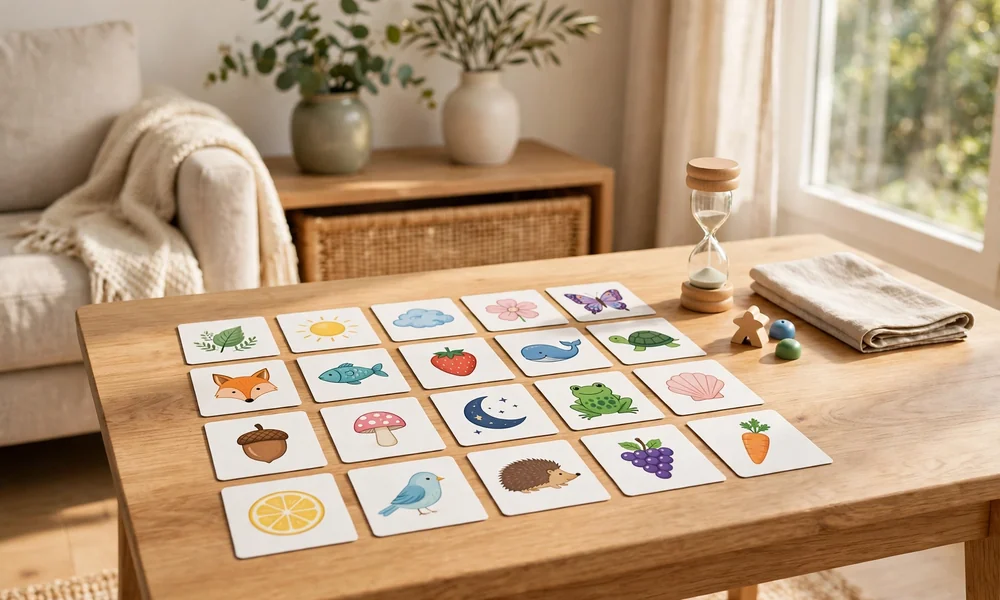
Ravensburger Memory is the gold standard of matching card games, with 72 beautifully illustrated tiles laid face down in a grid. Players flip two cards at a time, trying to find matching pairs, and the player with the most pairs wins. The simple rules mean even three-year-olds can play, while older children can use larger grids or play against the clock.
It suits ages 3 and up, two to six players, and costs around $12. This is the game to buy first if your family is new to concentration games, because it teaches the core skill of holding a mental map of the board. The sturdy cardboard tiles last for years, and themed editions featuring animals, vehicles, and storybook characters keep younger players engaged round after round.
3. Spot It! by Asmodee
Spot It!, also sold as Dobble, is a lightning-fast visual attention game where every pair of cards shares exactly one matching symbol. Players race to spot the match and shout it out first, which trains the eyes to scan a busy image and lock onto a single detail in a fraction of a second. Rounds last about five minutes, so it is perfect as a warm-up game or a quick filler.
It suits ages 6 and up, two to eight players, and costs around $12. Spot It! is brilliant for mixed-age families because spotting speed matters more than knowledge, so a sharp-eyed seven-year-old can genuinely beat an adult. The tin is small enough to carry anywhere, making it a favourite for holidays, car journeys, and waiting rooms.
4. Rush Hour by ThinkFun
Rush Hour is a sliding-block traffic puzzle that turns concentration into a satisfying solo challenge. Players set up the cars and trucks on the grid according to a challenge card, then slide the vehicles around until the red car can escape through the exit. With 40 challenges from beginner to expert, the difficulty grows as the player’s skills grow.
It suits ages 8 and up, one player at a time, and costs around $15. Rush Hour is the best pick for quiet focus time, whether a child plays alone while a parent cooks or the whole family passes the puzzle around the table, taking turns to solve the next card. It builds planning, patience, and the ability to think several moves ahead, all skills that transfer directly to schoolwork.
5. Set by Set Enterprises
Set is a deceptively simple card game of visual perception: twelve cards are laid out, each showing shapes in different colours, numbers, and shadings, and players race to find a set of three cards that are either all the same or all different in every feature. It sounds easy until you try it, and the mental gear-shifting it demands is exactly what makes it such a powerful brain workout.
It suits ages 6 and up, two to eight players, and costs around $12. Set is a favourite with older children and teens, and it pairs well with other brain training games for teens for families who want a full evening of mental challenges. The game has won more than 40 awards, and because every card matters, there is no downtime between turns.
6. Blink by Mattel
Blink is the world’s fastest card game, and its whole point is sustained attention at speed. Players race to match cards by colour, shape, or count, discarding as fast as they can while keeping an eye on both their own hand and the shared piles. A full game takes about two minutes, so it is played in best-of-five bursts that leave everyone laughing and slightly out of breath.
It suits ages 7 and up, two players, and costs around $8. Blink is the cheapest game on this list and one of the most replayable, which makes it an ideal stocking stuffer or travel game. It is especially good for children who struggle to sit still, because the pace is so fast that focus becomes a reflex rather than a chore.
7. Bop It! by Hasbro
Bop It! is a noisy, physical concentration game that tests listening skills under pressure. The device shouts commands like “Bop it!”, “Twist it!”, and “Pull it!”, and players must perform the right action before the beat runs out. Each correct move speeds up the commands, so the game becomes a hilarious test of how long you can stay calm when everything is moving faster.
It suits ages 8 and up, one or more players taking turns, and costs around $25. Bop It! works brilliantly at family parties because the whole room can watch and cheer, and the pass-it-on mode lets everyone share one device. It trains auditory processing and reaction speed, and it is one of the few concentration games that gets the whole family laughing out loud.
8. Perfection by Hasbro
Perfection is a race against the clock and your own nerves. Players must fit 25 different shaped pieces into their matching holes on the board before the timer pops and sends the pieces flying. The ticking timer creates gentle pressure, and the only way to improve is to stay calm, scan the board, and place each piece with care.
It suits ages 5 and up, one to four players, and costs around $20. Perfection is a wonderful first timed game for younger children because the shapes are chunky and easy to handle, and the pop-up ending is always funny rather than frustrating. It builds shape recognition, fine motor control, and the ability to focus under a deadline, all in rounds that last just sixty seconds.
9. Kanoodle by Educational Insights
Kanoodle is a pocket-sized 3D brain teaser with 200 puzzles that challenge players to fit colourful pieces into a grid. The 2D puzzles build spatial reasoning, while the 3D pyramid challenges demand real concentration, as every piece must sit exactly right for the pyramid to hold together. It is a solo game, but families love solving it together, with each person suggesting the next move.
It suits ages 7 and up, one to two players, and costs around $13. Kanoodle’s small case makes it one of the best concentration games for travel, and the puzzle book’s twelve difficulty levels mean it grows with your child for years. It is a calm, quiet game, ideal for winding down before bed or for car journeys when you need focused, screen-free play.
10. Gravity Maze by ThinkFun
Gravity Maze combines a marble run with a logic puzzle, and it is one of the most satisfying concentration games a family can own. Players follow a challenge card to place towers on the grid, then drop the marble and watch whether it reaches the target. If it misses, the whole arrangement must be rethought, which teaches persistence and careful planning.
It suits ages 8 and up, one player at a time, and costs around $30. Gravity Maze is the premium pick on this list, and it earns its price with sturdy pieces, 60 challenges, and that wonderful moment when a tricky marble run finally works. It is the best choice for families with a child who loves building, engineering, and puzzles that reward deep, unhurried thinking.
Best Concentration Games for Families Compared
| Game | Publisher | Ages | Players | Price | Best for |
|---|---|---|---|---|---|
| Simon | Hasbro | 8+ | 1+ | ~$25 | Memory sequences |
| Memory | Ravensburger | 3+ | 2-6 | ~$12 | Young children |
| Spot It! | Asmodee | 6+ | 2-8 | ~$12 | Visual attention |
| Rush Hour | ThinkFun | 8+ | 1 | ~$15 | Solo logic |
| Set | Set Enterprises | 6+ | 2-8 | ~$12 | Pattern spotting |
| Blink | Mattel | 7+ | 2 | ~$8 | Fast reactions |
| Bop It! | Hasbro | 8+ | 1+ | ~$25 | Listening skills |
| Perfection | Hasbro | 5+ | 1-4 | ~$20 | Timed play |
| Kanoodle | Educational Insights | 7+ | 1-2 | ~$13 | Travel puzzles |
| Gravity Maze | ThinkFun | 8+ | 1 | ~$30 | Building and logic |
Family Game Night Checklist: 6 Steps to Sharper Focus
Use this simple checklist to get the most from your concentration games, whether you are playing for ten minutes after dinner or running a full family tournament.
- Start with the easiest game first. Warm up with a quick matching or spotting game so younger players build confidence before the harder challenges arrive.
- Match the game to the youngest player. Check the age range on the box and pick a title everyone at the table can genuinely play, not just watch.
- Keep sessions short and regular. Two or three 15-minute sessions a week build focus far better than one exhausting hour on a Sunday.
- Mix fast and slow games. Pair a speedy card game like Blink with a calm puzzle like Rush Hour so different kinds of attention all get a workout.
- Rotate who chooses the game. Letting each family member pick the night’s game keeps everyone invested and introduces the group to new favourites.
- Celebrate personal bests, not just wins. Praise a child for beating their own Simon score or solving a harder Rush Hour card, and focus becomes its own reward.
If you are building a wider family game shelf, our roundup of the best kids board games is a useful next stop, with plenty of titles that pair well with the concentration games above.
Frequently Asked Questions
What age should children start playing concentration games?
Simple matching games work from around age three, when children can recognise pictures and take turns. Timed and pattern games suit ages six and up, while logic puzzles like Rush Hour and Gravity Maze are best from age eight. The age ranges on this list are a reliable guide, but watch your own child: if they enjoy the game and can follow the rules, they are ready.
Do concentration games really improve focus?
Yes, in a practical sense. Regular play strengthens working memory, visual scanning, and the habit of sticking with a task until it is finished. The gains are strongest when children play often and in short sessions, and when the games are fun enough that they want to play again. No single game is a cure for attention difficulties, but as part of a balanced routine they make a real difference.
How long should a family concentration game session last?
For children under eight, aim for 10 to 15 minutes. Older children and teens can happily play for 20 to 30 minutes, especially with a mix of fast and slow games. Stop while everyone is still enjoying it: ending on a high note makes the family far more likely to play again tomorrow.
Which concentration game is best for a family with a wide age gap?
Spot It! and Memory are the safest choices, because spotting speed and picture matching do not depend on reading or maths skills. You can also level the playing field by giving younger players a head start, using a smaller grid, or playing in teams so a younger child pairs with an adult.
Are electronic concentration games like Simon as good as card games?
They train different skills. Simon builds auditory memory and sequence recall, while card games build visual memory and pattern recognition. A good family collection includes both, because variety keeps game night interesting and exercises more kinds of attention. Both are screen-free in the traditional sense, with no apps or adverts involved.
Can concentration games help before homework or school?
Many families use a quick five-minute game as a warm-up before homework, and teachers often do the same at the start of a lesson. A short burst of focused play wakes up attention and gets children into a concentrating mindset, which can make the first ten minutes of homework noticeably smoother.
The Bottom Line
The best concentration games for families are the ones your family actually asks to play again, and every game on this list has earned that honour in homes around the world. Start with Memory or Spot It! for younger children, add Set or Rush Hour as they grow, and keep a fast favourite like Blink on hand for busy evenings. Play little and often, celebrate personal bests, and you will watch focus, memory, and confidence grow one game night at a time.


