
Finding the best card games for 51 players is very different from picking a game for a family of four. Fifty-one people cannot sit around one table, share one deck, or take turns in a single circle without the game grinding to a halt. What works instead is a format built for scale: several tables running at once, simple rules everyone can learn in minutes, and a structure that keeps every player involved from the first deal to the final score.
Card games suit a group this large. Decks are cheap, portable, and easy to duplicate, so you can run eight or nine tables for very little money. Most games here need nothing more than standard playing cards, a score sheet, and a clear host, and they work for school events, office parties, family reunions, community halls, and fundraiser nights.
This guide covers twelve games that genuinely work for 51 players, explains how to organise them across multiple tables, and compares them side by side. Every game here scales well, keeps waiting time low, and stays fun for strangers playing together for the first time.
Key takeaways
- Split 51 players into eight or nine tables of five or six; no single-table card game works well for 51 people at once.
- Choose games with rules that take under five minutes to explain, so new players can join any table without slowing the night down.
- Use one deck per table plus a spare deck for every two tables, and keep a central scoreboard so tables stay in sync.
- Rotation games and tournament formats work best for large groups because they mix players and keep energy high between rounds.
- Plan for ninety minutes to two hours, including setup, three or four rounds, and a short prize or closing round at the end.
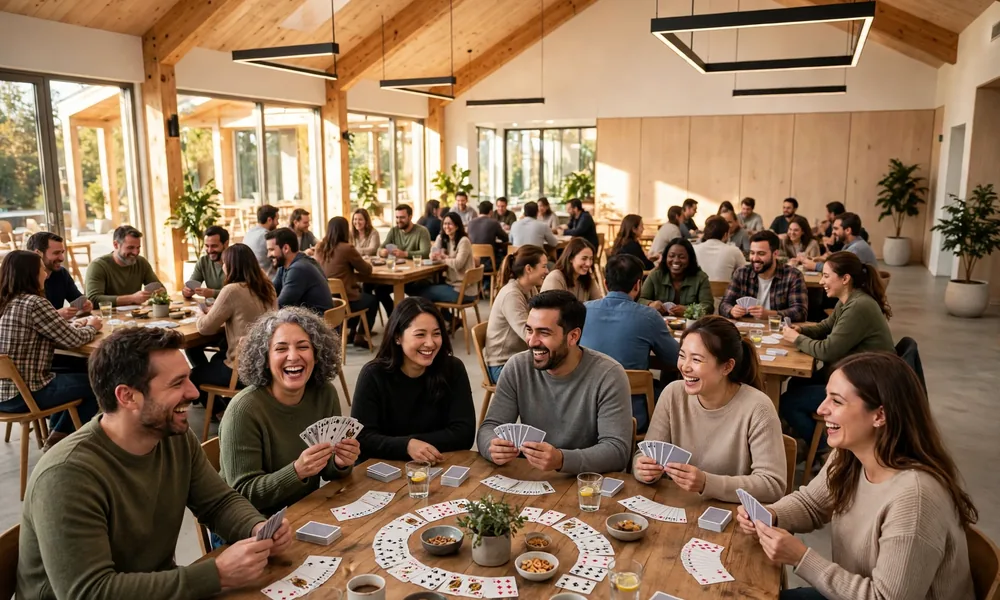
Why 51 Players Changes the Game
A card game for four people is a conversation. A card game for 51 people is an event, and it needs event planning. The three things that break down first are turn length, table space, and attention. If each player takes thirty seconds per turn, one round around a single table would take more than twenty-five minutes. That is why the multi-table format is not optional at this size; it is the whole solution.
The second problem is noise. Fifty-one people generate a lot of chatter, and a host who tries to explain complex rules to the whole room will lose half the audience. Short written rule cards on each table solve this: print the aim, the order of play, and the scoring in large type, so players can read it while the host deals.
The third problem is fairness. When tables run separately, some finish faster than others. A simple rotation system fixes this: after each round, the top two players at each table move to the next table. Over three or four rounds, everyone plays a wide mix of opponents, and people meet new faces instead of sitting with the same five neighbours all night.
How to Organise Card Games for 51 Players
Start with the room layout: eight tables of six and one table of three, or nine tables of five or six. Leave a clear walkway between tables so the host can move freely. Put a numbered card, a pen, a score sheet, and at least one deck on each table, plus a spare deck for every two tables to cover lost or damaged cards.
Decide the format before anyone arrives. In a parallel tournament, every table plays the same game, and the table winners advance to a final. In a rotation night, tables play different games, and players move to a new table and a new game after each round. The tournament suits competitive groups; rotation suits mixed groups that want variety and a relaxed evening.
Allow ten minutes for seating and rules, then run rounds of twenty to twenty-five minutes. Three rounds plus a final is a comfortable evening of about ninety minutes. Keep a central scoreboard where table winners write their names after each round, so everyone can follow the competition and the host can check that every table has reported in.
Seating and Table Sizes
Tables of five or six are the sweet spot for almost every game here. Four can feel thin when one person leaves for a break, and seven or eight make turns too slow. Use the three-player table for a game that works with fewer players, such as a short trick-taking game, or ask the host to join it and rotate out when a late guest arrives.
Decks, Score Sheets, and Supplies
Count your decks before the night. Most games need one standard deck per table, so nine decks cover the room; Rummy and Canasta need two per table. Buy inexpensive decks in bulk and keep them sealed, because old decks with bent corners or missing cards cause arguments. Keep score sheets simple: player name, round, points, and table winner. Print a few extra, because someone always spills a drink or loses a pen.
The 12 Best Card Games for 51 Players
The games below run from the easiest to explain to the most involved. Each entry tells you how many decks you need, how long a round takes, and why it works for a group of this size.
1. Spoons
Spoons is the loudest, fastest game on this list, and the best opener for a large group. Each table needs one deck and one spoon fewer than the number of players. Players pass cards around the table, trying to collect four of a kind, and when someone does, they quietly take a spoon. The rest must notice and grab a spoon before the last one is gone. A round takes ten to fifteen minutes, needs no scoring, and breaks the ice better than any other game here.
2. Cheat
Cheat, also known as Bluff, is a game of lying with a straight face, and it thrives in large groups because the social side matters more than the cards. Players discard cards face down, announcing what they claim to have played, and any player can challenge a claim. A correct challenge forces the liar to pick up the pile; a wrong challenge means the challenger takes it. The first player to shed every card wins. It needs one deck per table and takes fifteen to twenty minutes.
3. Rummy
Rummy is the most familiar card game in the world, and that is a real advantage with 51 players of mixed experience. Most people have played some version, so the host spends almost no time explaining rules. Each table plays with two decks, and players draw and discard to form sets of matching cards and runs in the same suit. A round ends when one player lays down their whole hand. A full round takes twenty to twenty-five minutes, and the game stays calm and conversational. For a smaller group that wants the same style of play, card games for two players offer a useful starting point for learning the basic mechanics at home.
4. Hearts
Hearts is a trick-taking game where the aim is to avoid tricks that contain hearts, and especially the queen of spades. It fits a table of four perfectly, but also works with five or six if you remove a few low cards to balance the deal. A round takes twenty minutes. Scoring is simple: each heart is one point, the queen of spades is thirteen, and the lowest score wins. It is a good tournament game because every table produces a clear winner.
5. Spades
Spades is a partnership trick-taking game, and partnerships make it a strong choice for a social night. At a table of six, form three partnerships, or play with two teams of three. Each partnership bids on how many tricks it will win, then plays to meet that bid, with spades always as the trump suit. A successful bid scores points; a failed bid loses them. A round takes twenty to twenty-five minutes.
6. Uno-Style Shedding Games
In shedding games, the aim is to be the first to play every card in your hand, which makes them the most accessible games for mixed-age groups. A standard deck works with simple house rules, or you can use a commercial deck with action cards that skip, reverse, or force the next player to draw. Each table needs one deck, and a round takes fifteen minutes, which makes them ideal for rotation nights. Children, grandparents, and beginners can all play together.
7. Canasta
Canasta is a Rummy-style game played with two decks, and the best choice for groups that want a longer, more strategic game. Players form melds of three or more matching cards, and a completed meld of seven, called a canasta, scores a large bonus. Played in partnerships, a full game can last forty minutes, so it suits the final round or a dedicated table for experienced players. Print a full rule sheet for Canasta tables, because the scoring has more detail than the other games.
8. President
President, also known as Scum, is a climbing game where players shed their cards in order, and the finishing order decides their rank for the next round. The first player out becomes the President, the last becomes the Scum, and the ranks bring small advantages and disadvantages in the next deal. This creates a story across rounds, which is what makes President so good for large groups. A round takes fifteen minutes, and the game needs one deck per table.
9. Euchre
Euchre is a fast trick-taking game played with a shortened deck of twenty-four cards, and a hand takes only five minutes. Players form two partnerships, bid on the trump suit, and try to win at least three of the five tricks in each hand. The short deck means the game moves quickly, and a table can play several hands in a twenty-minute round. Pair each Euchre table with an experienced player who can guide the first hand.
10. Go Fish Tournament Style
Go Fish is often dismissed as a children’s game, but run as a timed tournament it becomes fast, funny, and surprisingly competitive. Each table plays short five-minute heats, and the player with the most completed sets scores points. After each heat, the table reshuffles and deals again, so a twenty-minute round holds three or four heats. It is the best game here for groups with young children, because a child can play beside an adult without any disadvantage.
11. Big Two
Big Two is a climbing game popular across Asia, and one of the most strategic shedding games you can play with a standard deck. Players take turns playing single cards, pairs, or five-card combinations, each one higher than the last, and the first player to shed every card wins the hand. It rewards careful hand management and bold timing. A round takes twenty minutes, and the game needs one deck per table.
12. Golf Card Game
The Golf card game is a quiet, low-pressure game where each player has a small grid of face-down cards and tries to end with the lowest total over nine holes, just like a round of golf. It takes one deck per table, a round takes fifteen to twenty minutes, and the game is almost silent, a useful contrast to the noisy tables running Spoons or Cheat nearby. Golf is the best closing game here: run it as the final round, when the room is tired and people want something calm before the prizes.
Best Card Games for 51 Players Compared
The table below compares all twelve games on what matters most when you are planning for 51 people: decks per table, round length, difficulty, and the group each game suits best. Use it to build your own mix, and aim for a balance of fast and slow, loud and quiet, so every guest can find a table that fits their mood.
| Game | Decks per table | Round length | Difficulty | Best for |
|---|---|---|---|---|
| Spoons | 1 | 10–15 minutes | Easy | Opening round, high energy |
| Cheat | 1 | 15–20 minutes | Easy | Social groups, bluffing fun |
| Rummy | 2 | 20–25 minutes | Easy | Mixed experience, calm play |
| Hearts | 1 | 20 minutes | Medium | Tournament play |
| Spades | 1 | 20–25 minutes | Medium | Partnerships, competitive groups |
| Shedding games | 1 | 15 minutes | Easy | Families, mixed ages |
| Canasta | 2 | 40 minutes | Medium | Experienced players, final round |
| President | 1 | 15 minutes | Easy | Rotation nights, social play |
| Euchre | 1 short deck | 20 minutes | Medium | Fast hands, tournament play |
| Go Fish tournament | 1 | 20 minutes | Easy | Children, timed heats |
| Big Two | 1 | 20 minutes | Medium | Strategic players |
| Golf card game | 1 | 15–20 minutes | Easy | Closing round, quiet play |
Choosing the Right Game for Your Group
The best mix depends on who is coming. For a family reunion, choose Spoons, shedding games, Go Fish, and Golf, because all four are easy to learn and none leaves a beginner feeling lost. For an office party, choose Cheat, President, Rummy, and Spades, because they reward social skills and teamwork. For a community fundraiser, choose Hearts, Euchre, and Rummy as tournament games, because they produce clear winners and a satisfying final.
Think about the room as well. If the venue is small, avoid running Spoons on every table, because the noise and grabbing will overwhelm the quieter games. Mix one or two loud tables with several calm ones, and put the loud tables near the edge of the room. If the venue is large, spread the tables out and use the central scoreboard as a meeting point between rounds.
Finally, consider the skill range. Regular card players will enjoy Hearts, Spades, Canasta, and Big Two, and will be disappointed by a night of only simple games. First-timers need the opposite: short rules, fast turns, and games where luck matters as much as skill. The safest plan for a mixed group is three easy games, two medium games, and one challenging game, then let players choose their table after the first round. The best card games for 49 players follow the same multi-table approach with a slightly smaller room.
Card Games for 51 Players Checklist
Use this checklist in the week before your event. It covers the supplies, the room, and the running order, so nothing important is left to the last minute.
- Count the guest list and confirm the final number, then plan nine tables of five or six players with a numbered card on each table.
- Buy or borrow at least twelve standard decks, plus spare decks, and check every deck for missing or damaged cards.
- Print a short rule card for each game, a score sheet for every table, and a large central scoreboard for the room.
- Choose your format, tournament or rotation, and write the round times on the scoreboard so every table stays in sync.
- Brief two or three helpers before the night, and place one experienced player at each table that runs a medium-difficulty game.
- Prepare a small prize for each table winner and one overall prize, and plan a short closing round so the night ends on a high note.
Frequently Asked Questions
Can 51 people play one card game together?
Not at a single table. One deck and one turn order cannot serve 51 players without very long waits. Split the group into eight or nine tables of five or six, run the same game or different games at each table, and bring the table winners together for a final. This keeps every player involved and each round to about twenty minutes.
How many decks do I need for 51 players?
Plan for at least twelve decks. Most games need one per table, so nine tables need nine, and Rummy and Canasta need two per table. Add three spares for lost or damaged cards. Check each deck before the night, because one with a missing card can spoil a whole round.
What is the best card game for a large group of beginners?
Spoons is the best opener: the rules take two minutes to explain and the game creates energy immediately. Shedding games and Go Fish suit mixed-age groups best, because children and adults play on equal terms. For a calm game, start with Rummy, which most people have played before.
How long should a card game night for 51 players last?
Plan for ninety minutes to two hours: ten minutes for seating and rules, three rounds of twenty to twenty-five minutes, and ten minutes for a final table and prizes. Sixty minutes works with two rounds, but three rounds give the rotation system time to mix players properly.
How do I keep score across nine tables?
Use a simple score sheet at each table and a central scoreboard in the room. After each round, the table winner writes their name and score on the board. The host checks the board between rounds to confirm that every table has reported in. It is simple, visible, and builds excitement as the names accumulate.
What if the number of players changes on the night?
Build flexibility into the seating plan. Keep one table that can grow or shrink, such as a shedding game table, where five, six, or seven players all work well. If extra guests arrive, add them to that table; if guests leave early, merge two short tables into one. The rotation format handles changes better than a strict tournament, because players move tables each round anyway. If you are planning for a slightly different group size, the best board games for 50 players use the same flexible seating approach.
Bottom Line
The best card games for 51 players respect the size of the group: simple rules, fast turns, several tables running at once, and a format that mixes players between rounds. Spoons opens the night with energy, Rummy and Hearts give the tournament its backbone, and Golf closes it quietly. Pick three or four games from this guide, print the rule cards, and count your decks.


