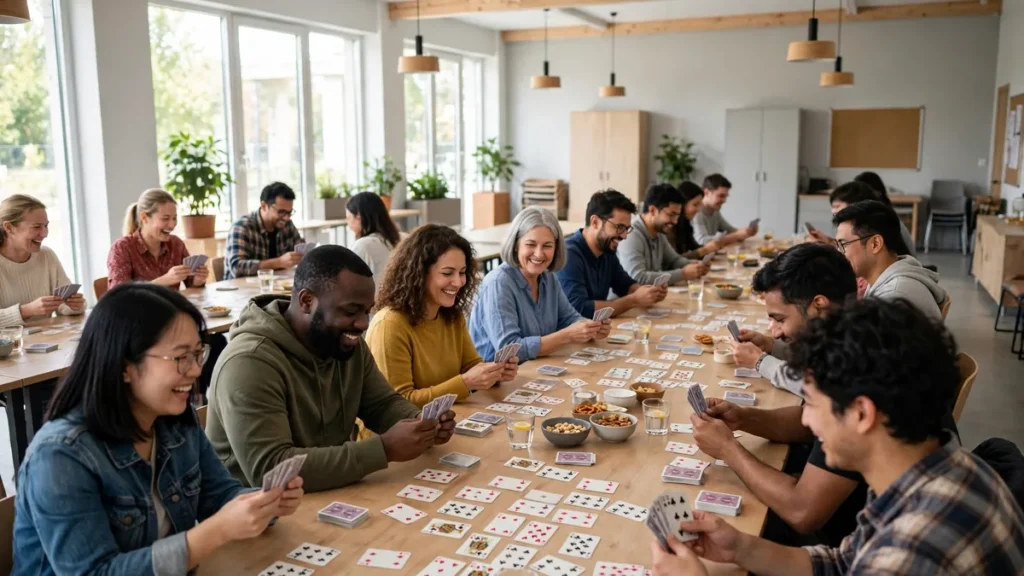
The best card games for 302 players are not the games you play around a single kitchen table. They are team formats, relay formats, and station formats that split a very large crowd into small, fast-moving groups while keeping everyone part of one shared event. When 302 people gather for a game night, a school festival, a company social, or a community celebration, the usual rules break down. Nobody can wait for 301 other turns, nobody can see a single small pile of cards from the back of a hall, and nobody wants to sit out while a handful of people play.
That is why the best card games for 302 players rely on parallel play. Instead of one game for everyone, organisers run many identical games at once, link them with a shared scoreboard, and rotate teams through short rounds. A table of six plays a quick round of a matching or sorting game, reports its result, and moves on, while dozens of other tables do the same thing at the same moment. The room stays loud, busy, and fair, because no table waits long and no team dominates the whole evening.
This guide covers the ten formats that handle a crowd of this size best, along with the setup and timing that make the difference between a smooth event and a confusing one. Every game here uses ordinary playing cards or simple printed card sets, needs no special equipment beyond tables, timers, and score sheets, and works for mixed ages and mixed experience levels. Whether you are planning a one-off celebration or a regular large-group game night, these are the card games that scale gracefully and keep every player involved.
Key Takeaways
- Split 302 players into teams of four to eight and run identical games at many tables at the same time.
- Choose games with rounds of five to ten minutes so no team waits long between turns.
- Use a single visible scoreboard and a clear sound signal to start and stop every round together.
- Pick rules that take less than two minutes to explain, so new players can join any table confidently.
- Rotate teams between stations so everyone tries several different games before the final round.

Why 302 Players Changes Everything About Card Games
A card game for four people is a conversation. A card game for 302 people is an event, and it needs event thinking. The first change is space. You need enough tables for roughly forty to fifty small groups, plus clear walkways between them, a central area for the host and the scoreboard, and a registration desk where teams collect their table assignments. Numbered table cards, printed in large type, save more time than any other single preparation.
How to Set Up Card Games for 302 Players
Next, prepare the card sets and the scoring. Most games here need one or two standard decks per table, so plan for at least sixty decks, plus spares for damaged or missing cards. Scoring should be simple enough for a volunteer to record in seconds, with one points box per round on each table sheet. A central scoreboard, updated after every round, keeps the competition visible. The easiest rotation is a simple clockwise move: after each round, every team moves to the next numbered table, where a new game is waiting. For ideas on structuring a large-group evening, the companion guide to party games for 300 players shows how a similar crowd can be organised around short, rotating rounds.
The 10 Best Card Games for 302 Players at a Glance
| Game | Players per Table | Best For | Round Length | Energy Level |
|---|---|---|---|---|
| Team Rummy Relay | 4 to 6 | Strategy and teamwork | 10 minutes | Steady |
| Snapshot Memory Match | 4 to 8 | Focus and recall | 8 minutes | Calm to lively |
| Card Chain Story | 5 to 8 | Creativity and laughter | 10 minutes | High |
| Sorting Sprint | 4 to 6 | Speed and observation | 5 minutes | Very high |
| Guess the Card | 4 to 8 | Questions and deduction | 8 minutes | Steady |
| Build the Tower | 4 to 6 | Steady hands and patience | 10 minutes | Tense and fun |
| Sequence Bingo Cards | 6 to 8 | Mixed ages | 8 minutes | Lively |
| Trivia Card Duel | 4 to 6 | Knowledge and speed | 8 minutes | High |
| Matching Pairs Relay | 4 to 8 | Movement and teamwork | 6 minutes | Very high |
| Grand Card Parade | 6 to 8 | Whole-room finale | 10 minutes | High |
The 10 Best Card Games for 302 Players
1. Team Rummy Relay
Team Rummy Relay turns a familiar card game into a fast team contest. Each table plays a shortened version of rummy, where the aim is to collect sets of three or four matching cards, or runs of three or more cards in the same suit. The twist is the relay: only two players from each team play at a time, and after every two minutes the host sounds a signal and the next pair takes over the same hand. The incoming players must read the table quickly and continue without a long discussion, so everyone stays alert. Teams earn points for each completed set or run, plus a bonus for finishing first, and a ten-minute round allows two or three hands.
2. Snapshot Memory Match
Snapshot Memory Match is a large-group version of the classic pairs game, and it works beautifully because the rules are already familiar to almost everyone. Each table lays out a grid of twenty-four face-down cards, and players take turns turning over two cards to find a matching pair. A matched pair stays with the player who found it, and that player takes another turn, while a miss passes the turn on. The team with the most pairs wins the table points. It rewards attention rather than speed, so players of very different ages can compete fairly, and every revealed card is useful information for the whole table. An eight-minute round allows two full grids.
3. Card Chain Story
Card Chain Story is the loudest and most creative game in this collection, and it is often the one players remember afterwards. Each team receives a hand of picture cards, and the first player begins a story with a sentence inspired by one of their cards, then places that card face up in the centre. The next player continues the story using one of their own cards, and the chain continues until every player has contributed at least twice. The team then performs its best chain for a judge, who awards points for imagination, humour, and clever linking. Keep stories short, with three minutes to build and two to perform, and the game needs no prior skill at all.
4. Sorting Sprint
Sorting Sprint is pure speed, and it is the best game in this list for waking a room up after a quieter round. Each table receives a shuffled deck, and on the starting signal the team must sort it into four piles by suit, then order each pile from ace to king, as quickly as possible. Only one player may touch the cards at a time, and players must tag the next person in before that person can start, which turns simple sorting into a noisy, laughing relay. Accuracy matters as much as speed, because a team that finishes first with a mistake must fix it before the time is recorded. The game takes only five minutes, needs almost no explanation, and works well as the first station of the evening.
5. Guess the Card
Guess the Card is a deduction game that rewards good questions rather than good luck. One player at each table secretly chooses a card and places it face down, and the rest of the team must work out which card it is by asking questions that can only be answered with yes or no. Is it red? Is it higher than a seven? Is it a picture card? Each team has a limit of fifteen questions, and the fewer questions they need, the more points they score. Stronger teams quickly learn that the best questions split the remaining cards roughly in half, so the second round is noticeably smarter than the first. A printed list of example questions helps new players get started.
6. Build the Tower
Build the Tower is a test of patience disguised as a card game, and it creates some of the tensest moments of any large-group night. Each team receives a deck of cards and must build the tallest free-standing tower it can, using only the cards and the table surface, within ten minutes. Teams may fold cards or lean them against each other, but they may not use tape, glue, or any other support. A judge measures each tower at the end, awarding points for height, with a bonus for the most creative design. The game gives quieter players a genuine role, since the person with the steadiest hands can be the hero of this station, and teams quickly divide the work between builders and card suppliers.
7. Sequence Bingo Cards
Sequence Bingo Cards blends the familiar excitement of bingo with the variety of a card deck, and it is one of the easiest games to run for a very large group. Each player receives a printed grid filled with card names, such as ace of spades or queen of clubs, and the host draws cards from a large deck at the front of the hall and calls them out. Players mark the matching square, and the first player at each table to complete a full row, column, or diagonal calls out and wins the table round. The whole hall plays together, which fills the room with the small sounds of marking and checking that make bingo nights enjoyable, and the game needs no strategy or prior knowledge at all.
8. Trivia Card Duel
Trivia Card Duel pairs general knowledge with quick card play, and it is the best choice for groups that enjoy a competitive quiz atmosphere. Each table has a set of trivia cards, and a standard deck decides who answers first: the dealer turns over a playing card, and the player whose position matches the card value must answer the next question within thirty seconds. A correct answer earns a point for the team, while a wrong answer passes the question to the next team at the table, which keeps everyone listening. Choose questions across food, music, sport, science, and everyday life, at a level where most players can answer about half correctly, and an eight-minute round allows about fifteen questions.
9. Matching Pairs Relay
Matching Pairs Relay is the most physical game in this guide, and it is ideal for the middle of the evening, when the room needs movement after sitting through quieter rounds. Each team lines up beside its table, and a grid of face-down cards is laid out several steps away. One player at a time walks briskly to the grid, turns over two cards, and returns to tag the next teammate. If the two cards match, the team keeps the pair; if not, the cards are turned face down again. Memory still matters, but speed and clear communication matter just as much, since the next runner needs to know which cards have already been revealed. Keep the walkway clear and safe, and use large cards that are easy to turn over quickly.
10. Grand Card Parade
Grand Card Parade is the whole-room finale, designed to bring all 302 players together after an evening of separate table games. Each team is given a suit, hearts, diamonds, clubs, or spades, and must arrange its members in a sequence, from ace to king, by finding the matching card each player was given at the start of the round. Players hold their cards above their heads and move around the hall until their team forms a complete, correctly ordered line, with the host checking each line as it forms. The first team to complete its sequence wins, with bonus points for the best team cheer. After an hour of table games, the room needs a reason to stand up and cheer, and this provides exactly that.
Choosing the Right Mix for Your Group
Not every group needs all ten games, and the best evenings are often built from six or seven well-chosen formats rather than a rushed tour of everything. If your group is mostly families with children, lean towards Snapshot Memory Match, Sequence Bingo Cards, and Matching Pairs Relay, which need no prior card knowledge. If your group is mostly adults who enjoy strategy, give Team Rummy Relay, Guess the Card, and Trivia Card Duel more time, and use Sorting Sprint and Build the Tower as lively breaks. A similar approach works for the wider family of large-group formats, and the guide to card games for 300 players offers a useful comparison for organisers planning a slightly smaller crowd.
Common Mistakes to Avoid
The second mistake is letting the scoring become a mystery. If teams cannot see how they are doing, they lose interest, and if the scores are announced only at the end, the middle of the evening feels flat. Update the scoreboard after every round, announce the top five teams, and mention a team that has improved sharply, even if it is not yet in the lead. Players who are curious about how these formats compare with other large-group ideas will find the companion list of puzzle games for 301 players a helpful next read, since many of the same setup principles apply.
Event Checklist
- Confirm the venue, table layout, and walkways, with numbered table cards printed in large type.
- Form teams of four to eight in advance, with a named captain and a printed rotation sheet for each team.
- Prepare at least sixty standard decks, plus spares, and one printed rule card for every table.
- Set up a visible central scoreboard and agree on a clear sound signal for starting and stopping rounds.
- Brief volunteers on scoring, timing, and rotation before players arrive, and keep spare pens, sheets, and decks at the central desk.
- Plan a rest break halfway through and a whole-room finale, then announce the overall winners while everyone is still together.
Frequently Asked Questions
How many decks do I need for 302 players?
Plan for at least sixty decks, which is one or two per table across roughly fifty tables, plus ten spare decks for replacements. Check every deck before the event and keep the spares at a central desk where volunteers can reach them quickly.
How long does a card games event for 302 players take?
Most events run for ninety minutes to two hours, including introductions, a short break, and a finale. Seven rounds of eight minutes, plus changeovers, fit comfortably into ninety minutes, while a two-hour evening can include all ten games in this guide.
Can children play these card games alongside adults?
Yes, and mixed-age teams usually work best. Games such as Snapshot Memory Match, Sequence Bingo Cards, and Matching Pairs Relay need no prior card knowledge, and children often do very well at memory and observation games. Place younger players in teams with adults who can help with the rules.
What if some players have never played card games before?
Choose games with rules that take less than two minutes to explain, and put a printed rule card on every table. Start with the simplest game, such as Sorting Sprint or Sequence Bingo Cards, so new players gain confidence before the more strategic rounds begin.
Do I need a professional host for 302 players?
A confident volunteer host is usually enough, provided they have a clear plan, a sound signal, and helpers for scoring and rotation. The host needs to keep time, update the scoreboard, and maintain a warm, encouraging tone, rather than knowing every rule in detail.
How do I keep scoring fair with fifty teams playing at once?
Use the same points scale at every table, record results on a simple sheet after each round, and update a central scoreboard that everyone can see. Award points per round rather than using single elimination, so a team can recover from a slow start, and check any disputed scores before the next round begins.
The Bottom Line
The best card games for 302 players succeed because they are built for a crowd, not adapted from a game for four. Short rounds, parallel tables, simple rules, and a visible scoreboard turn a huge gathering into a shared event where every player has a role and every team has a chance to climb the table. Start with the setup, choose a mix that suits your group, and finish with a whole-room game that brings everyone together. Do that, and 302 players will leave with the same feeling as a great small game night, only louder, busier, and far more memorable.


