
Finding great card games for 18 players is a different challenge from picking a game for a quiet evening with four friends. At this size, most card games on the shelf simply stop working. Decks run out, turns drag on forever, and half the table ends up watching instead of playing. An 18-player game night needs games built for big groups, games that split neatly into teams, or classics that scale with a second deck.
The good news is that 18 is a wonderful number for a card game night. You have enough people for proper team rivalries, hidden-role games with real tension, and party games where the room itself becomes part of the fun.
In this guide, you will find twelve card games for 18 players that actually work at full strength. Each entry includes the player count, typical play time, what you need, and the honest truth about how it handles a group of eighteen.
Key takeaways
- Choose games designed for large groups, team play, or multiple decks. Standard games built for four to six players rarely stretch to eighteen without house rules.
- Hidden-role and party games are the strongest fit for 18 players because everyone plays at once and no one waits for a turn.
- Team formats turn almost any good card game into an 18-player game. Split into three teams of six or two teams of nine.
- Keep rounds short. Games with quick turns and simultaneous play hold a big room far better than slow, turn-by-turn games.
- Have two or three games ready. A short warm-up, one main event, and a fast closer keep an 18-player night moving.
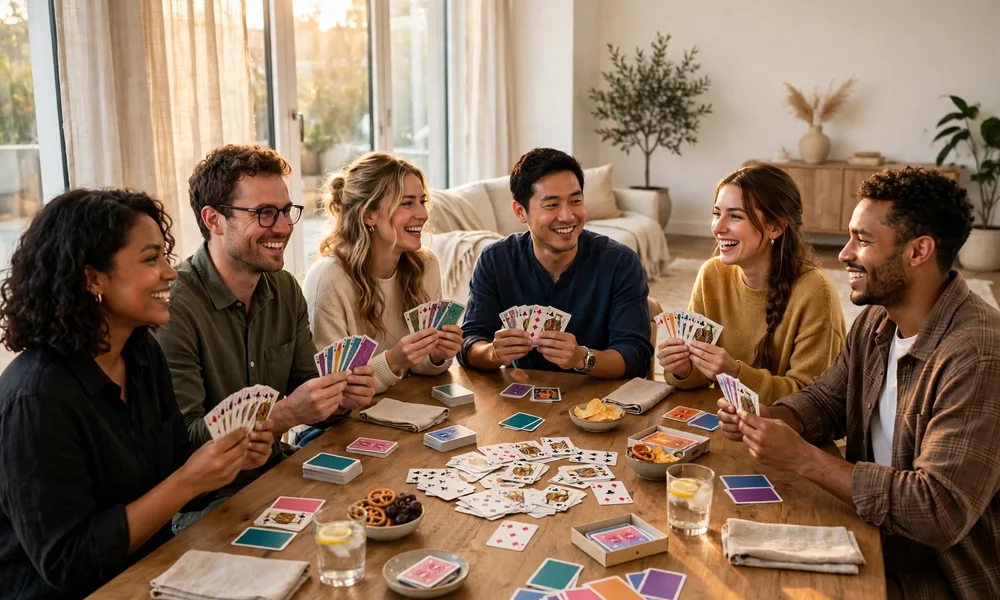
What Makes a Card Game Work for 18 Players
A game that works for eighteen people has to solve three problems at once. First, it must keep everyone involved. If players sit out for ten minutes between turns, the game has failed, no matter how clever its rules are.
Second, it has to move quickly. A game that takes two minutes per turn becomes a forty-minute round with eighteen players. Fast turns, simultaneous actions, and short rounds are essential.
Three Formats That Work
Large-group card games for eighteen players generally fall into three formats. The first is the all-play party game, where everyone participates at the same time. Hidden-role games, guessing games, and drawing games usually work this way. The second is the team game, where players form groups and compete together. Team play is the easiest way to stretch a game designed for fewer players up to eighteen. The third is the multi-deck classic, where a standard deck game scales simply by adding a second deck.
How We Picked These Games
Every game on this list was chosen because it genuinely works with eighteen players, not because it can be forced to fit. We looked at the official player counts, how the game handles large groups in practice, how long a full game takes, and how much downtime each player faces.
The 12 Best Card Games for 18 Players
1. Werewolf
Players: 7 to 20+ | Play time: 20 to 40 minutes | What you need: A Werewolf card set or a standard deck with role cards
Werewolf is the classic large-group hidden-role game, and eighteen players is close to its sweet spot. Most players are villagers, but a few are secretly werewolves trying to eliminate the village without being caught. Each round, the group debates, accuses, and votes to remove one player, while the werewolves strike at night. For a group that loves talking, bluffing, and laughing at wrong accusations, this is the single best card game for eighteen players.
2. Two Rooms and a Boom
Players: 6 to 30 | Play time: 15 to 20 minutes | What you need: The Two Rooms and a Boom card set
Two Rooms and a Boom was designed from the ground up for big groups, and eighteen players sits right in its comfort zone. The group splits into two rooms, and each player holds a secret role card. One team protects the president, the other tries to find the bomber, and players move between rooms in timed rounds while trading information. If your group enjoys strategy mixed with social chaos, this is one of the most memorable games you can play with eighteen people.
3. Fishbowl
Players: 6 to 20+ | Play time: 30 to 45 minutes | What you need: Paper, pens, and a bowl or hat
Fishbowl, also known as the Hat Game, is a free team game that scales beautifully to eighteen players. Each player writes a few words or famous names on slips of paper, and the slips go into a bowl. Teams take turns guessing the words across three rounds: describing them, acting them out with one word, and finally miming them in silence. It costs nothing, takes five minutes to set up, and consistently produces the loudest moments of any game night.
4. Monikers
Players: 4 to 20 | Play time: 30 to 60 minutes | What you need: A Monikers card set
Monikers is the polished, boxed version of the Fishbowl idea, and it supports up to twenty players straight out of the box. The deck is full of funny, well-chosen names, from celebrities to fictional characters. Teams take turns getting their teammates to guess the names, first with any words, then with a single word, then with silent gestures. With eighteen players, split into three teams of six for the best balance. It is one of the safest choices on this list for a mixed group of friends, family, or colleagues.
5. Cards Against Humanity
Players: 4 to 20+ | Play time: 30 to 90 minutes | What you need: A Cards Against Humanity base set
Cards Against Humanity is a fill-in-the-blank party game that thrives with a large crowd. One player reads a black question card, and everyone else submits a white answer card. The reader picks the funniest combination, and the winner keeps the black card as a point. The humour is deliberately adult and irreverent, so it suits groups of grown-ups who enjoy that style. More players means funnier and more surprising answer combinations, since every black card gets eighteen possible responses.
6. Codenames
Players: 4 to 20+ in teams | Play time: 15 to 30 minutes | What you need: A Codenames set
Codenames is a team word game where two spymasters give one-word clues to help their team find the right words on a grid of cards. With eighteen players, split into two teams of nine, with one spymaster per team and eight guessers on each side. The spymaster role suits quieter players who prefer thinking to shouting, while the guessing side suits the loud debaters.
7. Wavelength
Players: 2 to 12, or up to 20+ in teams | Play time: 20 to 40 minutes | What you need: A Wavelength set
Wavelength is a social guessing game built around a target on a spectrum. One player draws a card with two opposite ideas, such as hot versus cold, and gives a clue that places a hidden target somewhere on that scale. Their team then debates where the target sits and places a dial on the board. Officially, Wavelength supports up to twelve players, but it adapts to eighteen beautifully in teams. Split into two teams of nine, and the debate within each team becomes the whole game.
8. Telestrations
Players: 4 to 12 per set, or 18 with two sets | Play time: 20 to 30 minutes | What you need: Two Telestrations sets, or two tables of nine
Telestrations is the telephone game as a drawing game. Each player writes a word, passes it on, and the next player draws it. The drawing is passed on, the next player guesses the word, and the chain continues until every book comes back. The results are usually hilarious, especially when a simple word turns into something completely different after eight passes.
9. Uno
Players: 2 to 10 per deck, or 18 with two decks | Play time: 20 to 40 minutes | What you need: Two Uno decks
Uno is one of the most widely known card games in the world, and two decks are all it takes to stretch it to eighteen players. Shuffle two decks together, deal seven cards each, and play with the standard rules. The extra cards keep the draw pile healthy, and the familiar rules mean nobody needs a tutorial. For a family gathering or a mixed-age group, Uno is the most accessible game on this list.
10. President
Players: 4 to 18+ | Play time: 15 to 30 minutes per round | What you need: Two standard decks of playing cards
President, also known as Asshole or Scum, is a classic climbing card game that was made for large groups. The aim is simple: get rid of all your cards before anyone else. Players take turns playing cards higher than the previous play, and the first person out becomes the President, while the last person out becomes the lowest rank. With eighteen players and two decks, the game stays fast because each turn is a single quick decision. There is no downtime, since every player is watching the pile and planning their next move.
11. Cheat
Players: 3 to 18+ | Play time: 20 to 30 minutes | What you need: Two standard decks of playing cards
Cheat, also called I Doubt It, is a bluffing game that gets better with more players. Each player takes turns placing cards face down and announcing their rank, and they are allowed to lie. Any other player can call out a suspected lie, and the loser of the challenge picks up the whole pile. The first player to empty their hand wins. The game is pure social play: reading faces, spotting tells, and deciding when to take a risk.
12. Wits and Wagers
Players: 3 to 7 players or teams, or 18 in teams | Play time: 25 to 40 minutes | What you need: A Wits and Wagers set
Wits and Wagers is a trivia betting game where nobody needs to know the right answer to win. Each round asks a numerical question, such as how many calories are in a fast-food meal. Players write down their best guess, then bet on which answer is closest. The betting is where the game lives, and it rewards smart judgement rather than memorised facts. For eighteen players, split into six teams of three. Each team discusses its guess and places its bets together, which makes the game a proper team competition.
Card Games for 18 Players at a Glance
| Game | Players | Play Time | Best For | What You Need |
|---|---|---|---|---|
| Werewolf | 7 to 20+ | 20 to 40 min | Bluffing and debate | Role cards or a deck |
| Two Rooms and a Boom | 6 to 30 | 15 to 20 min | Strategy and chaos | Game set |
| Fishbowl | 6 to 20+ | 30 to 45 min | Free team fun | Paper and pens |
| Monikers | 4 to 20 | 30 to 60 min | Guessing and laughter | Game set |
| Cards Against Humanity | 4 to 20+ | 30 to 90 min | Adult humour | Game set |
| Codenames | 4 to 20+ in teams | 15 to 30 min | Team wordplay | Game set |
| Wavelength | Up to 20+ in teams | 20 to 40 min | Debate and discussion | Game set |
| Telestrations | 18 with two sets | 20 to 30 min | Drawing and creativity | Two game sets |
| Uno | 18 with two decks | 20 to 40 min | Family-friendly fun | Two Uno decks |
| President | 4 to 18+ | 15 to 30 min | Classic card play | Two standard decks |
| Cheat | 3 to 18+ | 20 to 30 min | Bluffing | Two standard decks |
| Wits and Wagers | 18 in teams | 25 to 40 min | Trivia and betting | Game set |
How to Run an 18-Player Card Game Night
A great game night with eighteen players needs a little planning, but not much. The most important decision is the shape of the evening. Pick one short warm-up game, one main game, and one relaxed closer. That structure gives the night a clear rhythm and stops the group from spending half the evening deciding what to play next.
Setting Up the Room
Eighteen players need more space than a single small table provides. A long dining table works well for most card games, and two smaller tables work even better for games that split into groups. Make sure everyone can see the centre of the table and reach the shared piles. If you are playing a game that needs two rooms, such as Two Rooms and a Boom, check that both spaces are comfortable before the night begins.
Keeping the Pace Brisk
The biggest risk with eighteen players is slow play. Appoint a host or moderator for the evening, and let that person keep rounds moving. Short rounds are your friend. Games that resolve in under five minutes per round keep the energy high and give everyone frequent chances to play.
If your group size changes from one night to the next, it helps to know how the same games adapt. Our guide to card games for 17 players covers many of the same titles with the small adjustments that work when one player drops out.
Tips for Choosing the Right Game for Your Group
Not every game suits every group, so match the game to the people in the room. A group of close friends who love teasing each other will enjoy bluffing games such as Werewolf and Cheat. A family group with a wide age range will do better with friendly games such as Uno, Telestrations, or Fishbowl. A work team or a group that has just met will enjoy team games such as Codenames and Wits and Wagers, where nobody is put on the spot alone.
For a slightly smaller crowd, the same approach works with a few tweaks. Our list of card games for 16 players shows how these large-group formats adapt when the table is a little smaller.
Your 18-Player Game Night Checklist
Use this checklist before the night begins so nothing is left to chance.
- Pick three games: a fast warm-up, one main event, and a relaxed closer.
- Check the player counts and make sure each game genuinely works for eighteen people.
- Split the group into teams in advance for team games, aiming for balanced sides.
- Set up enough table space so everyone can see the cards and reach the shared piles.
- Keep drinks and snacks on a side table to protect the cards from spills.
- Appoint a host to explain the rules, keep rounds moving, and settle any disputes quickly.
Frequently Asked Questions
What is the best card game for 18 players?
Werewolf is the strongest all-round choice for eighteen players because it is designed for large groups, everyone plays at once, and the debates keep the whole room involved. Fishbowl and Monikers are the best free and boxed alternatives if you prefer a team guessing game.
Can you play Uno with 18 players?
Yes, Uno works with eighteen players if you combine two decks. Shuffle both decks together, deal seven cards each, and play with the standard rules. The larger draw pile keeps the game moving, and the familiar rules mean nobody needs a tutorial.
What card games work for 18 players without buying anything?
Fishbowl, President, and Cheat all work for eighteen players with nothing more than paper, pens, and one or two standard decks of playing cards. Fishbowl is completely free, while President and Cheat need two decks to give every player enough cards.
How do you split 18 players into teams for card games?
The best splits are two teams of nine or three teams of six. Two teams of nine work well for Codenames and Wavelength, where large teams make the debates richer. Three teams of six suit Fishbowl, Monikers, and Wits and Wagers, where smaller teams get more turns. Try to balance each team with a mix of confident and quieter players.
Are party card games better than classic card games for 18 players?
Party card games usually work better for eighteen players because they are designed for simultaneous play and short rounds. Classic card games can work just as well, but they need the right format, such as two decks or team play.
How long should a card game night for 18 players last?
Plan for about two to three hours, including breaks. That gives you time for a short warm-up game, one main game, and a relaxed closer, with time to chat and eat between rounds. If you are planning a broader game night with other types of games too, our guide to party games for 16 players has ideas that pair well with the card games on this list.
The Bottom Line
The best card games for 18 players are the ones that keep everyone involved, move quickly, and are easy to teach. Werewolf leads the list for pure large-group energy, Fishbowl is the best free option, and Codenames is the strongest team game. Two decks turn classics such as Uno, President, and Cheat into excellent eighteen-player games, while team formats open up Wavelength and Wits and Wagers to the whole room.
With the right games, eighteen players is not a problem to solve. It is the reason the night will be memorable.


