
What if the biggest thing standing between you and a great garden isn’t sunlight, water, or luck, but the dirt itself? Ask any experienced grower and they’ll tell you the same thing: plants fail at the soil level long before they fail at the leaf level. The trouble is that soil is invisible chemistry. You can’t see a pH of 5.2 or a phosphorus deficiency just by looking at a bed. That’s where a soil test comes in, and it doesn’t have to cost a fortune.
Budget soil testing kits have improved a lot, but the cheap end of the market is also crowded with gadgets that look scientific and deliver nonsense. This guide walks through the three main kit types, what each one is genuinely good at, how to sample correctly, and where people waste money. It’s written for gardeners, allotment holders, and small-scale growers who want real information without a lab budget.
Why a Cheap Soil Test Beats Guessing

Most garden problems that get blamed on pests or weather are actually nutritional or pH-related. A plant sitting in soil at pH 5.0 can’t access nutrients that are physically present in the ground. No amount of fertilizer fixes that. A five-dollar test that reveals the pH problem is worth more than fifty dollars of the wrong amendment.
There’s also a money argument. Fertilizer, compost, and lime all cost something, and applying them blindly is how budgets quietly disappear. Testing first means buying only what the soil actually needs. For anyone already pinching pennies on garden tech, the same logic applies to the digital side of things: small teams hunting for affordable testing and verification tools can start with this roundup of low cost AI prompt testing tools for small teams on a budget and this guide to low cost email verification tools that actually work on a budget. The principle is identical: measure before you spend.
The Three Kinds of Budget Soil Test Kit

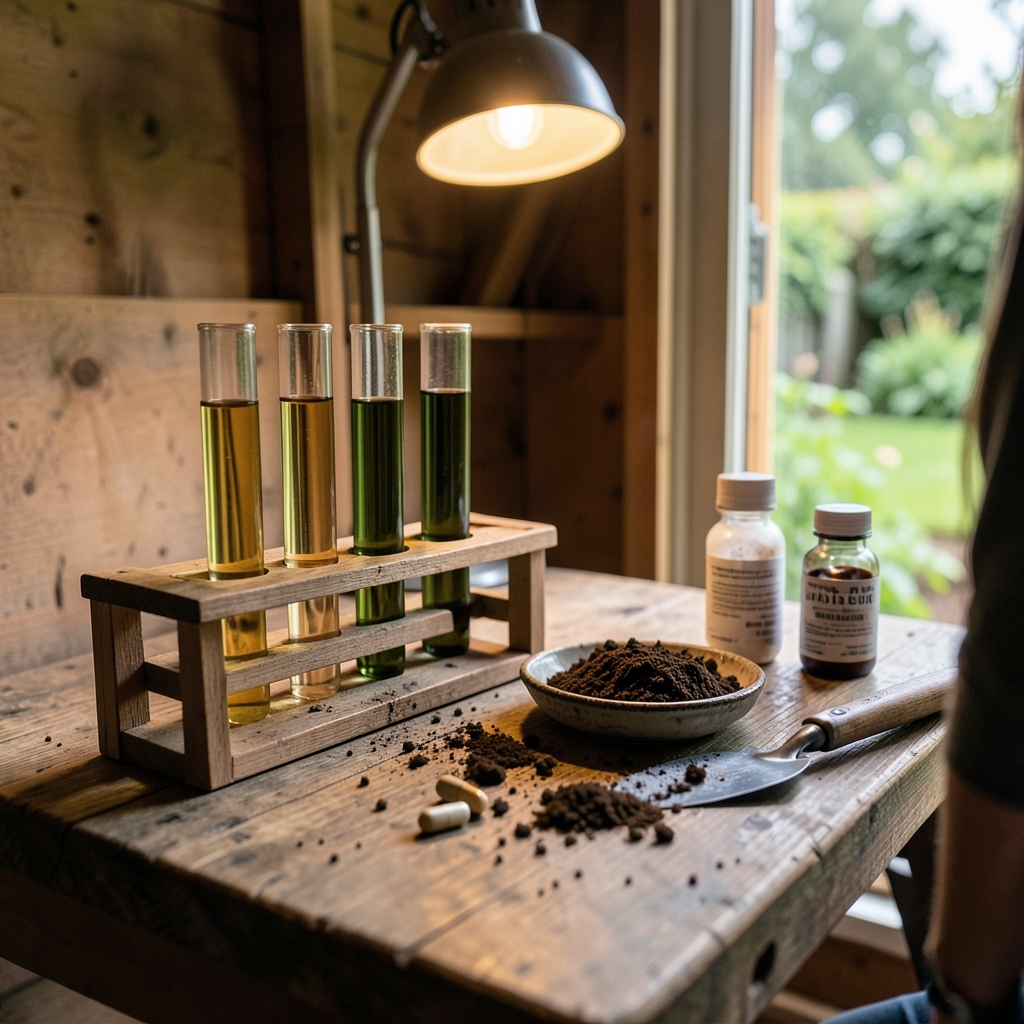
Almost every affordable kit on the market falls into one of three categories. Knowing which one you’re buying is half the battle, because they answer different questions.
Colorimetric chemical kits
These are the classic capsule-and-test-tube kits. You mix a soil sample with water or a reagent, add a colored powder or liquid, and compare the resulting color against a chart to estimate pH, nitrogen, phosphorus, and potassium.
What they’re good at: catching big problems. If your pH is wildly off or nitrogen is near zero, a colorimetric kit will usually show it. They’re cheap, require no batteries, and give you a rough N-P-K snapshot in under half an hour.
Where they fall short: precision. These kits are best described as semi-quantitative. The difference between two adjacent shades on a color chart is often larger than the actual difference in your soil. Treat the numbers as directional, not diagnostic. Never calculate a fertilizer rate from a color-match reading.
Electronic pen meters
These are the pocket-sized probes with a digital display, usually measuring pH and sometimes moisture or electrical conductivity. They’re fast, reusable, and satisfying to use.
What they’re good at: repeated pH checks. If you’re monitoring a compost pile, a raised bed, or a hydroponic reservoir, a pen meter lets you test weekly without buying refills.
Where they fall short: accuracy without calibration. A pH pen needs regular calibration against buffer solutions, typically pH 4.0 and 7.0, and inexpensive models drift over time. An uncalibrated meter can be confidently wrong, which is worse than no reading at all. If you buy one, budget for calibration solution and treat it as part of the kit.
Mail-in lab kits
You collect a sample at home, post it to a laboratory, and receive a report by email or app. The budget versions usually test pH plus major nutrients, and sometimes organic matter.
What they’re good at: comparability. Lab reports come back in standard units, with phosphorus and potassium often in parts per million or pounds per acre and organic matter as a percentage. Those units plug directly into fertilizer recommendations, which consumer color charts simply can’t do.
Where they fall short: turnaround time and per-test cost. You wait days or weeks for results, and if you want to retest after amending, you pay again.
Budget Soil Test Kit Comparison at a Glance
| Kit type | Typical cost level | Best for | Accuracy | Reusable |
|---|---|---|---|---|
| Colorimetric chemical kit | Lowest | One-off N-P-K and pH snapshot | Semi-quantitative | Limited refills |
| Electronic pH pen | Low to mid | Frequent pH monitoring | Good if calibrated | Yes, with calibration |
| Mail-in lab kit | Mid (per sample) | Fertilizer planning, record keeping | High, standard units | No, pay per test |
The honest takeaway: no single budget kit does everything. The most practical combination for most gardeners is a cheap chemical kit for a first look plus a mail-in test when a real decision is on the line.
What Budget Kits Cost and What You Get
Prices shift constantly and vary by region, so treat any specific figure with suspicion. What’s stable is the cost structure. Chemical kits are the cheapest entry point and often include enough reagents for several tests. Pen meters cost a little more up front but need calibration fluid, which is a recurring cost people forget to factor in. Mail-in kits are priced per sample, so the cost scales with how often you test.
A useful budgeting rule: decide how many tests you’ll realistically run in a season before buying. Someone testing three beds once a year is better served by a mail-in kit than by a pen meter that sits in a drawer slowly drifting out of calibration.
Sampling Method Matters More Than the Kit
Here’s the uncomfortable truth that kit manufacturers don’t put on the box: how you take the sample affects your result more than which brand you bought. A perfect lab test on a bad sample is a waste of money.
- Take multiple cores. A single scoop from one spot tells you about that spot, not your bed. Collect eight to twelve small subsamples from across the area and mix them in a clean bucket.
- Keep depth consistent. For lawns and garden beds, a depth of roughly six to eight inches is the usual guidance. Confirm the right depth for your specific use, since pasture and orchard sampling can differ.
- Avoid atypical zones. Skip spots near paths, compost heaps, fence lines, or where pets do their business. Those readings will skew your average.
- Use clean tools. A rusty trowel or a bucket with detergent residue can contaminate trace measurements. Stainless steel and plastic are safer.
- Sample at the right time. Testing before the growing season gives you time to amend. Testing right after heavy liming or fertilizing tells you almost nothing useful.
- Label everything. If you’re testing several beds, a strip of masking tape and a marker will save you from mixing up results.
The most common mistake is testing one spot and treating it as gospel. The second most common is testing immediately after adding amendments and then panicking at the reading.
Reading Results Without Overreacting
Most vegetables and many common crops perform best in a pH range of roughly 6.0 to 7.0, though plenty of plants tolerate more acidic or more alkaline conditions. If your reading lands outside that band, the fix is usually slow and cheap: lime to raise pH, elemental sulfur or organic matter to lower it, and time.
For nutrients, resist the urge to chase exact numbers from a colorimetric kit. Instead, ask whether the reading is broadly low, adequate, or high. Low nitrogen plus high phosphorus is a common pattern in over-fertilized gardens and calls for compost and patience, not another bag of bloom booster.
And if a reading looks impossible, retest before acting. Contaminated tools, distilled versus tap water, and sample depth all introduce error. One weird result is a data point. Two consistent results are a finding.
When to Skip the Budget Kit and Pay for a Lab
Budget kits have a ceiling. Step up to a proper lab test when:
- You’re making a significant investment in a new bed, orchard, or lawn renovation.
- You suspect contamination, such as lead near an older building or roadside soil.
- You need to prove a nutrient problem to claim a warranty or follow a professional plan.
- You’re managing a community garden or allotment site where multiple people need consistent data.
Laboratories that participate in proficiency testing programs, which check their results against reference samples, offer a level of confidence no home kit can match. For contamination questions especially, a professional test is not optional.
Practical Tips That Save Money
Buy refills, not new kits. Many chemical kits sell reagent refills separately, which is far cheaper than replacing the whole box.
Calibrate before you trust. If you buy a pH pen, buy the buffer solutions at the same time. A meter without calibration fluid is a random number generator with a screen.
Store reagents properly. Heat and moisture degrade chemical test reagents. A cool cupboard beats a hot shed.
Test the same beds at the same time each year. Trends matter more than single readings. A pH that’s drifting downward year over year is a story worth catching early.
Keep a simple log. Date, bed, readings, and what you added. Two seasons of notes will teach you more about your soil than any single test.
If you’re the type who likes structured comparisons before buying anything, the same discipline that makes a pricing comparison of AI prompt testing tools useful applies to garden gear: work out what you’ll actually pay over a year, beyond the checkout price. And teams comparing technical tools face the same trade-offs covered in this guide to technical SEO tools for small businesses on a practical budget.
Conclusion
The best budget soil testing kit isn’t the one with the most impressive box. It’s the one that matches the question you’re actually asking. Want a quick read on whether your beds are in the right ballpark? A cheap colorimetric kit will do that job for very little money. Want to monitor pH week to week? A calibrated pen meter earns its place. Making a real decision about fertilizer rates or a new planting area? A mail-in lab test is worth every cent.
Whatever you choose, spend your effort on sampling technique. Composite samples, consistent depth, clean tools, and a written log will do more for your garden than upgrading from a five-dollar kit to a fifty-dollar one. Test first, amend second, and let the soil tell you what it needs.
Frequently Asked Questions
Are cheap soil testing kits accurate enough to rely on?
For spotting large imbalances, yes. For precise fertilizer calculations, no. Colorimetric kits are semi-quantitative at best, so use them to identify broad problems and confirm details with a lab test before making significant amendments.
How often should I test my soil?
Once a year is plenty for most garden beds, ideally at the same time each season so you can compare trends. Test more often only if you’re actively correcting a major pH problem or monitoring a high-value crop.
Do I need to calibrate a budget pH meter?
Yes. Even inexpensive pH pens need regular calibration with buffer solutions, commonly pH 4.0 and 7.0. Without calibration, readings drift and can be confidently wrong, which is worse than having no meter at all.
Can I test soil in winter?
You can collect samples whenever the ground isn’t frozen, but results are most useful before the growing season so you have time to amend. Avoid testing right after applying lime or fertilizer, since the reading will reflect the amendment rather than the soil.
What’s the difference between a home kit and a lab test?
Home kits give fast, rough readings you interpret yourself. Lab tests return results in standard units, such as parts per million for phosphorus and potassium and percentage for organic matter, which map directly onto fertilizer recommendations and are far easier to compare year to year.
Is it worth testing soil before starting a new garden bed?
Absolutely. A single test before planting can reveal a pH problem or nutrient gap that would otherwise take a whole season to diagnose from plant symptoms. It’s the cheapest insurance a new bed can get.




