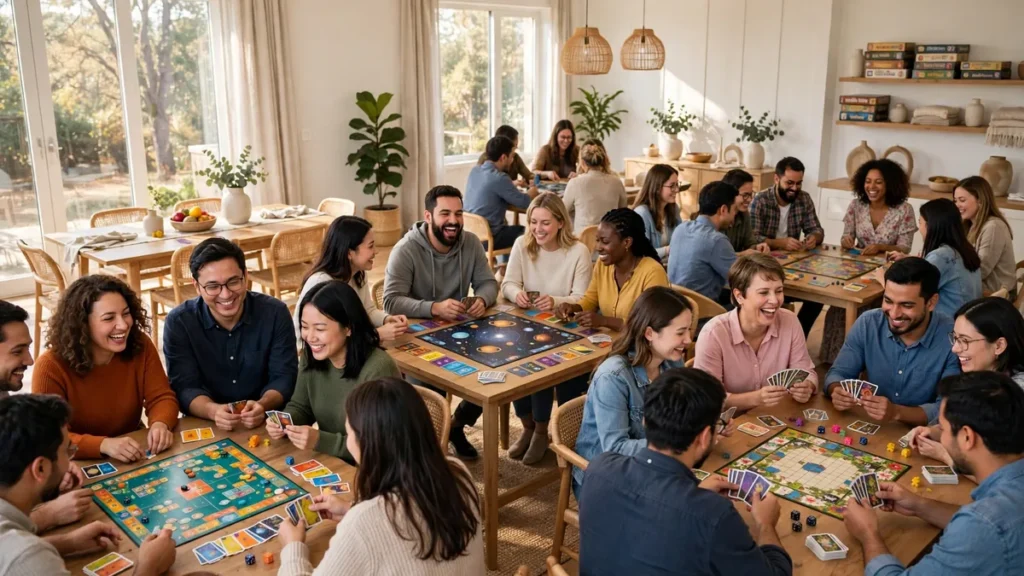
Finding the best board games for 29 players is very different from choosing a game for a family of four. Most board games are designed for two to six people, so a group of 29 cannot simply sit around one table and expect a normal game night to work. You need games that scale, a plan for splitting the group, and a format that keeps everyone involved.
The good news is that 29 is a wonderful number for a games night. It is large enough for proper teams, lively party games, and a real sense of occasion, yet small enough that one host can still organise it without hiring a venue. With the right mix of team games, table games, and rotation, 29 players can enjoy an evening that feels energetic from the first round to the last.
In this guide, we look at the games that genuinely work for 29 players, how to divide the group fairly, and how to avoid the mistakes that turn a big games night into a long wait between turns. Every recommendation below handles large numbers well, keeps the rules simple enough to explain in a few minutes, and creates shared moments that make people ask when the next night will be.
Key takeaways
- Do not try to play one standard board game with all 29 people at a single table. Split into teams or smaller tables.
- Team party games, social deduction games, and drawing and guessing games scale best for a group of 29.
- Plan for five or six tables of five or six players, or two large teams of fourteen and fifteen.
- Choose games with short turns and simultaneous play so nobody waits a long time between moves.
- Rotate tables or teams between rounds so everyone meets new people and tries different games.
Why 29 Players Changes the Way You Play
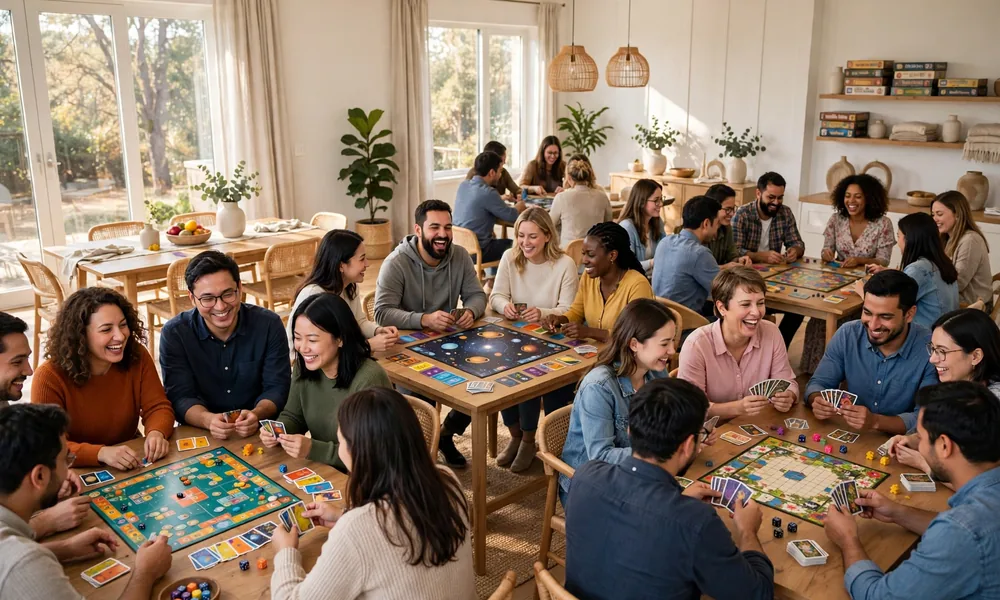
A group of 29 changes almost every assumption behind a normal board game. Turn order becomes a problem when one full round takes ten minutes. A single board becomes too small for everyone to see. Quiet players can disappear, while confident players can dominate the whole evening. The games that work best for 29 players are not always the games that are best for four players.
Space is the first change. Several smaller tables work far better than one large table, because each table becomes its own small game night within the larger event. Pace is the second change. Games with simultaneous play, where everyone writes, draws, or guesses at the same time, are ideal. Long strategy games with deep thinking between turns are best saved for a smaller night. The third change is social balance. The best games give everyone a role and reward teamwork rather than individual knowledge alone.
How to Organise 29 Players for a Games Night
Organisation matters more than the choice of any single game. Decide your format before guests arrive, and explain the plan in under two minutes.
Split Into Five or Six Tables
The simplest format is five tables of six players and one table of five, or six tables with four or five players each. Each table plays a different game, or the same game in parallel, and tables rotate after each round. Every game stays at its intended player count, turns stay short, and the host can visit each table in turn. It also lets you use games you already own, because you do not need a single game that supports 29 players. After thirty to forty minutes, rotate.
Play in Two Large Teams
Two teams of fourteen and fifteen players work brilliantly for party games, quizzes, and drawing games. One person from each team takes a turn while the rest of the team helps, guesses, or shouts out answers. This format creates a strong team spirit and works well in a single room, because everyone can see the same board or flip chart. It is ideal for the first game of the evening. Give each team a name, keep the rounds short, and change the active player often.
Use One Mega Game for the Whole Group
A small number of games are designed for very large groups. Social deduction games, for example, can involve twenty or more players in a single game, with everyone holding a secret role. These games work best when the group is comfortable with bluffing and discussion, and they need a confident host who can explain the rules clearly. Use a mega game once in the evening, as a headline event after a warm-up round, then split into tables. If the game involves elimination, use a short version, or set up a second table for eliminated players. For more ideas on scaling games up, see our guide to the best board games for large groups.
Best Board Games for 29 Players
The games below work as one large group, as two teams, or as several tables running at the same time.
Two Rooms and a Boom
Two Rooms and a Boom is one of the few games designed for very large groups, and it supports up to 30 players, which makes it a natural fit for 29. Players are split into two rooms and two teams, and each player holds a secret role card. The aim is to get your team leader into the same room as the other team leader, or to keep them apart, depending on your role. Rounds are timed, players swap rooms between rounds, and the game ends after three rounds. Everyone has a role, and the game takes about fifteen minutes to play.
Ultimate Werewolf
Ultimate Werewolf is a classic large-group game that can support dozens of players in a single game. A small number of werewolves secretly eliminate one player each night, while the village tries to work out who the werewolves are during the day. Players discuss, accuse, defend themselves, and vote, until either the werewolves or the villagers win. A group of 29 is large enough for several werewolves, several special roles, and a lively debate. The fun comes from conversation, not from a board. Play short rounds and set up a second table for eliminated players.
Codenames
Codenames is a team word game that works beautifully for 29 players in two large teams. A grid of twenty-five words is laid out, and each team has a spymaster who gives one-word clues to guide their team towards their own words and away from the other team words. The rest of the team discusses the clue, debates the options, and chooses a word together. The game takes about fifteen minutes. Change the spymaster each round, and run two games side by side with a second copy if you prefer smaller teams.
Wavelength
Wavelength is a party game about opinions, discussion, and reading the room. One player draws a card with two opposite ideas, such as hot and cold, and places a target on a scale between them. Their team then discusses where the target might be, using the clue word the player gives. The game rewards conversation and shared understanding rather than general knowledge, which makes it welcoming for mixed groups. With 29 players, play in two teams or in several tables of six or seven, and change the clue giver often.
Telestrations
Telestrations is a drawing and guessing game that combines sketching with a game of telephone. Each player draws a word, passes the sketchbook to the next player, who guesses the word and writes it down, and the book keeps moving around the table until it returns to its owner. The results are often hilarious, because a simple word can change beyond recognition after a few rounds. The standard game supports up to eight players, so for 29 players you need several copies or several tables. Four tables of seven or eight players work well, and drawing skill does not matter.
Monikers
Monikers is a party game in three rounds that uses the same set of cards each time. In the first round, players describe a person or character without saying the name. In the second round, they can use only one word. In the third round, they can only act it out. The cards stay the same, so players remember the clues from earlier rounds and the game gets faster and funnier as it goes on. For 29 players, play in two teams, with players taking turns to describe cards while their team guesses. The game takes about thirty to sixty minutes.
Wits and Wagers
Wits and Wagers is a trivia-style game that does not require players to know the answers. Each question asks for a number, and players write down their best guess. The guesses are laid out in order, players bet on the answer they think is closest, and points are awarded for correct bets. Because the game rewards smart betting rather than exact knowledge, everyone can play. It suits 29 players because it can be played in teams, and takes about twenty-five minutes.
Dixit, Herd Mentality, Just One, and The Resistance
Dixit is a storytelling game in which players use illustrated cards to give clues that are suggestive but not too obvious. It is best played in tables of five or six, so for 29 players you need several copies. It suits a quieter part of the evening, and takes about thirty minutes. Herd Mentality is a simple party game with one aim: think like everyone else. Each round, a question is read out and every player writes down an answer. If your answer matches the majority, you score points. It supports up to twenty players, so run two tables or two teams for 29.
Just One is a cooperative word game in which players work together to guess a mystery word. One player is the guesser, and the other players write a one-word clue each. Any identical clues are removed before the guesser sees them, so players must think of original hints. The standard game supports up to seven players, so use four or five tables of six. The Resistance is a social deduction game for five to ten players, perfect for the table format. Players are secretly divided into loyal members and spies, and the group votes on teams to complete missions. Run three or four tables of seven or eight, and rotate players between tables after each game.
Comparison Table: Best Board Games for 29 Players
Use this table to choose the right game for your group, your space, and your time.
| Game | Best format for 29 | Playing time | Why it works for 29 |
|---|---|---|---|
| Two Rooms and a Boom | One group of 29 | 15 minutes | Designed for up to 30 players |
| Ultimate Werewolf | One group of 29 | 30 to 45 minutes | Discussion-based, very social |
| Codenames | Two teams of 14 and 15 | 15 minutes | Team discussion, fast rounds |
| Wavelength | Two teams or tables | 20 to 30 minutes | Opinion-based, welcoming |
| Telestrations | Four tables of 7 or 8 | 30 minutes | Drawing, funny, low pressure |
| Monikers | Two teams of 14 and 15 | 30 to 60 minutes | Three rounds, team spirit |
| Wits and Wagers | Two teams or one group | 25 minutes | Betting rewards judgement |
| Dixit | Five tables of 5 or 6 | 30 minutes | Creative, gentle pace |
| Herd Mentality | Two tables or teams | 20 minutes | Simple, quick rounds |
| Just One | Five tables of 5 or 6 | 20 minutes | Cooperative, easy to learn |
| The Resistance | Four tables of 7 or 8 | 30 minutes | Secret roles, high replay value |
How to Run a Smooth Games Night for 29 Players
Begin with a short warm-up that involves the whole group, such as a team word game. A warm-up breaks the ice and gives late arrivals time to settle in. Keep it to twenty minutes or less. Explain only what players need to know to start, and answer questions as you play.
Use a visible timer to keep every table on pace, and set a clear time for each round, such as thirty minutes per table game. A simple schedule, such as a warm-up, two table rounds, and a final team game, gives the evening a clear shape. Choose snacks that are easy to eat without sticky fingers, place drinks away from the boards, and plan a break in the middle. If your group is slightly smaller on another night, the same ideas still apply. Our guide to the best board games for 20 players shows how the formats change with nine fewer players.
Common Mistakes to Avoid With 29 Players
The most common mistake is choosing a game that is excellent for four players and trying to stretch it to 29. Long strategy games, games with a single small board, and games where one player takes a long turn while everyone else waits are poor choices for a large group. Save those games for a smaller night. Another mistake is leaving the organisation to chance, so players cluster with people they already know and some tables fill up while others stay empty. A third mistake is playing only one game for the whole evening. Plan at least three different games, and avoid games that rely on specialist knowledge or fast reflexes alone.
Checklist for a 29-Player Games Night
Use this checklist when you plan your evening.
- Choose three or four games that suit 29 players, with a mix of team games and table games.
- Decide the format in advance: five or six tables, two large teams, or one mega game followed by tables.
- Check that you have enough copies, cards, and pieces for every table, and borrow extra copies if needed.
- Set up the tables, chairs, lighting, and snacks before guests arrive, with drinks kept away from the boards.
- Prepare a simple schedule with a warm-up game, two table rounds, and a final team game, plus a break in the middle.
- Appoint a host or a table captain for each table, so rules questions are answered quickly and the pace stays brisk.
Frequently Asked Questions
Can you play a board game with 29 players at one table?
Most board games are not designed for 29 players at one table, because the board is too small, turns take too long, and many players cannot see the pieces. A few social deduction games can work as one group, but the best approach is usually to split into teams or tables.
What is the best game for 29 players?
Two Rooms and a Boom is the best single game for 29 players, because it is designed for up to 30 players and gives everyone a role. For a team game, Codenames is an excellent choice, and for table play, a mix of Telestrations, Just One, and the Resistance works well.
How do you split 29 players into teams fairly?
Split 29 players into two teams of fourteen and fifteen, or into five tables of six and one table of five. Mix experienced and new players, mix friends who already know each other with people meeting for the first time, and change the teams or tables between rounds. Keep the teams balanced by skill and confidence, not just by numbers.
How long does a games night for 29 players take?
A good games night for 29 players takes about two and a half to three hours, including a warm-up, two or three main games, and a break. Each game should take twenty to forty minutes, with time to explain the rules and rotate tables.
Do you need special equipment for 29 players?
You do not need special equipment, but you do need enough tables, chairs, and copies of the games. For team games, a whiteboard helps everyone see the clues and scores. For table games, make sure each table has its own copy of the game, pens for scoring, and a timer.
What games should you avoid with 29 players?
Avoid long strategy games with slow turns, games with a single small board that only a few players can see, and games that eliminate players for a long time. Also avoid games that rely on specialist knowledge or fast reflexes alone.
If you want to see how the same ideas work with fewer players, read our guide to the best board games for 15 players.
Bottom Line
The best board games for 29 players are the ones that turn a large group into an advantage. Split into teams or tables, choose games with short turns and simultaneous play, and mix social deduction, word, drawing, and guessing games so everyone has a game they enjoy. With Two Rooms and a Boom for the whole group, Codenames for team play, and Telestrations, Just One, and the Resistance for table rounds, 29 players can enjoy a fast, funny, and social evening where nobody waits long and nobody is left out.


