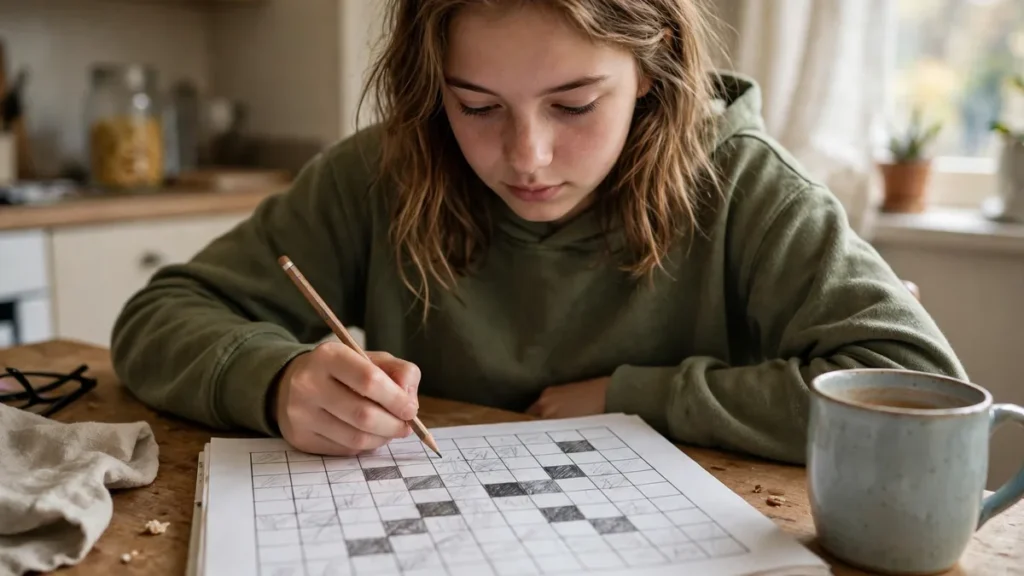
My answer in one paragraph
Yes, with conditions. A logic puzzle is one of the few pastimes that asks a teenager to reason rather than recall, and that distinction is the case for it. A crossword tests what you already know. A quiz tests what you remember. A logic grid hands you every fact you need and asks you to work out what must follow from them. Teenagers who do that regularly get practised at ruling out impossible answers, keeping several facts in play at once, and checking their own work before declaring themselves done. But the benefit is narrow and fragile. It vanishes when the puzzles are far too easy, when they crowd out the studying they were meant to support, or when an app turns a quiet hobby into a daily streak a teenager feels guilty about breaking.
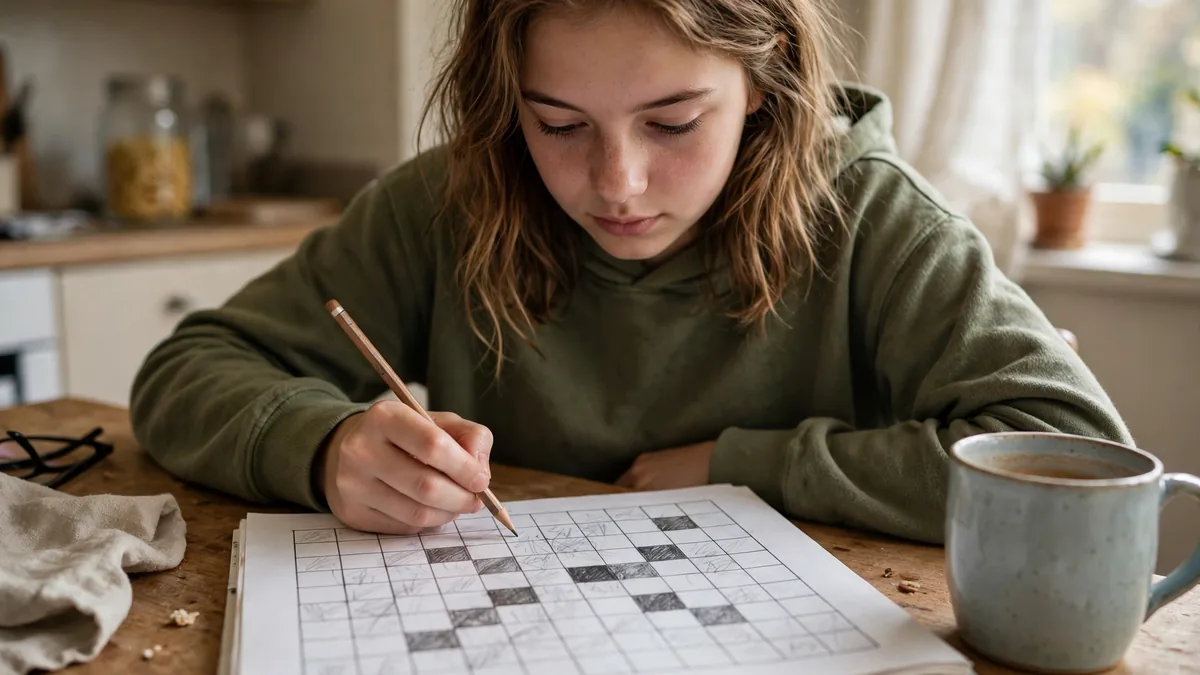
Why the teenage years are the right window
Logic puzzles land differently at fourteen than at nine. Younger children can follow a rule and spot a pattern, but the thinking a grid demands, asking what would have to be true if a particular clue holds, only really beds in during adolescence, and school starts asking for it at the same time. A science teacher wants to know what would change if one variable moved. A maths teacher wants a proof, which is just a demand to show that each step follows from the one before. A teenager who has spent months working through grids has rehearsed that move dozens of times, in private, with nothing at stake.
Four moves a grid teaches
The case rests on four specific moves, and naming them matters, because vague claims about brain training are worth nothing.
The first is elimination. Most of a logic puzzle is spent deciding what cannot be true, and teenagers underuse that move everywhere else. In a multiple-choice question, the student who can confidently discard two wrong options has already doubled their odds. A grid makes elimination the whole game: every clue removes possibilities, and the answer is whatever survives.
The second is juggling facts. A logic puzzle rarely surrenders to a single clue. The solver has to carry three or four established facts while testing a fifth against them, and that is working memory doing its job, the same capacity a teenager needs for a multi-step maths problem. It is effortful, and it gets less effortful with practice.
The third is verification. A logic puzzle punishes the solver who stops at the first answer that looks plausible, because the remaining clues will contradict it. Teenagers who learn that habit start applying it without thinking: rereading the question after finishing an answer, checking units in a calculation, noticing that an essay conclusion does not follow from its argument.
The fourth is the cheapest lesson of all: being wrong in private. A logic puzzle lets a teenager try an idea, watch it collapse, and start again, all within a few minutes and with nobody watching. Teenagers who dread being wrong tend to avoid hard problems altogether, which is the worst possible strategy for learning. A puzzle habit gives them a quiet place to practise error and recovery until it stops feeling like failure.
Do they help at school?
Parents usually ask the exam question first, so here is a straight answer. Logic puzzles do not teach subject content. No amount of Sudoku will teach French vocabulary, and anyone who suggests otherwise is overselling. What they can improve is the way a teenager approaches the questions in front of them, and that is a real, if limited, benefit.
The clearest gain is in reading the question properly. Logic puzzles turn on tiny words: not, only, always, except. Miss one, and the whole grid goes wrong. Teenagers who solve grids regularly start reading exam questions with the same care, because they have felt the cost of skimming. Many lost exam marks come not from ignorance but from answering a slightly different question from the one that was set.
The second gain is in multi-step problems. A logic puzzle cannot be solved in one leap; it has to be worked through in stages, with each stage depending on the last. That is the shape of most hard exam questions. Teenagers used to that shape are less likely to panic when a question does not yield at once: establish what is certain, discard what is impossible, and take the next small step.
None of this makes puzzles a stand-in for revision. A grid slotted between study blocks is a genuine aid; a whole evening of grids on the eve of an exam is work dodged. The difference shows in what follows: a useful break sends the teenager back to their notes with more attention to spare, while a dodged evening just leaves less night for the notes themselves.
The phone in the room
Logic puzzles now live in two worlds, paper books and phone apps, and the device changes the experience more than most people admit.
Paper has one great advantage: it finishes. A book has a fixed number of pages, a puzzle has a fixed number of clues, and when it is done, it is done. There is nothing to scroll to and no notification waiting. For a teenager whose attention is tugged in a dozen directions all day, that fixed boundary is genuinely restful.
Apps have genuine advantages too. They tune the difficulty, mark answers at once, and live in a pocket, so for a teenager who would never buy a puzzle book, an app may be the only route in.
The trouble is what apps bring with them. Notifications, streak counters, leaderboards, and the ever-present option to switch to a video or a message thread. A logic puzzle app sits one tap away from everything designed to capture a teenager’s attention, and the puzzle itself is often designed to keep the teenager tapping.
The workable compromise is simple. Paper first, when it is available, especially in the evening and during exam season. Apps are fine for a bus journey or a waiting room. If a teenager insists on the app, switching off its notifications and ignoring the streak counter removes most of the harm.

A field guide to the kinds that click with teens
The classic grid is a good starting point, but it is only one branch of the family, and matching the branch to the teenager is half the battle.
Sudoku and its cousins suit teenagers who like numbers and patterns. Killer Sudoku adds arithmetic to the logic, nonograms use row and column numbers to reveal a hidden picture for visual teenagers, and KenKen combines arithmetic with elimination for teenagers who enjoy maths but dislike its homework form.
Murder-mystery grids suit teenagers who love stories. These present a crime, a set of suspects, and a tangle of clues, and the solver has to work out who did it and how. Escape-room puzzle books work the same way. For a teenager who would never pick up a plain grid, a mystery can be the doorway in, because the reasoning is identical and the motivation is far stronger.
A sensible ladder looks like this. At thirteen to fifteen, short grids, four-by-four Sudoku, and simple mystery puzzles. At sixteen to eighteen, full Sudoku, Killer Sudoku, nonograms, longer mystery grids, and timed challenges against friends. The teenager should be choosing, not being assigned. A puzzle a teenager picks for themselves is far likelier to get finished than one handed over like homework, and choosing is itself part of learning which kind of thinking they enjoy.
For a teenager who wants to try the habit without spending anything, our free printable logic puzzles are a low-pressure place to start, with answers included. And if the habit catches on, our guide to starting a puzzle club shows how to turn a solo habit into a regular social one.
Five ways the habit turns sour
A fair opinion has to include the ways a good thing goes wrong, so here are five to watch for.
First, displacement. Two hours on grids the night before an exam is not downtime. It is revision postponed behind a respectable-looking activity. Ask what the session produced: a teenager who goes back to their notes with a clearer head used the puzzle well, while one who simply ran the clock down used it as a shield. When the second pattern repeats, the notes need to come first.
Second, perfectionism. Some teenagers cannot bear an unsolved puzzle. They will sit with it for an hour, growing more frustrated, refusing a hint, refusing to put it down, because leaving it unfinished feels like failure. That is not patience. The remedy is a rule agreed in advance: twenty minutes, then a hint, then put it down and come back tomorrow.
Third, comparison. Leaderboards, timed challenges, and friends who solve faster can turn a quiet hobby into another arena where a teenager feels measured and found wanting. A logic puzzle should be one of the few places where nobody is watching and nobody is keeping score. If a teenager starts dreading the puzzle because of how they compare, the competitive element should go, not the puzzle.
Fourth, the grind. Streak counters and daily challenges are designed to make a teenager feel guilty for missing a day. A teenager who solves grids to protect a streak is no longer solving for pleasure or for practice. They are doing homework for an app.
Fifth, the difficulty cliff. A teenager who jumps from easy puzzles to very hard ones can go from success to repeated failure in a single afternoon, and the confidence built over weeks can drain away quickly. Difficulty should rise one small step at a time, and a teenager who is struggling should be allowed to step back down without it being treated as a defeat.
A weekly shape that holds
For a teenager who wants to try, the routine that works best is deliberately modest: a quarter of an hour, a few evenings a week, sustained over a couple of months. Little and often is what beds the habit in.
The best slot is a settled part of the day rather than an exhausted one: after homework, before bed, or in the gap between revision sessions. A grid used as a pause between study blocks works particularly well, because it absorbs attention fully and then stops, unlike a feed. Our round-up of the best mind games for teens is a useful shelf to browse together when the teenager is ready to branch out beyond logic grids.
Frequently asked questions
How often should a teenager do logic puzzles? A quarter of an hour, a few times a week, is plenty. Little and often is what makes the habit stick, and it leaves room for the rest of a teenager’s week.
Do puzzle apps work as well as printed puzzles? Apps are convenient and they tune difficulty well, but they arrive with notifications, streak counters, and every other app one tap away. A printed puzzle has a definite end and no phone in the frame. Use apps for travel and waiting rooms, and paper at home when you can.
Can logic puzzles help with exam revision? They work as a pause between study blocks, not as a stand-in for studying. A short puzzle lets the mind reset, so the next round of revision goes better. They cannot teach the material itself, and a teenager who puzzles in place of revising is dodging the work.
What if my teenager calls logic puzzles boring? The ones they have been shown probably deserve it. Try another branch: a murder-mystery grid, an escape-room book, a nonogram, or a timed challenge against a friend. The dullness is usually in the particular puzzle, not in logic puzzles as a whole.
The bottom line
So, do they earn their place in a teenager’s week? Yes, under the conditions this piece has laid out. They give a teenager regular, low-stakes practice at elimination, at carrying several facts in mind, at checking work, and at being wrong cheaply. Those are real skills, and they show up in exams and in any problem worked through in stages. They also offer a genuine change of pace from screens.
They are not magic. On their own they lift no grades and mend no serious stress. They turn sour when they displace revision, when a leaderboard turns them into a contest, when perfectionism makes an unsolved grid feel like a failure, or when the difficulty leaps too far too fast.
The honest answer, then, turns on fit rather than on puzzles in the abstract: the right branch, the right difficulty, picked by the teenager, done mostly on paper, in brief regular sessions, with permission to set a puzzle aside and return tomorrow. A teenager with that arrangement has something small and genuinely useful: a way of thinking clearly and finishing something.