Are you ready to challenge your brain with clever word puzzles? Rebus puzzles are a fun way to test your observation, vocabulary, and creative thinking. They use letters, numbers, symbols, and word arrangements to represent familiar phrases and expressions.
The interesting part is that the answer is not always hidden in the words themselves. Sometimes, the position of a word, a repeated letter, or an unusual arrangement reveals the meaning.
Whether you enjoy solving brain teasers alone or challenging friends and family, these 30 rebus puzzles with answers offer a fun mix of easy, medium, and challenging wordplay. If you enjoy visual challenges too, try guess the object zoomed in and see how quickly you can recognize everyday items from a closer look.
Try to solve each puzzle before looking at its answer!
What Are Rebus Puzzles?
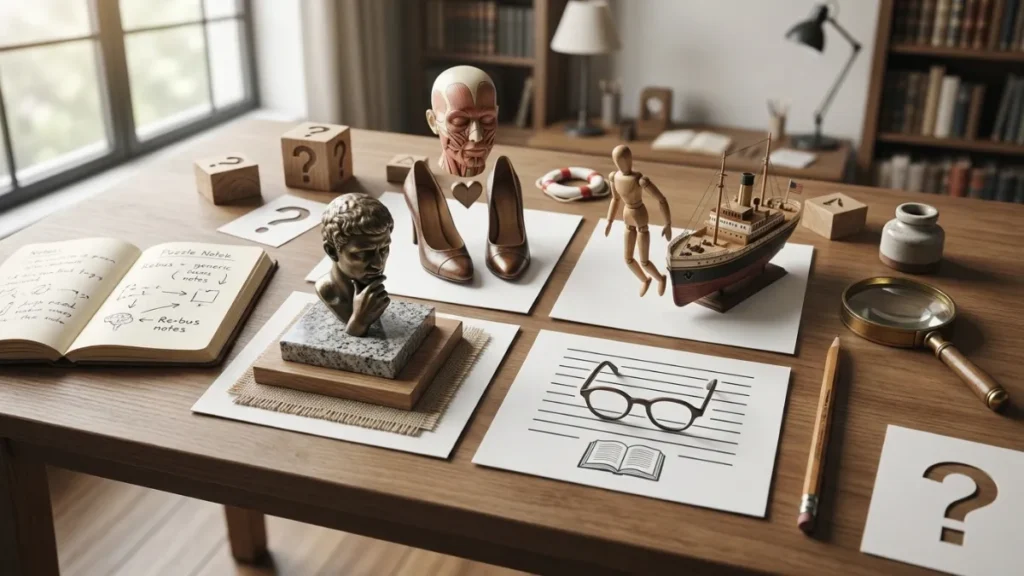
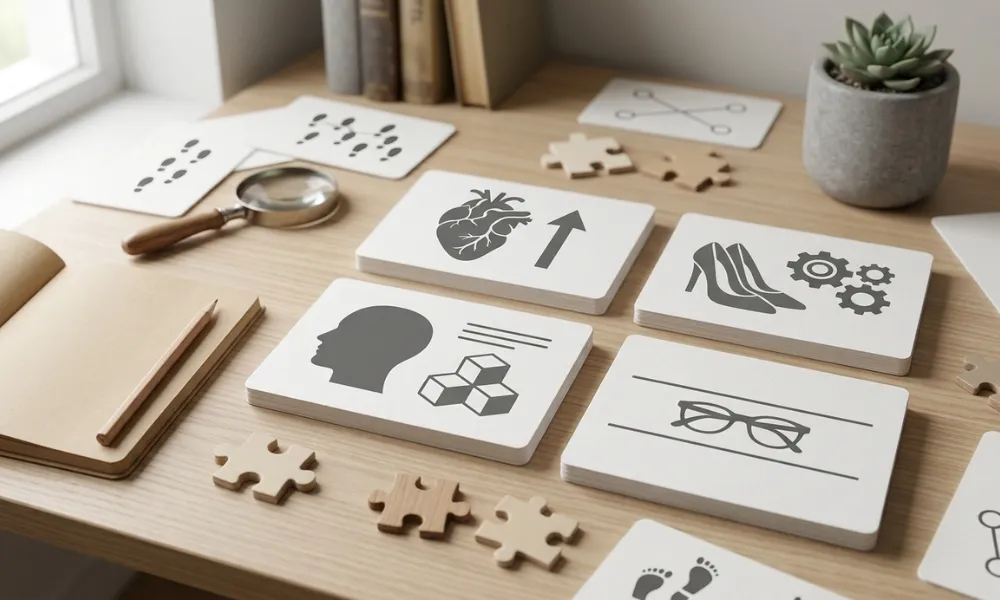 Rebus puzzles are visual word puzzles that use letters, numbers, symbols, and the positioning of words to represent a word, phrase, or common expression.
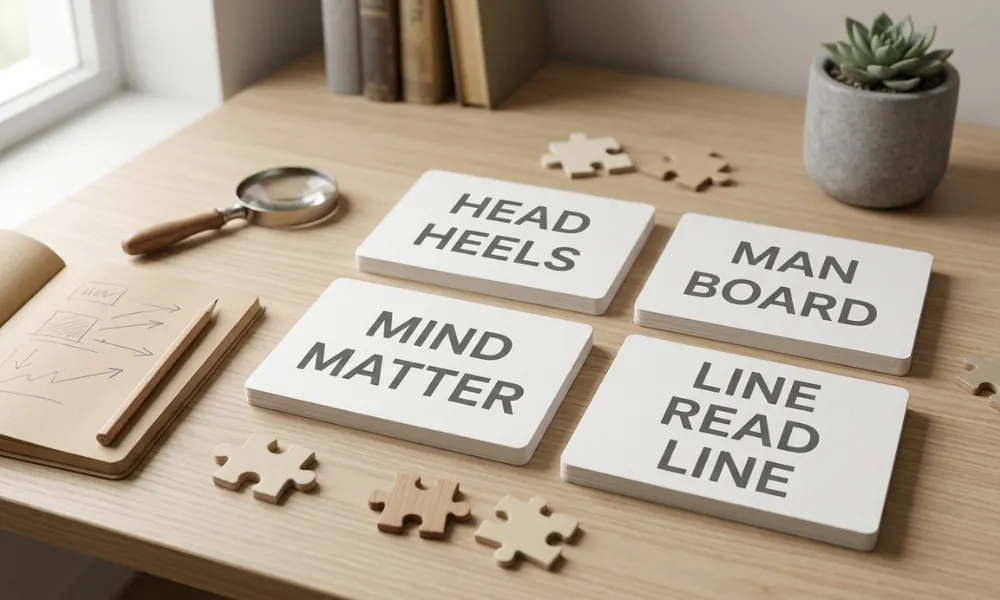
For example, placing the word HEAD above the word HEELS represents the expression “head over heels.”
The key is to look at the complete arrangement rather than reading each word separately. A word might be upside down, repeated, placed inside another word, or positioned above or below something to reveal a hidden meaning.
Rebus puzzles are popular in quizzes, classrooms, family games, and brain-training activities because they combine language skills with creative problem-solving.
30 Rebus Puzzles With Answers
The following puzzles are divided into three difficulty levels. Start with the easy ones and see how many you can solve without checking the answers.
Easy Rebus Puzzles
1. I Understand
STAND
  I
Answer: I understand.
Explanation: The letter I is under the word STAND, creating “I under stand.”
2. Man Overboard
MAN
BOARD
Answer: Man overboard.
Explanation: MAN is positioned over BOARD.
3. Head Over Heels
HEAD
HEELS
Answer: Head over heels.
Explanation: HEAD appears above HEELS, representing the familiar expression.
4. Mind Over Matter
MIND
MATTER
Answer: Mind over matter.
Explanation: MIND is placed above MATTER.
5. Backward Glance
ECNALGAnswer: Backward glance.
Explanation: GLANCE is written backward.
6. Bicycle
CYCLE
CYCLE
Answer: Bicycle.
Explanation: Two CYCLE words represent the two wheels of a bicycle.
7. Tricycle
CYCLE
CYCLE
CYCLE
Answer: Tricycle.
Explanation: Three CYCLE words represent the three wheels of a tricycle.
8. Read Between the Lines
LINE
READ
LINE
Answer: Read between the lines.
Explanation: READ is positioned between two LINE words.
9. Top Secret
TOP
SECRET
Answer: Top secret.
Explanation: TOP is placed above SECRET.
10. Downtown
DOWN
TOWN
Answer: Downtown.
Explanation: DOWN appears above TOWN, representing the word downtown.
Medium Rebus Puzzles
 These puzzles require a little more attention. Look at how the words are arranged and consider how their positions affect their meanings.
11. Once Upon a Time
ONCE
UPON
 A
TIME
Answer: Once upon a time.
Explanation: The words appear in the same sequence as the familiar expression.
12. Broken Heart
BROKEN
  ♥
Answer: Broken heart.
Explanation: The word BROKEN appears above a heart symbol, representing a broken heart. The heart symbol is intended as the visual representation of the phrase.
13. Upside Down
DOWN
  ↑
Answer: Upside down.
Explanation: The upward arrow appears with the word DOWN, suggesting the expression “upside down.”
14. One in a Million
MILL1ONAnswer: One in a million.
Explanation: The number 1 replaces the word ONE inside MILLION.
15. Four Seasons
SEASON
SEASON
SEASON
SEASON
Answer: Four seasons.
Explanation: The word SEASON appears four times.
16. Three Times
TIME
TIME
TIME
Answer: Three times.
Explanation: TIME appears three times.
17. Two-Faced
FACE
FACE
Answer: Two-faced.
Explanation: Two occurrences of FACE represent two faces.
18. Crossroads
    |
----+----
    |
Answer: Crossroads.
Explanation: The intersecting lines represent two roads crossing.
19. Far Apart
FAR APARTAnswer: Far apart.
Explanation: FAR and APART are separated by a large space.
20. Side by Side
SIDE SIDEAnswer: Side by side.
Explanation: The two SIDE words are positioned next to each other.
Hard Rebus Puzzles
The final ten puzzles are designed to make you think more carefully. Pay attention to the placement of each word, the direction of the letters, and the use of symbols.
21. Inside
+----------------+
|                |
|      IN        |
|                |
+----------------+
Answer: In a box.
Explanation: IN is positioned inside a box. This is a literal visual rebus for “in a box.”
22. Overlook
OVER
LOOK
Answer: Overlook.
Explanation: OVER is placed above LOOK, representing the compound word OVERLOOK.
23. Underestimate
UNDER
  ESTIMATE
Answer: Underestimate.
Explanation: UNDER is positioned above the word ESTIMATE, representing the word underestimate.
24. Falling
F
A
L
L
I
N
G
Answer: Falling.
Explanation: The letters of FALLING are arranged vertically, suggesting something falling downward.
25. Long Time
L
O
N
G

T
I
M
E
Answer: Long time.
Explanation: LONG and TIME are written vertically, emphasizing the idea of a long period of time.
26. High Five
HIGH
  5
Answer: High five.
Explanation: HIGH appears above the number 5, which is pronounced “five.”
27. Second to None
2
TO
NONE
Answer: Second to none.
Explanation: The number 2 represents “second,” followed by TO and NONE.
28. See You Later
C U L8RAnswer: See you later.
Explanation: C sounds like “see,” U sounds like “you,” and L8R represents “later.”
29. Before You
B4UAnswer: Before you.
Explanation: B4U uses the number 4 as a sound-based substitute for “fore,” creating “before you.”
30. Today
2DAYAnswer: Today.
Explanation: The number 2 sounds like “to,” so 2DAY reads as “today.”
Tips for Solving Rebus Puzzles
Finding the answer to a rebus puzzle becomes easier when you know what to look for. Use these tips to improve your puzzle-solving skills, and challenge your friends with these best friend quiz questions to see how well you know each other.
1. Pay Attention to Word Position
The position of a word can completely change its meaning. A word above another may suggest “over,” while a word below something may suggest “under.”
2. Look for Repeated Words
Count how many times a word or letter appears. Repetition may represent a number or a familiar expression.
3. Notice Unusual Spacing
Words placed far apart, close together, or inside a shape may represent expressions related to distance, position, or location.
4. Read Words in Different Directions
A word written backward or vertically may suggest a hidden meaning. Check whether the direction of the letters is important.
5. Think of Familiar Expressions
Many rebus puzzles use common idioms, sayings, and everyday phrases. Consider familiar expressions that fit the arrangement.
Why Are Rebus Puzzles Good for Your Brain?
Rebus puzzles are entertaining, but they also encourage several useful thinking skills.
- Creative thinking: They encourage you to connect words and symbols in unexpected ways.
- Observation: They help you notice small details in word placement and arrangement.
- Vocabulary: They expose you to common expressions, phrases, and wordplay.
- Problem-solving: They encourage you to test different interpretations before choosing an answer.
- Mental engagement: They offer an enjoyable way to keep your mind active.
They are also a great activity for classrooms, family game nights, parties, and friendly competitions.
Final Thoughts
Rebus puzzles are a creative way to turn ordinary words, numbers, and symbols into entertaining brain teasers. From simple word arrangements to sound-based clues, each challenge encourages you to look beyond the obvious.
These 30 rebus puzzles with answers provide a mixture of familiar expressions and visual wordplay for beginners and experienced puzzle lovers.
Try solving them with friends, challenge your family, or use them during your next quiz night. For even more entertainment on your next journey, explore these 25 best road trip games to keep everyone engaged. Remember to look carefully at every detail because even a small change in position can reveal the hidden answer!
Frequently Asked Questions
1. What is a rebus puzzle?
A rebus puzzle is a visual word puzzle that uses letters, numbers, symbols, and word arrangements to represent a hidden word or phrase.
2. Are rebus puzzles good for adults?
Yes. Rebus puzzles for adults provide an entertaining way to practice observation, vocabulary, creative thinking, and problem-solving.
3. How do you solve a rebus puzzle?
Look carefully at the words, letters, symbols, and their positions. Check for repetition, unusual spacing, reversed words, and familiar expressions that could match the arrangement.
4. What is the difference between rebus puzzles and regular word puzzles?
Regular word puzzles often use definitions, spelling, or written clues. Rebus puzzles rely on the visual arrangement of words, letters, numbers, and symbols to communicate a hidden meaning.
5. Where can I use rebus puzzles?
You can use rebus puzzles in classrooms, family game nights, birthday parties, team-building activities, quizzes, and other social gatherings.
Disclaimer: These puzzles are intended for entertainment and recreational use. Some are based on sound-based wordplay or compound words, so preserve their spacing and formatting when displaying them.