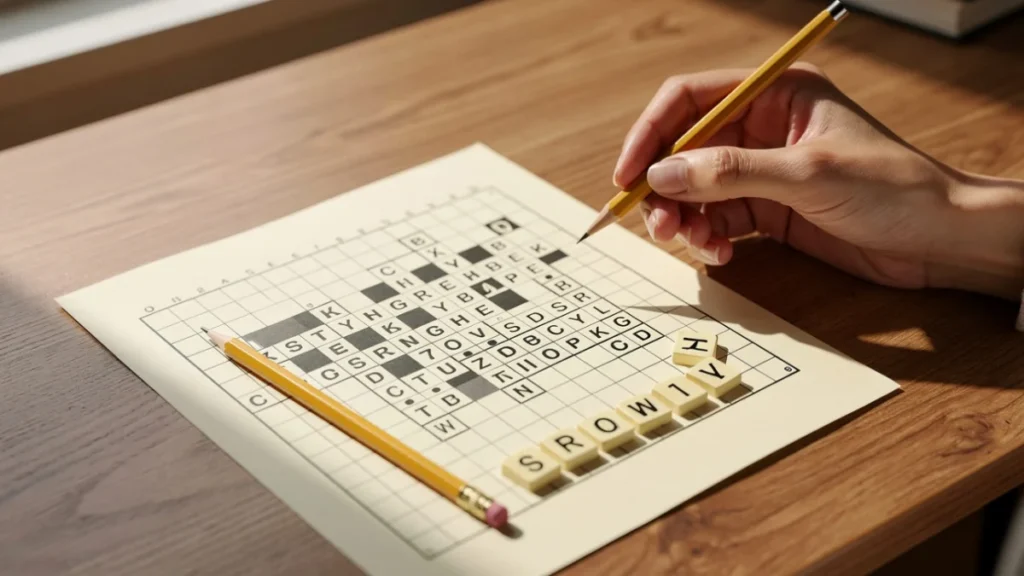
Cryptic clue puzzles are the “secret agents” of the word-game world. At first glance, they look like absolute gibberish, but that is the ultimate trick. Each clue is a mini-puzzle that buries a real answer under layers of clever wordplay.
At RiddlesPuzzle, we live for that “aha!” moment when the mess of words snaps into one clean answer. If you love a guess the word game or want to sharpen your brain with cryptic riddles, you are in the right plac
What Are Cryptic Clue Puzzles?xxl
A cryptic clue puzzle is a word puzzle where each clue hands you the answer twice, once as a plain definition and once as buried wordplay. You crack it by slicing the clue into those two halves and matching them to a single word.
Cryptic clue puzzles are word challenges where every clue holds two paths to one answer. One path is a plain definition. The other is wordplay that builds the same word through anagrams, buried letters, sounds, or tricks. Both land on one word, so a right answer proves itself twice.
That sets them apart from a quick clue, which just gives a synonym and a number. A cryptic clue says one thing but means another. The surface is a decoy, so your job is to find the break point. Cryptics were born in Britain in the 1920s and stay popular across the UK, Ireland, and Australia. American solvers came to them later, so plenty feel stumped at first. That fades fast once the patterns show themselves.
How Cryptic Riddles Differ From Regular Riddles
These two get tangled together all the time, so let us sort it out. A regular riddle runs loose and poetic, and it leans on one clever idea hidden in plain language. Cryptic riddles are stricter and built on rules. Each one carries a definition half plus a wordplay half, and it usually plants a signal word that whispers which trick is at work.
A riddle wants you to think sideways. A cryptic clue wants you to read with a magnifying glass. Both are a treat, yet cryptics pay you back for noticing structure rather than waiting on a single flash of inspiration.
Cryptic Clue Puzzle vs. Regular Riddle vs. Quick Crossword Clue
| Feature | Cryptic Clue Puzzle | Regular Riddle | Quick Crossword Clue |
|---|---|---|---|
| Has a definition half | Yes | Sometimes | Yes |
| Uses signal or indicator words | Yes | Rarely | No |
| Wordplay required | Always | Sometimes | No |
| Beginner difficulty | Medium | Easy to medium | Easy |
| Example | Mix up ‘rats’ to shine (4) = STAR | What has hands but cannot clap? = a clock | Bright object in the sky (4) = STAR |
How Cryptic Clue Puzzles Work: The Two-Part Rule
Here is the single rule that governs the entire game. Every clue divides into a definition and some wordplay, and the divide almost never sits where your eye expects it. Pin down that break, and the puzzle cracks open.
Try this clue: Vehicle plus a tame animal covers the floor (6). The definition is covers the floor, and the wordplay is vehicle plus a tame animal. A vehicle gives you CAR, a tame animal gives you PET, and you stitch them together for CARPET. Both halves agree on the same word, so you know the answer holds up.
More than 90 percent of cryptic clues run on a small set of standard patterns, so endless memorizing is not the goal. What you really need to learn is the signal words. These tiny tip-offs tell you which trick the setter used, and for a beginner, they are the quickest door inside.
The 8 Types of Cryptic Clue Puzzles
Nearly every clue you meet falls into one of eight families. Learn them in the order below, since the early ones put the mechanics on full display, and the later ones build straight on top of that.
Anagram Clues, Rearranging the Hidden Word
The letters of one word get shuffled to spell the answer. Keep an eye out for scramble words such as mixed, broken, wild, cooked, or shaken.
- Clue: Mix up rats to shine in the sky (4)
- Wordplay: rats rearranged
- Definition: shine in the sky
- Answer: STAR
Hidden Word Puzzles Inside the Clue
The answer hides in plain sight, spelled out across the seam of two words. Hidden word puzzles flag themselves with words like some, part of, in, or held by.
- Clue: Flower hidden in last error (5)
- Wordplay: laST ERror conceals the answer
- Definition: Flower
- Answer: ASTER
Charade Clues, Building the Answer in Pieces
You stack the answer from smaller chunks set side by side, just like the party game. Joiners such as plus, with, and after usually glue the parts together.
- Clue: Vehicle plus a tame animal covers the floor (6)
- Wordplay: CAR plus PET
- Definition: covers the floor
- Answer: CARPET
Container Clues, One Word Inside Another
One set of letters tucks itself inside another. Watch for inside, trapped by, around, or holds.
- Clue: Man trapped by a cat will deceive (5)
- Wordplay: HE (man) slides inside CAT, so C-HE-AT
- Definition: deceive
- Answer: CHEAT
Double Definition Clues, Two Meanings, One Word
The whole clue is nothing but two definitions of the same word, with no signal word at all. These run short, so resist the urge to overthink them.
- Clue: A dog’s sound from a tree (4)
- Meaning one: a dog’s sound
- Meaning two: the outer layer of a tree
- Answer: BARK
Homophone Clues, Sounds Like the Answer
The wordplay points at a word that sounds like the answer but wears a different spelling. Tip-offs include we hear, sounds like, said, and reportedly.
- Clue: Bloom, we hear, is good for baking (5)
- Wordplay: FLOWER sounds like the answer
- Definition: good for baking
- Answer: FLOUR
Reversal Clues, Reading It Backwards
You spell a word backwards to reach the answer. Signals include back, returns, turned around, and reversed.
- Clue: Wicked when turned around, yet full of life (4)
- Wordplay: LIVE reversed
- Definition: Wicked
- Answer: EVIL
Deletion Clues, Dropping a Letter
You lop a letter off a word to form the answer. Signals include endless, headless, loses its head, or cut short.
- Clue: Grain loses its head to give warmth (4)
- Wordplay: WHEAT without its first letter
- Definition: warmth
- Answer: HEAT
The 8 Cryptic Clue Types at a Glance
| Clue Type | What It Does | Indicator Words | Difficulty | Beginner-Friendly? |
|---|---|---|---|---|
| Anagram | Scrambles letters | mixed, wild, broken, cooked | Medium | Yes |
| Hidden Word | Conceals answer in the text | some, part of, in, held by | Easy | Yes |
| Charade | Joins parts in order | plus, with, after, and | Easy | Yes |
| Container | Puts one word inside another | inside, around, holds, trapped | Medium | Fairly |
| Double Definition | Gives two meanings | none | Easy | Yes |
| Homophone | Uses a sound-alike word | we hear, sounds like, said | Hard | Less so |
| Reversal | Spells a word backwards | back, returns, reversed | Easy | Yes |
| Deletion | Removes a letter | endless, headless, cut short | Medium | Fairly |
How to Solve Cryptic Clue Puzzles Step by Step
Let us work one together so you can watch the real thinking, not just admire the finished answer.
Clue: Mix up listen to find something quiet (6)
- Hunt for a signal word. Mix up jumps right off the page, and that practically shouts anagram.
- Find the fodder, which is the word you scramble. It is listen here, and it carries six letters, matching the answer length in brackets. Promising start.
- Find the definition. The leftover piece is something quiet, parked at the end of the clue.
- Shuffle the letters of LISTEN until they spell a six-letter word that means quiet.
- You arrive at SILENT. It uses every letter of LISTEN, and it means quiet, so both halves shake hands.
That is the entire method. Catch the signal, split the clue, test the trick, then double-check the letter count against the definition.
Quick Tips to Spot Each Cryptic Riddle Faster
You will breeze through cryptic riddles once your eye learns the tip-offs. Here is the shortcut:
- Spot disorder words like mixed or broken, and reach for an anagram.
- Spot in, some, or part of, and start scanning for a hidden word.
- Spot a tiny two-part clue with no signal, and try a double definition.
- Spot sound words like we hear or reportedly, and chase a homophone.
- Spot back or returns, and read something in reverse.
- Spot a lone question mark at the end, and expect a pun or a stretched meaning.
Indicator Word Cheat Sheet
| If you see… | The clue type is probably… | Example indicator words |
|---|---|---|
| Disorder words | Anagram | mixed, broken, wild, shaken |
| Containment words | Hidden Word | some, in, part of, held by |
| Joining words | Charade | plus, with, after, and |
| Enclosure words | Container | around, inside, holds, trapped |
| Sound words | Homophone | we hear, sounds like, said |
| Backward words | Reversal | back, returns, reversed |
| Cut words | Deletion | endless, headless, cut short |
| A lone question mark | Cryptic Definition | the whole clue is a pun |
Why Cryptic Clue Puzzles Are Great for Your Brain
These puzzles do far more than burn through ten idle minutes. They grow your vocabulary, since you keep bumping into fresh synonyms and strange little word parts. They also drill lateral thinking, because you train yourself to drop the obvious reading and dig for the buried one. On top of that, they sharpen focus, as each clue demands your full attention before it gives anything up.
The best part is how the difficulty grows with you. A kid can begin with simple anagrams and hidden words, while an adult can wrestle with the slipperier homophones and containers. That is exactly why we keep building brain teasers and mind games for every age at RiddlesPuzzle. You sharpen your skill at your own speed, and the fun never dries up.
Try These Guess the Word Cryptic Puzzles
Feeling brave? Treat each one as a guess the word game, and take your shot before you sneak a look below. Every clue uses a type from this guide.
- Mix up rats to shine in the sky (4)
- Flower hidden in last error (5)
- A dog’s sound from a tree (4)
- Vehicle plus a tame animal covers the floor (6)
- Wicked when turned around, yet full of life (4)
Answers: 1. STAR (anagram of rats). 2. ASTER (hidden in laST ERror). 3. BARK (double definition). 4. CARPET (CAR plus PET). 5. EVIL (LIVE reversed).
How many did you land on the first pass? Swing back tomorrow and they will feel softer, since the patterns lock in fast once you start catching signal words.
Final Thoughts
Cryptic clue puzzles stop reading like gibberish the moment you learn the two-part rule and start catching signal words. Find the definition, find the wordplay, then watch both halves meet on one answer. That is the whole secret, and everything after it is simply happy practice. Keep playing with the guess the word mindset, take a swing at a clue type you have not beaten yet, and let the patterns settle in.
For more cryptic riddles, brain teasers, and word games at every skill level, keep poking around RiddlesPuzzle and enjoy cracking the code.
Frequently Asked Questions
What is a cryptic clue puzzle in simple terms?
It is a word puzzle where each clue gives you the answer two ways at once, through a plain definition and through hidden wordplay. You solve it by splitting the clue and matching both halves to the same word.
Are cryptic riddles the same as cryptic crosswords?
They overlap, but they are not one and the same. Cryptic crosswords are full grids stitched from these clues, while cryptic riddles often turn up as single standalone clues you solve on their own.
What is the easiest cryptic clue type for beginners?
Hidden word and anagram clues make the friendliest entry point. The hidden word sits right there in the text, and the anagram shows you the exact letters to shuffle.
How do you identify a hidden word puzzle clue?
Look for a signal such as some, in, part of, or held by, then scan across the words for the answer spelled out in order. The letters run in a straight line, so they never hop around.
Can kids solve cryptic clue puzzles?
Yes, and many of them love it. Start a child on short anagrams and double definitions, then add one new clue type at a time as confidence builds.