Have you ever wondered why you approach problems differently than your friends or coworkers? Some people look at a chaotic situation and immediately see a spreadsheet, while others see a blank canvas for a creative solution.
The way your mind processes information defines your daily life, and taking a targeted quiz can reveal whether you rely on structured analysis or intuitive creativity. Discovering exactly what type of thinker are you can help unlock your hidden potential, improve your communication skills, and change the way you handle daily challenges.
If you want to understand your mental default settings, this comprehensive thinking style test will break down your patterns. By looking at modern cognitive theories, we can move past simple labels to find your actual mental framework. Let us find out how your mind works.
The Big Split: Left Brain vs. Right Brain
For decades, scientists and the public have used the concept of hemisphere dominance to explain human behavior. While modern neuroscience shows that both sides of the brain work together, taking a right brain left brain quiz is still a highly effective way to map out your general cognitive habits.
The two sides of your brain process the exact same world in completely different ways:
-
The Left Hemisphere: This side operates like a high-speed computer. It looks at the world in sequence, breaking big problems down into small, manageable parts. It loves data, language, and structured rules.
-
The Right Hemisphere: This side operates like an artist. It sees the world all at once, focusing on global patterns, spatial relationships, and emotional tones. It thrives on intuition and visual concepts.
Understanding this balance is the first step toward optimizing your mental performance.
Interactive Thinking Style Test
Answer the following five questions honestly. Write down the letter of the choice that best describes your natural reaction to each scenario.
Question 1: You are assembling a complex piece of furniture. What is your first step?
-
A) You open the manual and read every single safety warning and step before touching a tool.
-
B) You look at the picture on the box, arrange the pieces on the floor, and start building by feel.
-
C) You skim the instructions quickly but modify the steps if you find a faster way to finish.
Question 2: Your friend is upset about a problem at work. How do you respond?
-
A) You analyze the timeline of events and offer a step-by-step plan to fix the situation.
-
B) You sit quietly, listen deeply, and focus on validating their emotional experience.
-
C) You brainstorm a list of creative alternatives they have not considered yet.
Question 3: What does your work desk or living space look like right now?
-
A) Perfectly organized. Everything has a specific spot, and there is no visible clutter.
-
B) A bit chaotic, but you know exactly where everything is located in the pile.
-
C) Constantly shifting with notebooks, sketches, and sticky notes covering the surfaces.
Question 4: When you have to make a major life decision, what do you trust most?
-
A) A detailed spreadsheet comparing the pros, cons, costs, and long-term data points.
-
B) A strong, immediate gut feeling that tells you exactly what choice feels right.
-
C) Advice from trusted mentors combined with a vision of where you want to be in five years.
Question 5: Which school subject did you find most enjoyable or natural?
-
A) Mathematics or chemistry, where answers are clearly either right or wrong.
-
B) Art, creative writing, or music, where you can express your personal style.
-
C) History or literature, where you can debate different viewpoints and human motivations.
Scoring Your Results
Count how many times you selected each letter to discover your dominant profile in our personality brain quiz.
| Most Common Answer | Dominant Profile | Primary Strategy | Major Strength |
| Mostly A’s | The Analytical Thinker | Logical Deduction | Spotting errors and technical flaws |
| Mostly B’s | The Intuitive Thinker | Creative Synthesis | Seeing massive trends and big pictures |
| Mostly C’s | The Strategic Thinker | Practical Adaptability | Finding unique solutions to roadblocks |
Deep Dive: The Three Thinker Profiles
Now that you have your results from the quiz, let us look closely at what these categories mean for your daily routine.
1. The Analytical Thinker
If you scored mostly A’s, you are a linear processor. You view life through a lens of cause and effect, meaning you prefer clear data over vague promises. You excel at keeping projects on schedule, managing finances, and finding small errors that others completely miss.
Your biggest challenge is analysis paralysis, where you spend so much time gathering information that you struggle to make a final choice.
2. The Intuitive Thinker
If you scored mostly B’s, you are a holistic processor. You do not need a map to find your way through a problem because you rely on your gut instincts and emotional intelligence. You are likely highly empathetic and naturally gifted at creative arts, design, or reading the energy of a room.
Your biggest challenge is detail management. You might struggle to finish the boring, repetitive steps required to turn your brilliant ideas into reality.
3. The Strategic Thinker
If you scored mostly C’s, you are an adaptable processor. You sit right in the middle of the spectrum, using both logic and imagination to achieve your goals. You love solving puzzles because you can see multiple angles at the exact same time.
Your biggest challenge is focus. Because you see so many interesting possibilities, you can get distracted by new projects before finishing your current tasks.
Why Understanding Your Brain Style Matters
Knowing how you think is not just a fun trivia fact. It is a powerful tool for your personal and professional growth.
-
Better Teamwork: When you know your style, you can partner with people who balance your weaknesses. An intuitive visionary works best when paired with an analytical coordinator.
-
Reduced Stress: You will stop forcing yourself to work in ways that fight your natural instincts.
-
Faster Learning: Analytical minds learn best through structured textbooks, while intuitive minds absorb information faster through visual metaphors and hands-on experiments.
Summary of Cognitive Frameworks
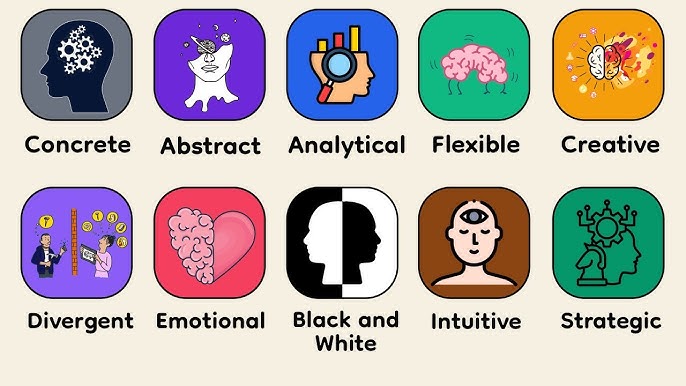
To help you remember how these different styles function in the real world, keep this quick summary in mind. Analytical Processing, Relies on sequence, words, facts, and logic. Perfect for technical execution and budgeting. Intuitive Processing, Relies on patterns, feelings, imagination, and visuals. Perfect for innovation and artistic design. Strategic Processing, Relies on balance, context, flexibility, and problem-solving. Perfect for leadership and crisis management.
No matter which category you fall into, your mind has unique strengths waiting to be used. The next time you face a difficult choice or a complex puzzle, pay attention to how your brain handles the information. If you want to keep testing your cognitive limits and training your mind with daily challenges, make sure to visit us at riddlepuzzle.com to keep your brain sharp.
Frequently Asked Questions
What type of thinker are you if you use both sides of your brain equally?
People who show a balanced use of both analytical and creative skills are known as whole-brain thinkers or lateral strategists. They can easily switch between detailed planning and high-level creative brainstorming depending on the situation.
Is a personality brain quiz scientifically accurate?
While simple online quizzes are designed for entertainment and self-reflection, they are based on established psychological concepts like cognitive style theory, which measures individual preferences for organizing and processing information.
Can your thinking style change over time?
Yes, your brain retains plasticity throughout your entire life. If you intentionally practice new habits, such as learning a musical instrument or studying formal logic, you can strengthen new neural pathways and shift your style.
Where can I find more mental tests and brain games?
You can explore a massive collection of logic puzzles, cognitive challenges, and self-discovery games by visiting our community hub at riddlepuzzle.com.