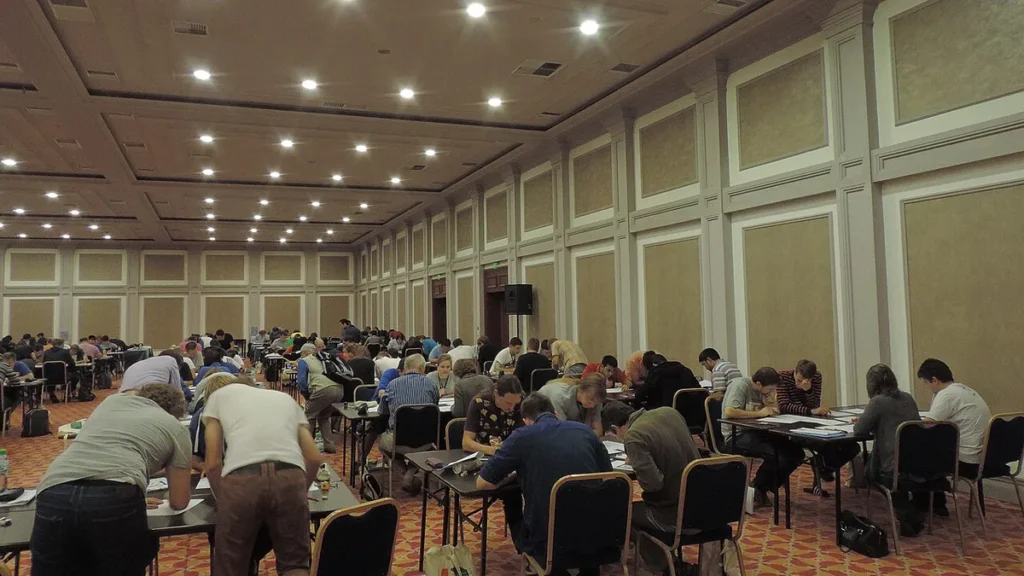
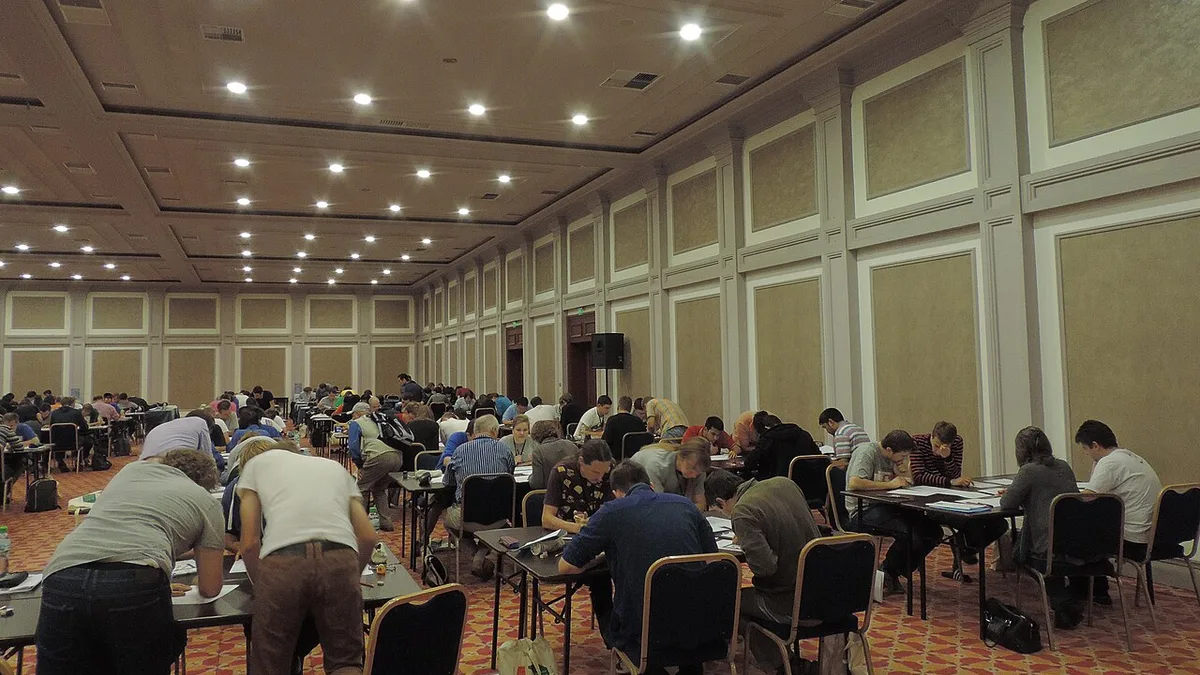
Four hundred and ninety-seven players in one hall sounds like a departure lounge at rush hour until the first station bell rings. Then the noise settles into a steady hum: teams calling out flight numbers, tags being matched, and seat maps filling in row by row. This plan turns that crowd into 33 teams, each moving through nine airport stations in turn, with every team working on a puzzle that can be checked and scored before the next round.
The airport theme is the reason a group this large can play together without long queues or idle players. Nobody waits for a turn, and no single expert can carry a whole team. Each station gives every player a small job at the same time, so a team of 15 or 16 can spread around a long table and all be busy from the first minute. The rules fit on one card, and the finished boards make the scoring visible to everyone.
This guide gives you the full day in order: the nine races, the timing, the kit list, and the scoring system. If you want a smaller warm-up first, try the plan for 495 players before you scale up to 497. The two extra players join as a pair on one of the smaller teams, and nothing else in the plan needs to change.
Key takeaways
- Split 497 players into 33 teams: 31 teams of 15 and two teams of 16.
- Run nine airport stations at 25 minutes each, with five minutes to move, reset, and check the work.
- Give every station a printed briefing card, a worked sample, and a scoring sheet.
- Score finished work, accuracy, and teamwork together, not speed alone.
- Keep one host, nine station leaders, and a spare kit table so a missing card never stops a round.
The Nine Races at a Glance
| Race | What teams do | Round length | Kit per station |
|---|---|---|---|
| Boarding Pass Code Race | Decode a boarding pass | 25 minutes | Pass cards, code keys, pens |
| Luggage Tag Match Race | Match tags to destination cards | 25 minutes | Tag sets, destination cards |
| Departure Board Order Race | Order flights by departure time | 25 minutes | Flight strips, board frames |
| Seat Map Match Race | Seat passengers on a cabin map | 25 minutes | Cabin maps, passenger cards |
| Security Tray Pack Race | Pack a tray in the right order | 25 minutes | Trays, item sets, order cards |
| Baggage Claim Sort Race | Sort bags to the right carousel | 25 minutes | Bag tokens, carousel cards |
| Runway Light Sequence Race | Repeat a runway light sequence | 25 minutes | Light panels, sequence cards |
| Landing Queue Race | Order planes for landing | 25 minutes | Plane cards, fuel gauges |
| In-Flight Safety Card Race | Match symbols to their meanings | 25 minutes | Symbol cards, meaning sheets |
The Nine Airport Races
Each race below follows the same shape: a short demo, a timed round, and a check against a sample. Station leaders read the same script at every station, so every team gets the same fair start. Keep the briefing cards face down until the bell, and keep the worked sample covered until the check.
1. Boarding Pass Code Race
Boarding Pass Code Race gives each team a stack of boarding pass cards printed with a short code, plus a code key that turns each letter and number into a flight, a gate, and a seat. The team must decode every pass, write the flight, gate, and seat on the answer sheet, and lay the passes out in gate order. One player reads the codes aloud, one works the key, and the rest check the answers and sort the passes. A team that rushes will swap two gates that look alike, while a slow team will leave the last passes blank when the bell rings.
Score the round by checking each decoded pass against the answer key, giving one point per pass with the flight, gate, and seat all correct. A pass with the right flight but the wrong seat still loses the point for that pass. Keep spare code keys at the station, because a key with a coffee stain cannot be read in the time left. The best answer sheets go on the display wall.
2. Luggage Tag Match Race
Luggage Tag Match Race gives each team a box of loose luggage tags and a set of destination cards showing cities, flight numbers, and carousel letters. The team must match each tag to the destination card with the same flight and city, then lay the pairs out in carousel order. It sounds easy until two tags for the same city carry different flight numbers, and the team has to read the small print instead of guessing from the city name alone.
Give each team a numbered answer sheet and a pencil, and let one player act as the reader who calls the destination cards in order. The rest find the tag, check the flight number, and place the pair down. Score one point per correct pair, with a bonus for a full carousel matched without a change. Keep the spare tags in a separate box, clearly marked, so a team cannot swap a tag after the bell.
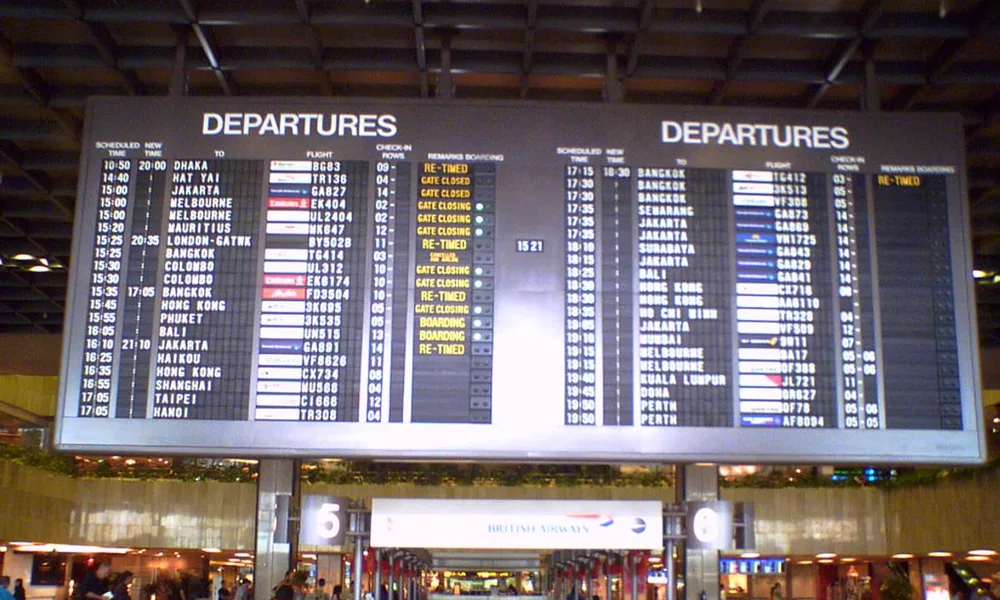
3. Departure Board Order Race
Departure Board Order Race starts with a jumbled set of flight strips and an empty board frame marked with time slots from morning to evening. Each team must place every strip in the right slot, reading the departure time, the destination, and the status word on each strip. The strips look alike at a glance, and the times run close together, so the team needs one reader, one placer, and two checkers who read the board back aloud before the bell.
Score the board by counting the strips in the right slots, then checking the status words against the answer key. A strip in the right time slot but with the wrong status still loses the point for that slot. Keep spare strips in the same size and print, because a torn strip cannot be fixed in the time left.
4. Seat Map Match Race
Seat Map Match Race gives each team a large cabin map with empty seats and a set of passenger cards showing names, groups, and seat wishes. The team must seat every passenger, keeping families together, leaving the exit rows for adults, and giving the window seats to the passengers who asked for them. The map fills fast, and a team that seats the first passengers without looking ahead will run out of window seats halfway through the round.
Score the finished map by checking each passenger against the answer key: one point per passenger in the right seat, with a bonus if every family sits together. A passenger in the wrong row loses the point, even if the seat type is right. One player should read the passenger cards aloud while another places the markers, and a third should hold the wish list so no request is missed. The finished maps make a fine display along the back wall.
5. Security Tray Pack Race
Security Tray Pack Race hands each team a tray, a set of travel items, and an order card showing the exact packing order the tray must follow. The team must place the laptop flat, the liquids bag on top, the shoes to one side, and the small items in the front pocket, all in the order shown on the card. The items are easy to mix up, so the best teams lay them out in a line and count them before packing. A single item out of order means the tray has to be emptied and packed again.
Score one point per item in the right place, with a bonus for a neat tray with nothing sticking over the edges. Keep the item sets in a shallow box with raised edges, because a spilled box will scatter across two tables. One player should read the order card aloud while another packs, and a third should hold the tray steady so the items do not slide. The finished trays go to the check table with the team name on a card.
6. Baggage Claim Sort Race
Baggage Claim Sort Race gives each team a pile of bag tokens and a set of carousel cards, one for each flight that landed that morning. The team must sort every token to the carousel card with the matching flight number, then stack the tokens on each card in the order the bags came off the belt. The tokens look alike at a glance, and the flight numbers differ by a single digit, so the team needs one sorter, one reader, and one checker who reads the piles back before the bell.
Score the round by counting the tokens on the right carousel cards, then checking the stack order against the answer key. A token on the right carousel but in the wrong place in the stack still loses the point for that token. Keep spare tokens in the same size and print, because a token with a torn corner cannot be read in the time left. The best sorters use spare time to double-check the close numbers.
7. Runway Light Sequence Race
Runway Light Sequence Race starts with a light panel showing a row of coloured lamps and a set of sequence cards. The leader flashes a sequence of lights, and the team must repeat it by pressing the lamps in the same order, then write the sequence down on the answer sheet. The sequences grow longer each time, and the colours repeat, so the team needs one watcher, one caller, and one writer who records each step before the next flash.
Score the finished sheet by comparing it with the sequence card: one point per light in the right place in the order, with a bonus for a full round with no mistakes. A light in the right colour but the wrong place still loses the point for that step. Keep the light panels charged and spare sequence cards in a folder, because a flat panel stops the round.
8. Landing Queue Race
Landing Queue Race gives each team a set of plane cards, each showing a flight number, a fuel gauge, and a passenger count, plus a landing strip with numbered slots. The team must order the planes for landing, putting the lowest fuel first, then the fullest planes, then the rest in arrival order. The gauges sit close together, so sorting by passenger count alone will send a nearly empty plane down while a fuller one circles overhead.
Score the queue by checking each plane against the answer key: one point per plane in the right slot, with a bonus if the three lowest-fuel planes land first in the right order. A plane in the wrong slot loses the point, even if it sits next to the right one. One player should read the fuel gauges aloud while another places the cards, and a third should check the passenger counts so no full plane is left circling. The finished queues go to the check table with the team name on a card.
9. In-Flight Safety Card Race
In-Flight Safety Card Race gives each team a set of symbol cards showing the pictures from a safety card and a set of meaning cards explaining what each picture tells passengers to do. The team must match every symbol to its meaning, then lay the pairs out in the order the pictures appear on the card. The pictures are simple, but two of them look alike at a glance, and the team has to read the small details instead of guessing from the shape alone.
Score the round by counting the correct pairs, with a bonus for a full set matched without a change. A symbol matched to the wrong meaning loses the point for that pair, even if the picture is in the right place. Keep the cards in two neat piles, symbols on the left and meanings on the right, so the table stays clear. One player should read the meanings aloud while another places the symbols, and the rest check the finished rows against the sample card before the bell.
How the Day Runs
Start at nine with a ten-minute welcome, a walk around the stations, and a clear reading of the scoring rules. Teams draw their starting station from a box. The first bell starts the first round at half past nine, and each round runs for 25 minutes, with five minutes to move and reset. After three rounds, take a 20-minute break, then run three more rounds, take lunch, and finish with the last three.
The timing follows the same station rhythm as the 494-player plan, with short rounds and a clear reset between them. That reset is the part most hosts undervalue: five minutes is enough to clear the table, count the kit, top up the card sets, and lay out fresh answer sheets, but only if the station leader has a checklist in hand. If a station falls behind, the host holds the bell for two minutes and lets the next round run two minutes short.
Finish with a 30-minute closing ceremony. Bring the best board from each station to the front table, read out the top three teams, and let the winning team choose one finished board to keep. Pack the kit while the ceremony runs, and keep the score sheets in one folder.
Setup Checklist
Work through this list the day before, not on the morning of the event. For a smaller hall, the 493-player plan shows how the same stations fit into tighter rooms. The kit below is counted for 33 teams, with spares for the stations that use the most material.
- Count 33 team tables, nine station kits, and one spare kit table with extra pass cards, tag sets, flight strips, cabin maps, trays, bag tokens, light panels, plane cards, and symbol cards.
- Print 33 sets of briefing cards, answer sheets, and scoring sheets, and put each set in a labelled folder.
- Brief the nine station leaders together, with a live demo of each race and a copy of the same script.
- Set out the trays, token boxes, and card sets early, and check the light panels and the spare supplies before the first team arrives.
- Mark the team tables clearly, lay out the display wall, and test the bell from the far end of the hall.
- Pack a repair box with spare cards, markers, pencils, timers, tape, and batteries, and keep it at the host table.
Frequently Asked Questions
How do 497 players fit into teams?
Make 33 teams: 31 teams of 15 and two teams of 16, which adds up to 497 players. The kit is counted for 15, so the leader should give the two larger teams a second set of the smallest tools. The scoring stays the same, because every station scores the finished work.
How long does the whole day take?
Plan for five hours of play, plus a welcome, two breaks, lunch, and a closing ceremony, which brings the day to about seven hours. The nine rounds take four and a half hours with the five-minute moves included. If the hall is only booked for six hours, cut lunch to 30 minutes and run the closing ceremony while the kit is packed.
Do we need a big hall?
You need a hall with room for 33 tables and nine station areas, plus a clear path for teams to move between rounds. A school hall or a community centre with a flat floor works well, as long as the tray and token stations sit near a table with a firm surface. If the hall is tight, put the quiet stations at the far end.
What if a team has never played anything like this before?
That is the normal starting point, and the plan is built for it. Each station starts with a two-minute demo, a worked sample to copy, and a briefing card that shows every step. New players take the reading and checking jobs first, then try the harder steps in the later rounds.
Can younger or older players take part?
Yes, with a small change at the stations that need quick hands. Younger players work with a teammate at the light panel and the tray packing, and older players can sit for the seat map, the tag matching, and the safety card stations. The code and order races need a steady eye rather than speed, so they suit players of every age.
What should we do if a kit breaks during a round?
Stop the clock for that station only, swap in the spare from the kit table, and add the lost minutes to the end of that round. The leader notes the break on the scoring sheet, so the team is not blamed for the delay. If a light panel goes flat or a card set spills, move the team to the spare table.
The Bottom Line
Running puzzle games for 497 players works when the work is real, the rules fit on one card, and every player has a job from the first minute. Nine airport stations, 33 teams, and a steady bell give a huge crowd the feel of a small departure lounge, and the finished boards on the display wall show the day better than any score sheet.
Start with the checklist, print the briefing cards, and book the hall early. The teams will bring the noise and the friendly rivalry. Your job is to give them a fair start, a clear finish, and a day where 497 people all solved something worth keeping.


