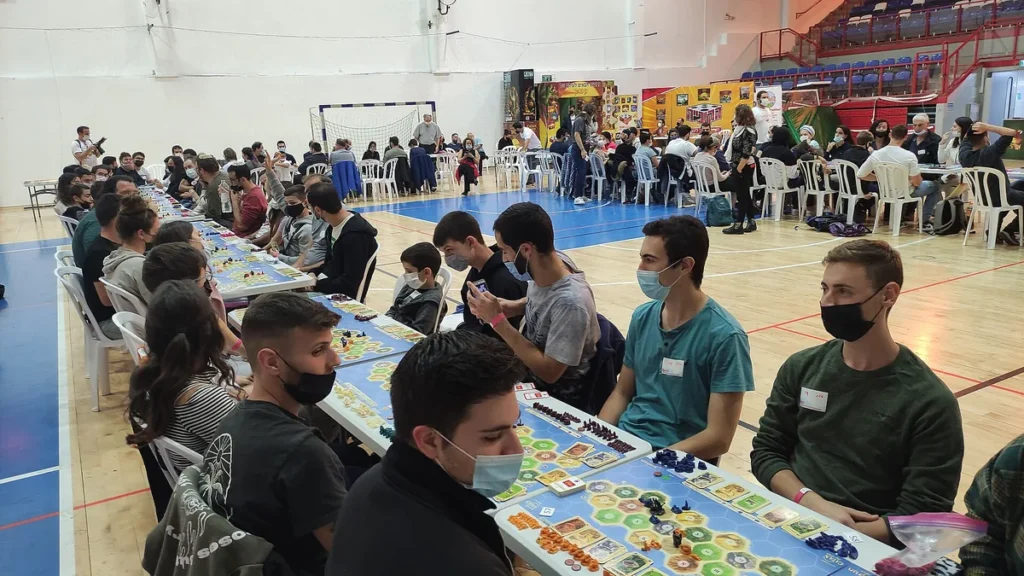
Board games for 410 players sound impossible until you stop picturing one enormous table and start picturing a hall full of tables. No single board game seats 410 people, and no sensible host would try to make one do it. Board games for 410 players are never really one game. They are dozens of games, played at the same time, in the same room, by teams that all feel part of one shared event.
This guide gives you the full plan, from the first headcount to the final scores. You will meet nine board games that survive contact with a crowd of this size, learn the three formats that actually work at scale, and see exactly how many copies, tables, and helpers a night for 410 players needs.
Most large game nights fail for boring, preventable reasons: the host buys one copy of a game that takes two hours to teach, or the scoring is so complicated that nobody trusts the result. The sections below remove those failure points, so your 410 players spend the evening playing instead of waiting around.
Key takeaways
- Board games for 410 players work as many small games played at once, not one huge game: plan in tables of 4 to 6 players, and scale by adding tables.
- The three scaling formats are teams, stations, and tournaments: teams suit mixed groups, stations suit drop-in crowds, and tournaments suit competitive players.
- Pick games that can be taught in under five minutes and finished in under 45 minutes, with fast turns and plenty of talking.
- You need about 69 to 103 tables for 410 players, plus one copy of a game per table and one helper for every 6 to 8 tables.
- Keep one central scoreboard so every table can see the leaders and the final result matters to the whole room.
Why Board Games Work So Well for 410 Players
Board games have three advantages that almost no other kind of entertainment can match at this scale. First, they are cheap to multiply: a single copy of a party game costs less than a catered meal for ten people, and you can mix cheap card games with a few bigger box games. Second, the rules are short, and most of the games in this guide can be explained in under five minutes.
Third, board games are fair in a way that keeps a crowd happy. The best large group games mix luck with light decisions, so a beginner at table forty has a genuine chance against the sharpest player in the room. That fairness keeps people playing, and it makes the final rounds genuinely exciting for everyone.
What 410 Players Really Means
The first thing to accept is that 410 players means roughly 69 to 103 tables. At four players per table you need 103 tables; at six per table you need 69. Most events land somewhere in between, because some games play best with four and others with six. That range is your real planning unit, and everything else in this guide follows from it.
Second, not everyone plays at the same speed: some tables will finish a twenty minute game in twelve minutes while others take thirty five, so build in buffers between rounds. Be honest about the headcount too, because 410 registered is not the same as 410 in the room at once, so plan for the busiest moment.
Three Formats That Scale to 410 Players
Before you pick a single game, choose your format. The format decides how many tables you need, how many volunteers you need, and how long the event lasts. Every successful night for 410 players uses one of these three formats, and picking the right one matters more than picking the right games.
The Team Format
In the team format, players are split into teams of 4 to 6 and each team sits at its own table with its own copy of the game. With 410 players, you need about 69 to 103 tables, which sounds like a lot, but most community halls can manage it with folding tables. Each round lasts about 20 to 30 minutes, so a full evening of four rounds fits into two hours.
Teams work best with social games like Concept, Pictionary, and Taboo, because the team can discuss and laugh together before answering. A similar approach works for the slightly smaller crowd in our guide to board games for 408 players, where the same table maths applies with two fewer seats to fill.
The Station Format
In the station format, you set up several different board games around the room and groups rotate from one station to the next every 15 minutes. Each group of 8 to 12 players visits every station, collects points at each one, and the highest total wins.
Rotation is ideal when your crowd includes children, seniors, and people who just want a fun evening rather than a competition. Plan for about 8 to 10 stations with one volunteer each. Stations work best with fast games like Exploding Kittens, Coup, and Skull, because a new group can learn the game in two minutes and finish a round before the bell rings.
The Tournament Format
In the tournament format, players compete in heats of 4 to 6 at each table, and the winners advance to the next round. With 410 players, you need about 69 tables for the first round, and each heat lasts about 15 to 20 minutes, so the whole field narrows to a final table in about an hour and a half.
Tournaments work best with short games like 7 Wonders, Azul, and Scattergories, because every table plays the same game at the same time. Keep the advancing rule simple, such as the top two players from each table moving on.
The 9 Best Board Games for 410 Players
Each game below is quick to teach, finishes in under 45 minutes, keeps every player involved on every turn, and works in parallel across dozens of tables. Together they cover wordless guessing, drawing, wordplay, bluffing, drafting, and fast card play, so every player finds a table they enjoy.
| Game | Players per table | Time | Best role at 410 players | Teach time |
|---|---|---|---|---|
| Concept | 4 to 12 | 40 minutes | Team tournament | 2 minutes |
| Pictionary | 4 to 12 | 30 minutes | Loudest table | 2 minutes |
| Taboo | 4 to 10 | 20 minutes | Mixed group icebreaker | 1 minute |
| Scattergories | 2 to 6 | 25 minutes | Fast filler | 2 minutes |
| Exploding Kittens | 2 to 5 | 15 minutes | Big room opener | 2 minutes |
| 7 Wonders | 3 to 7 | 30 minutes | Simultaneous play anchor | 4 minutes |
| Coup | 2 to 6 | 15 minutes | Bluffing station | 2 minutes |
| Skull | 3 to 6 | 30 minutes | Quiet bluffing table | 2 minutes |
| Azul | 2 to 4 | 30 minutes | Calm station game | 3 minutes |
1. Concept
Concept is a wordless guessing game in which one player gives clues using only pictures on a board covered in icons. There are no words, no drawing, and no acting, just a set of symbols that players combine to point at an idea. A team might point at the icons for animal, water, and large to suggest a whale.
The game takes about 40 minutes, plays best with 4 to 12 players per table, and needs only two minutes to teach, which makes it a natural fit for the team format.
2. Pictionary
Pictionary is the classic draw and guess game, and it is still one of the loudest games you can run at scale. One player draws a word on a pad or a whiteboard while their team shouts guesses against the clock. The drawings are usually terrible, and that is exactly why the game works: a wobbly sketch of a giraffe gets a bigger laugh than a perfect one.
A game of Pictionary takes about 30 minutes, works with 4 to 12 players per table, and takes two minutes to explain.
3. Taboo
Taboo is a word game built around forbidden words. One player has to get their team to say a target word without using any of the five banned words printed on the card. The banned words are always the obvious ones, so players end up describing a beach without saying sand, sea, or sun.
Taboo takes about 20 minutes per game, plays best with 4 to 10 players per table, and takes one minute to teach, which makes it the best icebreaker on this list.
4. Scattergories
Scattergories is a race against the clock to write down answers in a dozen categories that all start with the same letter. Roll a letter, flip the category list, and every player at the table writes answers at the same time. Points go to answers that no one else at the table wrote, so a clever answer beats a safe one.
A round of Scattergories takes about 25 minutes, plays with 2 to 6 players per table, and takes two minutes to explain. It works as a fast filler, because everyone plays at once.
5. Exploding Kittens
Exploding Kittens is a fast card game of luck, nerve, and light sabotage. Players draw cards one by one, hoping to avoid the exploding kitten, and use action cards to skip turns, peek at the deck, or shuffle the danger onto someone else. A full game is over in about fifteen minutes.
The game plays with 2 to 5 players per table and takes two minutes to teach, which makes it the best opener on this list. Start the night with it while latecomers arrive.
6. 7 Wonders
7 Wonders is a card drafting game in which every player builds a civilisation at the same time. Each round, every player picks one card from their hand, passes the rest to a neighbour, and the whole table acts at once. There is almost no downtime, which is exactly what a 410 player night needs.
A game of 7 Wonders takes about 30 minutes, plays with 3 to 7 players per table, and takes four minutes to teach. Simultaneous play means a table of seven finishes at the same speed as a table of three.
7. Coup
Coup is a bluffing game of hidden roles in which each player holds two character cards and claims powers they may or may not have. Players take coins, launch challenges, and call each other liars, and a wrong challenge costs a card. The whole game turns on nerve, and a quiet player who bluffs well can beat the loudest person at the table.
Coup takes about 15 minutes per game, plays with 2 to 6 players per table, and takes two minutes to explain, so it is short enough to play three times in one station rotation.
8. Skull
Skull is a bluffing game played with a handful of coasters, which is all the equipment a table needs. Each player places a coaster face down, bids on how many flowers they can flip without hitting a skull, and then flips coasters one by one while the table watches. The tension builds with every flip.
A game of Skull takes about 30 minutes, plays with 3 to 6 players per table, and takes two minutes to teach, so it suits a quiet corner where players want a slower pace.
9. Azul
Azul is a tile drafting game in which players take coloured tiles from shared factory displays and place them into a pattern on their own board. The rules are simple, the tiles feel good to handle, and the game rewards planning without punishing a new player for one bad move. It is the calmest game on this list, and every large night needs a calm table.
A game of Azul takes about 30 minutes, plays with 2 to 4 players per table, and takes three minutes to explain. Use it as a calm station game near the edge of the room, away from the shouting tables.
How Many Copies, Tables and Helpers You Need
Work from the table count first. For 410 players at 4 to 6 per table, you need 69 to 103 tables, and you need one copy of a game per table in each round. Copies are shared across rounds where the format allows it, so the real number is one copy per table per game, not 410 copies of everything.
Helpers are the part most first time hosts forget. Plan for one table host for every 6 to 8 tables, plus a master of ceremonies, a scorer, and a floater. That works out at about 10 to 15 table hosts for 410 players. For a second set of planning numbers at a nearby scale, see the guide to board games for 406 players, which uses the same table maths with four fewer seats.
A Sample Evening for 410 Players
A good evening for 410 players runs for about two and a half hours, including arrival and the final. Doors open thirty minutes before the first round, with Exploding Kittens on the tables so early arrivals start playing at once. The master of ceremonies welcomes the room, explains the format in two minutes, and starts the clock.
Round one runs for thirty minutes, then a ten minute break lets players stretch and find the next table. Round two and round three follow the same pattern, with the scoreboard updated after each round. Keep the timetable visible from every table, and if a round runs long, cut the break, not the game.
Your 410 Player Checklist
Run through this checklist the week before the night, and again on the morning of the event. Every item below has caught out a real host at least once.
- Count the tables, chairs, and copies twice, and keep five spare copies of the fastest games for tables that finish early.
- Print the rules summary, the scoring sheet, and the round times for every table host, and brief the hosts thirty minutes before the doors open.
- Test the projector, the scoreboard, and the microphone in the empty hall, and keep a spare microphone battery in your pocket.
- Label every game box with its table number, and put a lost property box by the door for pieces that wander off.
- Plan the food and drink away from the game tables, and keep drinks in cups with lids so a spill cannot ruin a board.
- Agree the tiebreak rule before the first round, and write it on the scoreboard where every table can see it.
Frequently Asked Questions
Can one board game really seat 410 players?
No, and no host should try. Board games for 410 players work as dozens of small games played at the same time, in the same room, by teams that all share one scoreboard and one timetable. Plan in tables of 4 to 6 players, scale by adding tables, and the number stops being a problem.
How many tables do I need for 410 players?
You need 69 to 103 tables, depending on the game. At four players per table you need 103 tables, and at six per table you need 69. Most events land in between, because games like Azul play best with four and games like Concept play well with twelve.
What is the best game to open the night with?
Exploding Kittens is the best opener, because a table can learn it in two minutes, finish a game in fifteen minutes, and start again while latecomers arrive. For a wider view of openers at this scale, see the board games for 404 players guide, which covers a different set of nine titles.
How many helpers do I need?
Plan for one table host for every 6 to 8 tables, plus a master of ceremonies, a scorer, and a floater. That is about 10 to 15 table hosts for 410 players, plus the three central roles. Brief the hosts before the doors open and give each one a printed rules summary.
Do I need 410 copies of every game?
No. You need one copy per table in each round, which is 69 to 103 copies of the game in play at that moment, not 410 copies. Copies are shared across rounds, borrowed from clubs, and reused at stations, so start with the cheap fast games in large numbers and add the bigger box games in smaller numbers.
What if some tables finish much faster than others?
That is normal, and your schedule should expect it. Keep five spare copies of the fastest games for tables that finish early, and build ten minute buffers between rounds. A central clock and a clear finish time keep the room together even when tables run at different speeds.
The Bottom Line
Board games for 410 players are not about finding one giant game. They are about running dozens of small games well, at the same time, in the same room, with one scoreboard and one timetable holding the night together. Pick nine quick games, choose the format that suits your crowd, and brief your hosts before the doors open.
Start with the cheap fast games, add one calm table for players who want a slower pace, and keep the scoring simple enough that every table trusts the result. Do that, and 410 players will spend the evening playing, laughing, and watching the leaderboard, instead of waiting for a game that never starts.