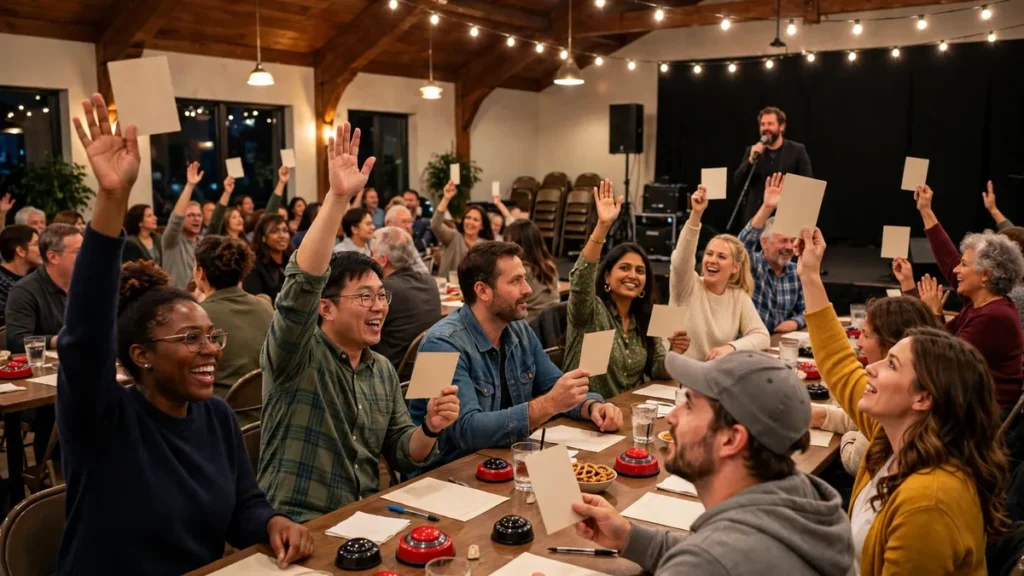
Finding the best dice games for 333 players sounds impossible at first. Three hundred and thirty-three people is not a game night, it is a festival, a school assembly, a company celebration, or a community gathering that needs an activity everyone can join at once. Yet dice games are one of the few kinds of play that scale this far, because the rules are simple, the equipment is cheap, and nobody has to wait long for a turn.
The best dice games for 333 players share three qualities: they can be played in parallel at many small tables, they use a central scoreboard or shared call so every table stays in step, and they finish in rounds that last only a few minutes. When those three things are in place, a crowd of 333 stops feeling like a crowd and starts feeling like one big game. Nobody needs to learn a complicated rulebook, and nobody is left watching from the sidelines while a handful of people play.
This guide covers the ten games that work best at this scale, how to set up your tables and supplies, how to keep 333 players moving together, and how to pick the right mix for your event. Every game here is played for points, tokens, or team pride, never for money, and every one of them can be run with ordinary dice, cups, and score sheets you can prepare in advance.
Key Takeaways
- Split 333 players into tables of 4 to 6, with one table host at each table, so every game runs in parallel instead of one long queue.
- Choose games with rounds of 5 to 10 minutes, such as Tenzi, Bunco, and Farkle, so the whole room stays in step and nobody waits.
- Use one shared signal, such as a bell or a shouted call, to start and end each round across all tables at the same time.
- Plan for about 2 dice per player, plus spare dice cups and printed score sheets, because dice roll off tables and sheets get lost.
- Score by table first, then bring table winners together for a short final round, so the event ends with a clear champion and a big cheer.
Why Dice Games Work for 333 Players
Most party games break down once the group passes twenty or thirty people. Board games need a board per group and a long explanation. Team quizzes need microphones, screens, and a host who can hold a room. Dice games avoid all of that. A set of dice costs very little, fits in a pocket, and can be explained in under a minute. That is why they are the practical choice when the guest list reaches the hundreds.
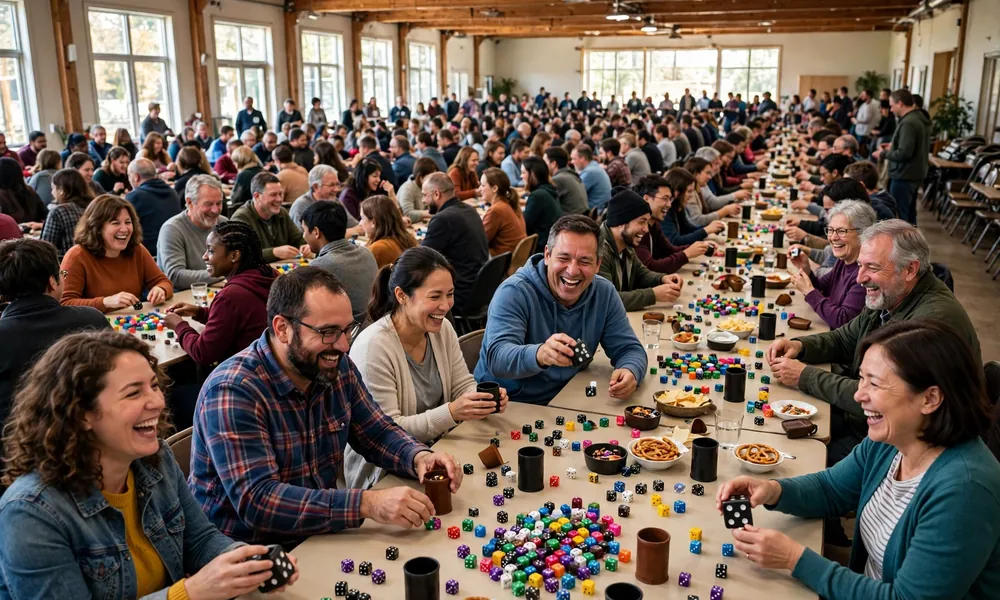
The format matters as much as the games themselves. When you run the same game at fifty or sixty tables at once, the room develops a rhythm: dice rattling, cups shaking, cheers rising from one table and spreading to the next. Organizers who have run similar events for slightly smaller crowds, such as the games in our guide to the best dice games for 330 players, report the same pattern every time: the first round is noisy and a little chaotic, the second round is smoother, and by the third round the whole room is playing as one.
The Maths of 333 Players
Before you buy anything, work out the table plan. With 333 players, tables of 6 give you 55 tables with 3 players left over, while tables of 5 give you 66 tables with 3 left over. Tables of 4 give you 83 tables with 1 left over. None of these divides evenly, so do not chase a perfect split. Instead, plan for mostly tables of 5 or 6, and let a few tables run with 4 players. The exact split matters far less than having a host at every table who knows the rules and can keep score.
How to Run a 333-Player Dice Event
A great dice event is really a piece of crowd management with games attached. The games themselves are easy; keeping 333 people in step is the hard part. The method below has four stages: a welcome and practice round, three or four scored rounds, a table-winners final, and a short prize ceremony. The whole event fits comfortably into two hours, including breaks.
Start with a practice round that does not count. Give every table five minutes to play one short round while hosts walk around answering questions. This single step prevents most of the problems that ruin large events, because players learn the rules by doing instead of by listening to a long speech. It also gives you time to fix seating problems, replace missing dice, and calm the room before scoring begins.
Use a single signal for every round. A bell, a whistle, or a loud air horn works, and the signal should be the same every time: one ring to start rolling, two rings to stop and record scores. Print the signal rules on every score sheet so nobody has to remember them. When the room hears the signal together, 333 people move together, and the event feels organised instead of chaotic.
Scoring That Scales
Keep scoring simple enough that a table host can do it in thirty seconds. Award table points rather than tracking every individual roll in detail. In most of the games below, each player records their own score, the host checks the sheet, and the table winner is the player with the highest total. The host then writes the winner’s name and score on a master sheet and hands it to a runner, who carries it to the scoring desk.
The 10 Best Dice Games for 333 Players
These ten games were chosen because they meet the same four tests: they can be taught in under two minutes, they need no more than six dice per table, they finish a round in ten minutes or less, and they stay fun when played at fifty or more tables at the same time. Each game below includes the player count per table, the dice needed, and the reason it works at this scale.
1. Tenzi
Tenzi is the fastest game on this list and the best opener for a huge crowd. Each player gets ten dice and rolls them all at once, trying to get all ten to show the same number. Players set aside matching dice and keep rolling the rest until all ten match. The first player at the table to finish shouts Tenzi and wins the round. A round takes two to four minutes, which makes it perfect for warming up a room of 333 people, and the sight of dozens of tables rolling at once is wonderfully noisy.
2. Bunco
Bunco is the classic large-group dice game, and it was practically designed for events like this. Players sit in groups of four at each table, roll three dice, and score points for rolling the number that matches the current round. After each round, winners move up a table and losers move down, so players constantly meet new people. Bunco needs three dice per table and a simple score sheet, and a full game runs in about an hour across six rounds, which fits a two-hour event with time for a final.
3. Farkle
Farkle is a push-your-luck game where players roll six dice, set aside scoring combinations, and decide whether to roll again for more points or bank what they have. Rolling with no scoring dice is a Farkle, and the player loses the points from that turn. The tension of that choice keeps tables lively, and the game is easy to learn because the scoring combinations fit on a single printed card. Farkle works well as a scored round in the middle of your event, when players are warmed up and ready for a game with a little more decision-making.
4. Pig
Pig is the simplest game here, which makes it ideal for tables with young children or first-time players. Each player rolls one die and adds the result to their turn total, choosing to roll again or stop and bank the points. Rolling a one wipes out the turn total, so every roll is a small gamble. The game needs only one die per table, so it is the cheapest game to supply for 333 players, and a full game to 100 points takes about ten minutes. Use Pig as a backup game for any table that finishes early.
5. Dice Bingo
Dice Bingo turns an ordinary bingo card into a dice game. Each player has a card with numbers on it, and a caller rolls two dice at the front of the room and announces the total. Players mark that number on their cards if they have it, and the first player to complete a row, column, or full card wins. Because one caller serves the whole room, Dice Bingo is the easiest game to run for all 333 players at once, and it works as a brilliant closing game when you want everyone playing the same game at the same time.
6. Liar’s Dice
Liar’s Dice is a bluffing game that works surprisingly well in large groups when played table by table. Each player shakes five dice in a cup, peeks at them, and then bids on how many dice of a certain number are showing across the table. The next player can raise the bid or challenge it, and the dice are revealed to settle the claim. The game needs five dice and a cup per player, so it uses more equipment than most games here, but the laughter and the bluffing make it worth the extra dice for at least one round.
7. Shut the Box Relay
Shut the Box is usually a game for one or two players, but the relay version turns it into a team game for a big room. Each table gets a Shut the Box set or a printed number flap board, and players take turns rolling two dice and flipping down the numbered flaps that match the roll. When no more flaps can be flipped, the turn ends and the next player takes over. The table with the lowest leftover total wins the round. If you are choosing between similar group sizes, the relay format in our guide to the best dice games for 331 players shows how the same idea adapts when a couple of tables are added or removed.
8. Roll and Write Challenge
Roll and Write games give every player the same dice results and ask them to make the best choices on their own sheet. A caller at the front rolls three dice, announces the results, and every player in the room writes the numbers into boxes on their sheet, trying to complete rows, columns, or patterns. Because everyone works from the same rolls, the game is perfectly fair across all 333 players, and scoring is a simple matter of adding up completed lines. Print the sheets in advance and keep the rounds short, with three rounds of five minutes each.
9. Left Center Right With Tokens
Left Center Right is a fast passing game where each player starts with three tokens and rolls special dice marked L, C, R, and dots. An L means pass a token left, R means pass right, C means put a token in the centre pot, and a dot means keep your tokens. The last player holding tokens wins the table round. Play with coloured tokens or counters only, never with money, and the game stays friendly and light. A round takes about five minutes, which makes it a great filler between longer games.
10. Zilch
Zilch, also known as 10000 in some families, is a close cousin of Farkle with slightly simpler scoring. Players roll six dice, keep scoring dice, and roll again to build their total, but rolling with no scoring dice wipes out the turn. The first player to reach an agreed target, usually 5000 or 10000 points, wins the table. Zilch is a strong closing game because the target score gives the final round a clear finish line, and tables can be set to the same target so every table ends at roughly the same time.
Comparing the Games at a Glance
| Game | Players per table | Dice per table | Round length | Best use |
|---|---|---|---|---|
| Tenzi | 4 to 6 | 10 per player | 2 to 4 minutes | Warm-up opener |
| Bunco | 4 | 3 | About 10 minutes | Main event game |
| Farkle | 4 to 6 | 6 | 8 to 10 minutes | Scored middle round |
| Pig | 4 to 6 | 1 | About 10 minutes | Simple backup game |
| Dice Bingo | Unlimited | 2 for the caller | 10 to 15 minutes | Whole-room closer |
| Liar’s Dice | 4 to 6 | 5 per player | 8 to 10 minutes | Lively bluffing round |
| Shut the Box Relay | 4 to 6 | 2 | About 10 minutes | Team relay round |
| Roll and Write | Unlimited | 3 for the caller | 5 minutes per round | Fair shared game |
| Left Center Right | 4 to 8 | 3 | About 5 minutes | Quick filler game |
| Zilch | 4 to 6 | 6 | 10 to 12 minutes | Closing scored game |
Checklist for Organising 333 Players
- Confirm the venue holds 333 people seated at tables with clear aisles, and check the sound system reaches every corner of the room.
- Buy or borrow 650 to 700 dice, 60 dice cups, 70 rolling trays, and at least 400 printed score sheets, plus spare dice in a different colour for each table.
- Recruit one table host per table, plus a scoring desk team of three, two runners, and one person on the microphone for the whole event.
- Print a one-page rules card for each game, a score sheet for every player, and a master winner sheet for every table host.
- Prepare a simple prize table with small prizes for table winners, a bigger prize for the overall champion, and a fun prize for the best team spirit.
- Test the start and stop signal, the microphone, and the leaderboard display the day before, and walk the room to check that every table can see and hear the front.
Frequently Asked Questions
Can 333 people really play dice games at the same time?
Yes, when the games are run at many small tables in parallel. You do not need one game for 333 people; you need sixty or so tables each playing the same game at the same time, with one shared signal to keep the rounds in step. Games like Tenzi, Bunco, and Dice Bingo are built for exactly this format, and the room feels like one event because everyone starts and stops together.
How many dice do I need for 333 players?
Plan for about 650 to 700 dice in total. Most games need only 5 or 6 dice per table, not per player, so the total is far lower than one set per person. The exceptions are Tenzi and Liar’s Dice, which need dice per player, so if you run those games, borrow extra sets or run them in shifts, with half the tables playing while the other half watches and cheers.
What is the best game to start with?
Tenzi is the best opener because a round takes only two to four minutes, the rules take thirty seconds to explain, and the whole room is rolling within a minute of the start signal. It wakes the room up, gets people laughing, and gives hosts a chance to spot any table that needs help before the scored rounds begin.
How do I pick a winner from 333 players?
Score by table first, then bring the table winners together for a final. After three scored rounds, take the best 12 to 18 table winners to a front table for one short deciding game, such as a round of Farkle or Dice Bingo, while the rest of the room watches. This gives you a clear champion without trying to compare 333 individual scores in detail.
Are dice games suitable for children at a large event?
Yes, and children are often the best players at the table. Games like Pig and Tenzi need only simple adding, and children learn the rules faster than adults expect. Seat children with an adult at each table for the first round, then let them play on their own once they are confident. Keep the prizes small and fun so every child leaves with something to smile about.
What if some tables finish early?
Keep a filler game ready at every table, such as Pig, so a table that finishes early can start a quick extra round instead of sitting and waiting. You can also ask early tables to swap one player with a neighbouring table, which keeps the room moving and gives people a chance to meet someone new. If you want ideas for a slightly different group size, the games in our guide to the best dice games for 329 players use the same table plan and swap cleanly into this schedule.
The Bottom Line
The best dice games for 333 players are the ones that are simple to teach, quick to play, and easy to run at dozens of tables at once. Tenzi opens the event with energy, Bunco and Farkle carry the scored rounds, and Dice Bingo or a table-winners final brings all 333 players together for a shared finish. Split the room into tables of 4 to 6, give every table a host and a printed rules card, use one clear signal for every round, and score by table before crowning a single champion. Do that, and 333 players stop being a logistical problem and become the best part of the event: a whole hall rolling dice, cheering together, and asking when you will do it again.