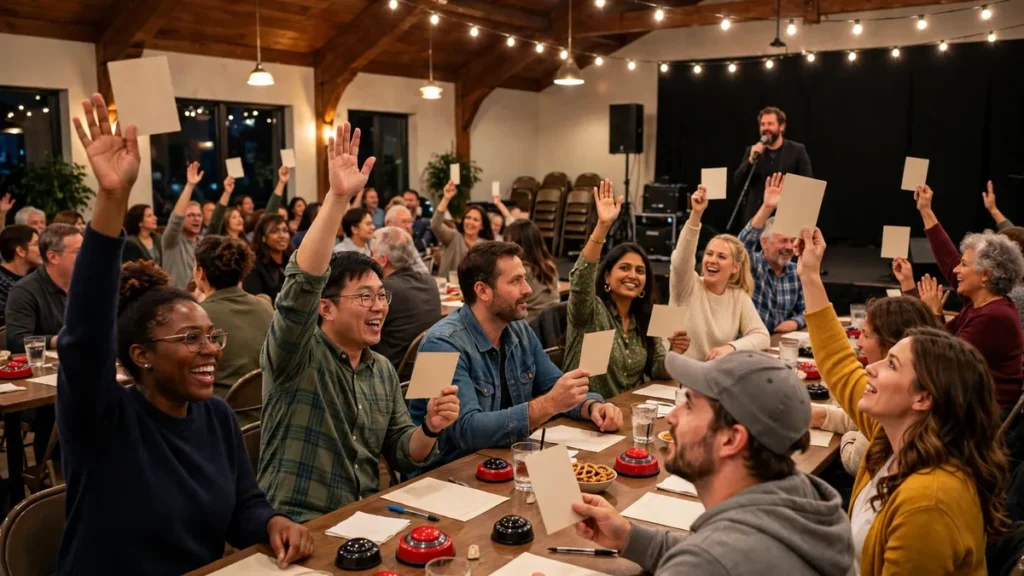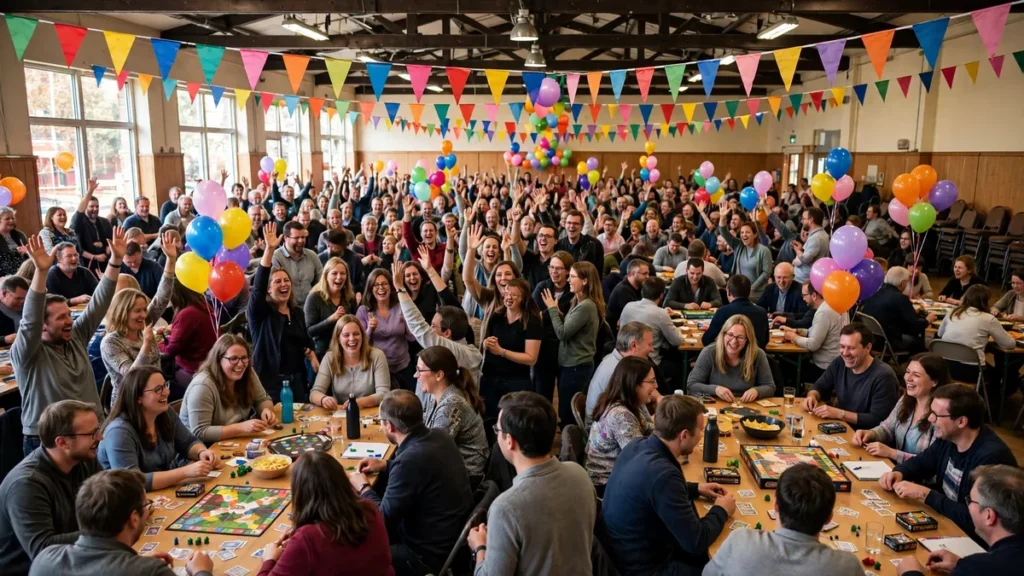
Finding the best party games for 332 players sounds impossible at first. Most party games are designed for six to twelve people in a living room, so a crowd of 332 feels far too large for one game, one host and one set of rules. The good news is that party games scale beautifully once you stop thinking of one circle and start thinking of a festival, with enough teams and stations for everyone to play at once.
The best party games for 332 players work because they are built around short rounds, simple rules and parallel play. Instead of one giant game that leaves most people watching, you run dozens of small games at the same time and let players move, score points and meet new opponents between rounds. That structure keeps waiting time low, keeps every player involved, and turns a huge crowd into a lively celebration.
This guide covers the games that actually work at this scale, the exact number of teams and stations you need, a rotation system that keeps 332 people moving smoothly, and a ready-to-use plan for your event. Whether you are planning a school event, a community festival, a corporate gathering or a record-breaking game night, these party games will keep every single person engaged from the first round to the final score.
Key takeaways
- Party games for 332 players work through parallel teams and short rounds, not one giant game.
- Divide 332 players into 28 teams of 11 or 12, with one captain and one clear colour or name per team.
- Simple, fast games such as trivia, charades, bingo and relay races are the best choices for very large groups.
- A rotation system where teams move to a new station every 15 minutes keeps every player active and social.
- Plan for one organiser per six teams, clear signage, a central scoreboard and a loudspeaker so 332 players always know what happens next.
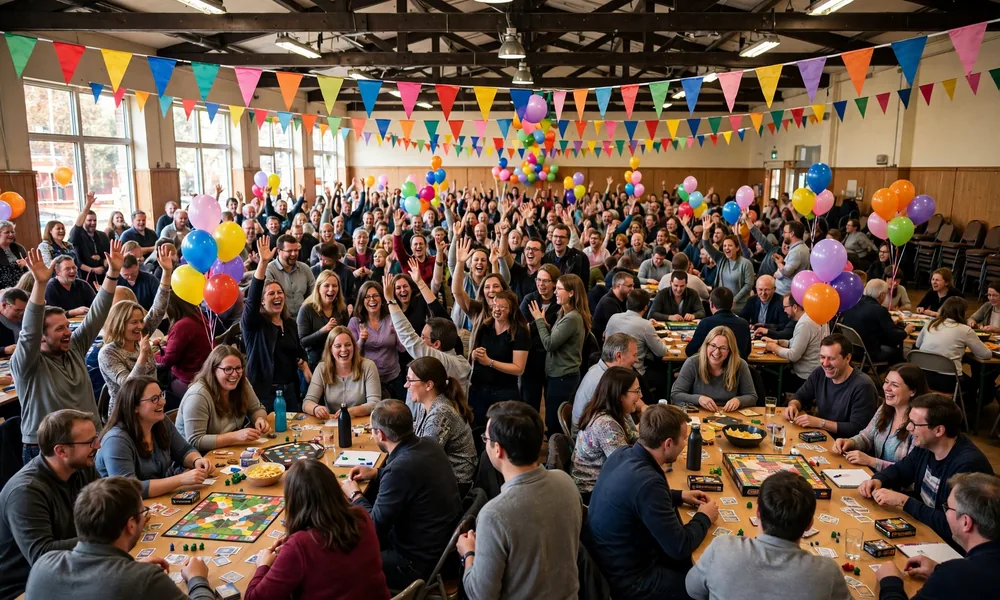
Why Party Games Work for 332 Players
Party games have three qualities that make them ideal for very large groups. First, they are cheap: most need little more than paper, pens, a speaker and a few props, and even 332 players can be equipped for a modest budget. Second, they are flexible: a game that works for ten people can be split into teams, run in parallel or turned into a relay without changing its core idea. Third, they are social: party games give strangers a reason to talk, laugh and work together, which is exactly what a large gathering needs.
The mistake most organisers make is choosing a game that only works in a single circle. Games that need everyone to take a turn in order, such as long storytelling games or games with a single board, slow down badly once the group passes twenty people. At 332 players, a single turn-taking game would take hours and most players would spend the evening waiting. The games in this guide avoid that trap, because every one of them can be played by many teams at once, finished in fifteen minutes or less, and explained in under two minutes.
The Maths of 332 Players
The numbers for 332 players are simpler than they look. Divide the crowd into 28 teams: 24 teams of 12 players and four teams of 11 players. That gives every team enough people for relays and team quizzes, while keeping each team small enough for everyone to take part. Give every team a captain, a colour and a name, and print the team lists before the event so nobody wastes time sorting themselves out on the day.
For station games, plan eight to ten stations. With 28 teams and ten stations, three teams share most stations, which works well if each station game is designed for two or three teams to play against each other. Each round lasts 15 minutes, with five minutes to move between stations. Ten rounds therefore take about three hours and twenty minutes, including a break in the middle. If you have less time, run six stations for two hours, or run a single-format tournament such as trivia or bingo for the whole group.
Staffing follows the same simple maths. You need one organiser for every six teams, which means five organisers plus a main host. Each station needs one volunteer to explain the rules, keep score and keep the game moving. Add two people on the scoreboard, one person on sound and one person on registration, and you have a team of about eighteen helpers for 332 players. That ratio keeps queues short and problems small.
How to Organise 332 Players Without Chaos
Organisation is what separates a great 332-player party from a confusing one. Start with registration: send team assignments in advance, put team lists on boards at the entrance, and give every player a wristband, sticker or badge in their team colour. That single step solves most confusion, because players can find their team by colour from across the hall, and organisers can spot a lost player at a glance.
Plan the room in zones. Put registration near the entrance, the main stage or scoreboard at the front, and the game stations around the edges with clear gaps between them. Leave wide walkways so 332 people can move between stations without bottlenecks, and mark each station with a large numbered sign. If the event is outdoors, use gazebos for shade and mark the boundaries with bunting or cones so teams know where each game begins and ends.
The format used here is close in spirit to the approach in our guide to the best party games for 330 players, where the same team-and-station structure keeps a very large crowd playing together instead of waiting in line. The numbers change slightly for 332 players, but the principle is identical: many small games, played at the same time, with clear movement between them.
Team Sizes, Stations and Rotation
Use 28 teams of 11 or 12 players. Teams of this size are large enough for relays, quizzes and group challenges, but small enough that every player still gets a turn. Smaller teams of six or eight would mean more than forty teams to manage, which doubles the work for organisers and makes the scoreboard harder to follow. Larger teams of twenty would mean half the players standing around while the other half plays.
Set up ten stations and give every team a rotation card listing the station order, the start time for each round and the team colour, so captains can lead their team without asking an organiser. Rotate in a simple loop: team one moves from station one to station two, team two moves from station two to station three, and so on, with the last team returning to station one. Print the loop on a large board at the front of the hall so everyone can check it.
Score every station out of ten points. That keeps the maths simple and lets teams compare results across very different games: a trivia round, a relay race and a drawing game can all be scored out of ten, and the total after ten rounds gives a maximum of one hundred points. Award bonus points for sportsmanship, the best team name and the best team cheer, because those small prizes encourage the friendly atmosphere that makes a large party work.
The Best Party Games for 332 Players
The games below are ranked by how well they work for a crowd of 332, how little equipment they need and how much fun they create. Every game has been chosen because it can be played by many teams at once, explained quickly and finished in fifteen minutes. Mix fast physical games with calm thinking games so players get variety, and alternate noisy games with quiet ones so the hall never becomes overwhelming.
| Game | Players per team | Time per round | Equipment needed | Best for |
|---|---|---|---|---|
| Team trivia tournament | 11 to 12 | 15 minutes | Question sheets, pens, answer cards | Whole-group play |
| Charades relay | 11 to 12 | 15 minutes | Prompt cards, timer | Energy and laughter |
| Giant bingo | 11 to 12 | 15 minutes | Bingo cards, caller, prizes | Calm, inclusive play |
| Scavenger hunt | 11 to 12 | 15 minutes | Clue sheets, pens | Movement and teamwork |
| Pictionary relay | 11 to 12 | 15 minutes | Whiteboards, markers | Creativity |
| Balloon relay race | 11 to 12 | 10 minutes | Balloons, cones, timer | High energy |
| Human bingo | 11 to 12 | 15 minutes | Printed grids, pens | Meeting new people |
| Two truths and a lie | 11 to 12 | 15 minutes | Score sheets, pens | Getting to know each other |
Team Trivia Tournament
Trivia is the safest and most reliable party game for 332 players. Every team answers the same ten questions in each round, writes the answers on a card and hands it in for scoring. Questions should cover general knowledge, music, food, sport, films and local knowledge, with a mix of easy and hard questions so every team can score some points. Include one picture round and one music round, because those formats keep players engaged and give different team members a chance to shine.
Run trivia as a whole-group game at the start or the end of the event, when all 332 players are together. The host reads each question twice, gives teams thirty seconds to agree on an answer, and then moves on. Scoring is simple: one point per correct answer, with a bonus point for a perfect round. Write your own questions or use a printed quiz pack, but check every answer before the event, because a wrong answer in front of 332 people is embarrassing and hard to fix once scores have been announced. For a smaller-group dice option that pairs well with the party games here, the best dice games for 331 players guide shows how a simple dice tournament can run alongside the main stations without extra staff or equipment.
Charades Relay
Charades is a classic party game, and the relay version makes it work for hundreds of players. Each team forms a line. The first player picks a prompt card, acts it out without speaking, and the team guesses. As soon as the team guesses correctly, the next player picks a card and the relay continues. Teams score one point per correct guess, and the team with the most correct guesses in fifteen minutes wins the station.
Prompt cards should cover films, songs, animals, jobs and everyday actions, with a mix of easy prompts for shy players and harder prompts for confident performers. Keep the acting area clear and mark it with cones or tape, so the audience knows where to watch. Award a bonus point for the funniest performance, judged by the station volunteer, and let the best performers repeat their act on the main stage at the end of the event.
Giant Bingo
Bingo is one of the few games that can be played by all 332 players at the same time with no teams at all. Every player gets a bingo card, the caller reads out numbers, and players mark their cards until someone shouts bingo. It is calm, inclusive and easy to understand, which makes it perfect for mixed-age groups and for players who prefer a quieter game.
Use large-print cards and a clear caller with a microphone. Project the numbers on a screen as well as calling them out, so players at the back of the hall can follow along. Offer small prizes for a line, two lines and a full house, and keep a spare set of cards for late arrivals. Bingo also works as a rest station: after two fast physical games, teams welcome a quiet game where they can sit down, chat and recover.
Human Bingo and Two Truths and a Lie
Human bingo is a getting-to-know-you game that suits a crowd of strangers. Every player gets a grid with descriptions such as has visited three countries, plays a musical instrument, or has a pet dog. Players walk around, talk to other players and fill in the grid with names. The first player to complete a line wins, and the first to complete the full grid wins a prize. It gives players a reason to talk to people outside their team, and it makes those meetings fun rather than awkward.
Two truths and a lie is a simpler version of the same idea. Each player tells the team two true statements and one false statement, and the team guesses which one is the lie. Play it in teams of eleven or twelve, with each player taking a turn. It is a gentle game that works well at the start of the event, when teams are still getting to know each other, and it needs no equipment at all. The team-based approach in our guide to the best party games for 328 players uses the same icebreaker idea, and it works just as well for 332 players.
Your Event-Day Checklist
Use this checklist on the morning of the event. Tick each item off as you complete it, and keep the list with the main host so nothing is missed in the rush of arrivals. A calm, prepared start sets the tone for the whole day.
- Print 28 team lists, 332 name badges or wristbands, rotation cards and score sheets, plus spares for late arrivals.
- Set up ten numbered stations with signs, equipment, timers and printed rules, and test the loudspeaker and microphone.
- Brief all eighteen helpers on their station, their timings and the scoring system before the first players arrive.
- Put the scoreboard, timetable and rotation chart where every player can see them, and update scores after every second round.
- Place water, first-aid supplies and a lost-property point in clear, signed locations around the venue.
- Prepare prizes, a camera for the group photograph and a backup plan for bad weather if any part of the event is outdoors.
Common Mistakes to Avoid With 332 Players
The most common mistake is choosing games that are too complicated. A game with a long rulebook will confuse 332 people, slow down every station and frustrate the volunteers. Choose games that can be explained in two minutes and demonstrated in one minute. If a game needs a long explanation, replace it with a simpler game.
Frequently Asked Questions
Can 332 players really play party games together?
Yes. The key is parallel play. Divide 332 players into 28 teams of 11 or 12, run eight to ten stations at the same time, and rotate teams every 15 minutes. Every player is active in every round, and the whole group comes together for whole-group games such as trivia and bingo at the start or the end of the event.
How many teams should 332 players be split into?
Split 332 players into 28 teams: 24 teams of 12 players and four teams of 11 players. This size is large enough for relays and team quizzes, but small enough that every player gets a turn. Give every team a captain, a colour and a name, and print the team lists before the event.
How long does a party games event for 332 players take?
A full event takes about three hours of play, plus thirty minutes for arrival and registration. Ten rounds of 15 minutes, with five minutes of movement between rounds, take about three hours and twenty minutes including a break. A shorter event with six stations takes about two hours.
What is the best party game for a very large group?
Team trivia is the best all-round choice, because every team can play at the same time, every player can contribute, and scoring is simple. Giant bingo is the best choice for a calm, inclusive game, and charades relay is the best choice for energy and laughter. Most successful events use a mix of all three.
How much does it cost to run party games for 332 players?
Costs are modest. Most games need only paper, pens, printed cards, balloons and a few props, plus hire of a hall, a loudspeaker and chairs if the venue does not provide them. Prizes can be small and fun, such as trophies, medals, vouchers or hampers. The largest cost is usually the venue and refreshments, not the games themselves.
What if some players do not want to play physical games?
Offer a mix of games so every player has a choice. Trivia, bingo, Pictionary, word games and quizzes suit players who prefer calm play, while relays and musical chairs suit players who enjoy movement. Let players sit out a physical round and join the next thinking game, and keep a quiet rest station with puzzles and word games for anyone who needs a break.
Bottom Line
The best party games for 332 players are simple, fast and played in parallel. Divide the crowd into 28 teams of 11 or 12, run ten stations in 15-minute rounds, score every game out of ten, and keep the host, the scoreboard and the timetable clear for everyone. Trivia, charades relay, giant bingo, scavenger hunts and Pictionary relay will keep every player active, laughing and working together, while a clear rotation and a good team of helpers will keep the event running smoothly. Plan the teams, the stations and the timing before the day, and 332 players will enjoy a party that feels like a festival, not a crowd.