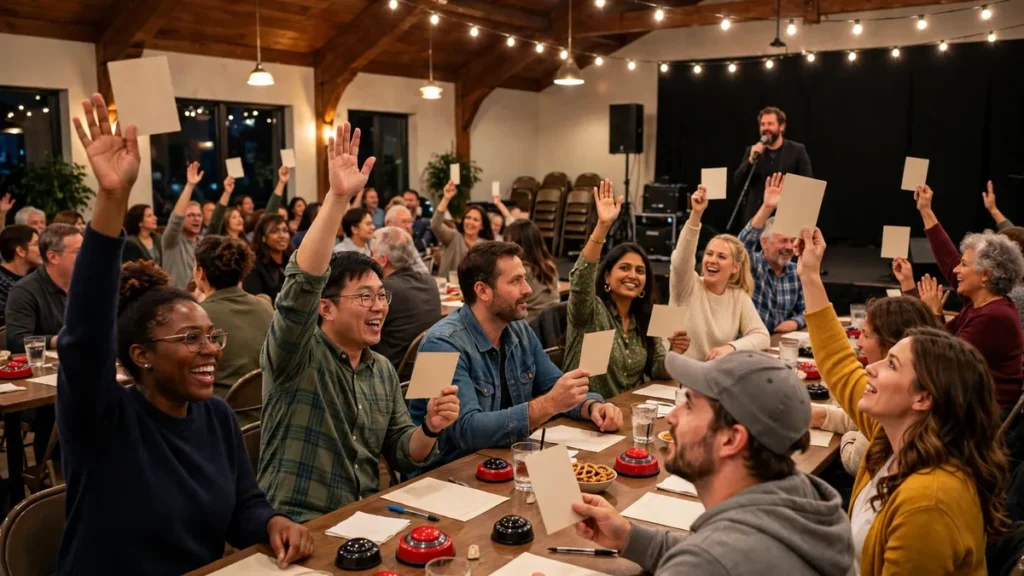
The best word games for 331 players turn a crowd that most hosts would call unmanageable into one of the liveliest group events you can run. Three hundred and thirty-one people sounds like far too many for a word game, because most word games were designed for a table of four or six, with everyone taking turns, hearing the same clue at the same moment, or crowding around a single board. The trick is not to find a game that seats 331 people at once. The trick is to choose word games that split cleanly into teams, give every person a useful job at the same time, and reward quick thinking and clear communication instead of the loudest voice in the room.
Word games suit a crowd of this size better than almost any other kind of party game. They need very little equipment, they work for a wide mix of ages and abilities, and they keep every team busy at the same moment, so nobody stands around waiting for a turn. A school festival, a company gathering, a community day, a youth camp, or a large family reunion can all run on the same basic plan: clear stations, simple rules, fair scoring, and word lists that suit the people in the room.
This guide covers the best word games for 331 players in full, from giant crossword relays and team anagrams to word bingo, chain games, and phone-based rounds that hundreds of people can join at once. You will also find a practical plan for teams, tables, timing, and scoring, plus a comparison table, a checklist, and answers to the questions hosts ask most often.
Key takeaways
- Split 331 players into teams of 5 to 7, which gives you roughly 48 to 66 teams that can all play at the same time.
- Choose games where every team works at once, so nobody waits for a turn while the rest of the room plays.
- Use short rounds of 10 to 15 minutes, with a clear signal to start and stop each round.
- Prepare word lists in advance, and keep a separate easy list and a harder list for mixed-age groups.
- Score by points per correct answer, with a small bonus for speed, and post the leaderboard where everyone can see it.
Why Word Games Work for 331 Players
Most party games fail at this scale for one simple reason: they make most people wait. A game where one person acts out a clue while three hundred people watch is a show, not a game. Word games are different, because the core activity is thinking and writing, and a hundred teams can think and write at exactly the same moment.
Word games also travel well across ages and backgrounds. A ten-year-old and a seventy-year-old can both play an anagram round, a word search race, or a category game, even if they do not know the same words. That matters when your 331 players include children, parents, grandparents, work colleagues, and neighbours.
Every Team Plays at Once
The strongest reason to choose word games for a huge group is that the format scales without extra cost. One printed sheet per team, one set of rules read aloud, and one timer is enough to start a round for sixty teams. Word games keep the host free to walk the room, answer questions, and keep the energy up, instead of running from table to table to keep the game moving.
Low Cost and Simple Setup
A word game night for 331 players can run on paper, pens, and a loudspeaker. You can print answer sheets in bulk, reuse letter tiles and whiteboards from round to round, and run the whole event in a single hall with long tables. If you want a digital round, a free quiz tool on a phone lets hundreds of players answer at once, and the scoring happens by itself.
How to Organise 331 Players
Good organisation matters more than the choice of game. With 331 players, a small delay at the start becomes a long delay by the third round, and unclear scoring creates arguments that slow everything down. Spend twenty minutes on the plan before the event, and the games will almost run themselves.
Form Teams of 5 to 7 Players
Divide the crowd into teams of 5 to 7 players, which gives you between 48 and 66 teams. Teams of this size are large enough that every team has a mix of strengths, and small enough that every member can speak and be heard. Give each team a number and a name, hand out a coloured wristband or a team card, and seat each team at its own table or marked area. Mixed teams work best, so blend ages and abilities where you can, and keep families together when children are part of the event. If you are running a similar event with a slightly smaller crowd, the planning in our guide to Best Word Games for 329 Players follows the same team sizes and rotation pattern.
Use Stations and Rotations
Set up four to six stations around the room, with a different word game at each one, and rotate teams every 12 minutes. Stations stop the room from feeling like one giant classroom, and they let teams play games that need different setups, such as a letter-tile table, a crossword wall, and a fast buzzer round. Put a simple instruction card at each station, and use a bell or a whistle to signal each rotation.
Keep Rounds Short and Timed
Short rounds keep energy high and stop stronger teams from running away with the event. A round of 10 to 15 minutes is long enough for real thinking and short enough that a team that struggles in one game gets a fresh start at the next station. Display a large countdown timer where everyone can see it, and collect answer sheets the moment time runs out.
The 10 Best Word Games for 331 Players
These ten games were chosen because they work for dozens of teams at once, need little or no special equipment, and stay fun across a wide range of ages. Each one includes the setup, the rules in brief, and a tip for running it with a crowd of 331.
1. Giant Team Crossword Relay
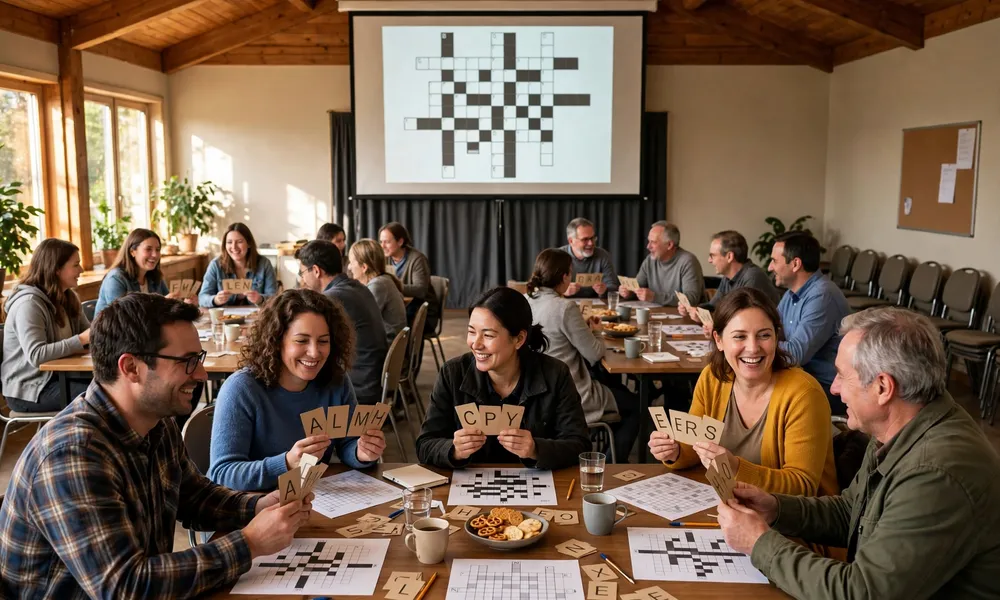
Print a large crossword grid on a poster or project it onto a screen at the front of the hall, and give each team a matching blank grid on paper. Read the clues aloud one at a time, and teams race to fill in the answers. Award two points for each correct answer and a bonus of five points for the first team to complete a full row. Use general knowledge clues and everyday words so that younger players can contribute as well as adults.
2. Anagram Race
Give each team a set of ten scrambled words, all from one theme such as food, animals, or travel. Teams unscramble as many as they can in ten minutes, with three points for each correct answer and a bonus for finishing first. Prepare an easy set and a hard set, and let teams choose which set to play, so that nobody feels stuck on words that are far beyond them.
3. Word Bingo
Word bingo is one of the simplest games to run for 331 players. Print bingo cards with words instead of numbers, and call out definitions or clues rather than the words themselves. A team marks the word that matches each clue, and the first team to complete a row, a column, or a full card calls out and wins the round. Laminate the cards if you plan to reuse them, and prepare several card designs so that neighbouring teams cannot copy each other.
4. Category Chain
In a category chain, the host names a category such as countries, animals, or foods, and each team must write down as many words in that category as it can in three minutes. Teams score one point per valid word, and they lose a point for any word that appears on another team list, which pushes teams toward unusual answers instead of obvious ones. Decide the rules for disputed words before you start, and appoint one judge per station.
5. Word Ladder Challenge
A word ladder asks teams to change one word into another by changing one letter at a time, with every step forming a real word. Turning COLD into WARM, for example, might pass through CORD, CARD, WARD, and WARM. Give each team five ladders of increasing difficulty, award points per completed ladder, and add a speed bonus for the fastest team. Word ladders suit a big crowd because they are quiet, focused, and easy to mark: an answer is either a valid chain or it is not. They also give quieter players a real role, since careful thinking beats fast talking.
6. Letter Tile Scrabble Sprint
Set out trays of letter tiles at each station, and give teams ten minutes to build the highest-scoring set of connected words they can on a shared board or table. Teams score the usual letter values, with double points for any word longer than six letters. A sprint format works far better than a full game for 331 players, because nobody waits for a turn and every team plays the whole time. Use large tiles or magnetic letters so that teams can work together around a table, and photograph each finished board before the next round so that scoring stays accurate.
7. Guess the Word
Guess the Word is a team version of the classic clue game. One player per team sees a secret word and gives one-word clues while the rest of the team guesses, with a new clue giver each round. Teams have two minutes per word and score a point for each word guessed correctly. Keep the word list friendly and familiar, and avoid words that only a few people in the room would know.
8. Word Search Race
Print a large word search grid for each team, with twenty hidden words from a single theme, and give teams twelve minutes to find them all. Teams score one point per word found, and the first team to find every word earns a five-point bonus. Word search races are calm, inclusive, and easy to run, which makes them a good change of pace after a noisy round. Use large print so that the grid is easy to read from across a table.
9. Missing Vowels
Write ten familiar phrases with all the vowels removed, such as HPPY BRTHDY for Happy Birthday, and ask teams to restore the full phrase. Teams score two points per correct phrase, with a bonus for the fastest correct sheet. Choose phrases that everyone in the room will know, from song titles and film names to everyday sayings, and keep the difficulty steady across all ten phrases.
10. Phone Quiz Showdown
For a modern finish, run one round on phones. Teams join a quiz app with a code, and the host projects each question on the main screen. Questions can be word definitions, anagrams, missing words, or odd-one-out rounds, and the app scores every team automatically. Test the Wi-Fi and the quiz code before the event, and keep a paper backup round ready in case the connection fails. If you want to mix in other kinds of games for a full day of play, our guide to Best Puzzle Games for 331 Players pairs well with this list.
Word Games for 331 Players at a Glance
Use this table to pick the right mix for your event. Quiet games suit the middle of the day, when energy dips, while fast games work best as an opener or a finale.
| Game | Time per round | Equipment needed | Best for |
|---|---|---|---|
| Giant Team Crossword Relay | 15 minutes | Projector and printed grids | Whole-room focus |
| Anagram Race | 10 minutes | Printed sheets | Quick thinking |
| Word Bingo | 15 minutes | Printed bingo cards | Mixed ages |
| Category Chain | 5 minutes | Paper and pens | Warm-up rounds |
| Word Ladder Challenge | 12 minutes | Printed sheets | Careful thinkers |
| Letter Tile Scrabble Sprint | 10 minutes | Letter tiles | Hands-on teams |
| Guess the Word | 10 minutes | Word cards | High energy |
| Word Search Race | 12 minutes | Printed grids | Calm rounds |
| Missing Vowels | 10 minutes | Printed sheets | Easy marking |
| Phone Quiz Showdown | 15 minutes | Phones and Wi-Fi | Grand finale |
Scoring That Keeps 331 Players Honest
Fair scoring is what turns a fun afternoon into an event people want to repeat. With sixty teams, you need a system that is simple enough to explain in one minute, hard to argue with, and easy to add up at the end. Points per correct answer, with a small bonus for speed, is the most reliable system. Every team understands it, every volunteer can apply it, and the leaderboard stays close enough that teams at the bottom keep trying.
Post the scores after every round on a large board or a projected screen, and read out the top five teams so that everyone knows where they stand. Announce the scoring rules before the first game, apply them the same way to every team, and keep one judge per station to settle disputes on the spot. Give small prizes for more than just the overall winner, such as the best team name, the fastest round, or the most creative answer, so that more teams leave with something to celebrate.
Checklist for Your Word Game Event
Run through this checklist the day before your event, and again on the morning of the event, so that nothing important is left to chance.
- Confirm the venue, the seating plan, and the number of tables for 48 to 66 teams.
- Print answer sheets, bingo cards, and word lists, with spares for every station.
- Prepare an easy word list and a harder word list for mixed-age groups.
- Test the projector, the loudspeaker, the timer, and the phone quiz code.
- Brief your volunteers on the rules, the scoring, and the rotation signals.
- Set up the leaderboard board and prepare small prizes for the winning teams.
Frequently Asked Questions
How many teams should 331 players form?
Teams of 5 to 7 players work best, which gives you roughly 48 to 66 teams. This size keeps every member involved while giving each team enough people to cover different strengths, from spelling and vocabulary to fast thinking and teamwork.
How long does a word game event for 331 players take?
Plan for two to three hours for three or four games in rotation, including a short welcome, the rotations, and the prize giving. A full-day event can run all ten games in this guide, with breaks for food and rest between sessions.
What equipment do I need for 331 players?
Paper, pens, printed answer sheets, a loudspeaker, a large timer, and a projector or a big screen cover most games in this guide. Add letter tiles, bingo cards, and whiteboards if you want hands-on stations, and test any phone quiz app and Wi-Fi connection well before the event starts.
Can children and adults play the same word games?
Yes, and mixed-age teams often do best. Choose games with simple rules, such as word bingo, category chains, and word search races, and prepare an easy word list alongside a harder one so that younger players can contribute in every round. For a change of pace between word rounds, the team quiz format in our guide to Best Trivia Games for 331 Players works with the same teams and the same rotation plan.
How do I stop stronger teams from winning every round?
Use short rounds, rotate the games, and give speed bonuses that are small compared with points for correct answers. Offer prizes for the best team name, the most creative answer, and the fastest single round, so that teams that never top the leaderboard still have something to aim for in every game.
What if the venue has no projector or Wi-Fi?
Almost every game in this guide runs on paper alone. Use printed crossword grids, answer sheets, and a large wall chart for scores, and replace the phone quiz round with an extra round of anagrams or alphabet races. A loud voice, a bell, and clear printed instructions matter far more than any screen.
Bottom Line
The best word games for 331 players are the ones where every team plays at the same time, the rules fit on a single card, and the scoring is fair enough that nobody argues about it. Split the crowd into teams of 5 to 7, run short rounds at clear stations, mix quiet games with fast ones, and finish with a round the whole room can watch together. Do that, and 331 players will not feel like a crowd to manage. It will feel like a room full of teams who all had a part to play.