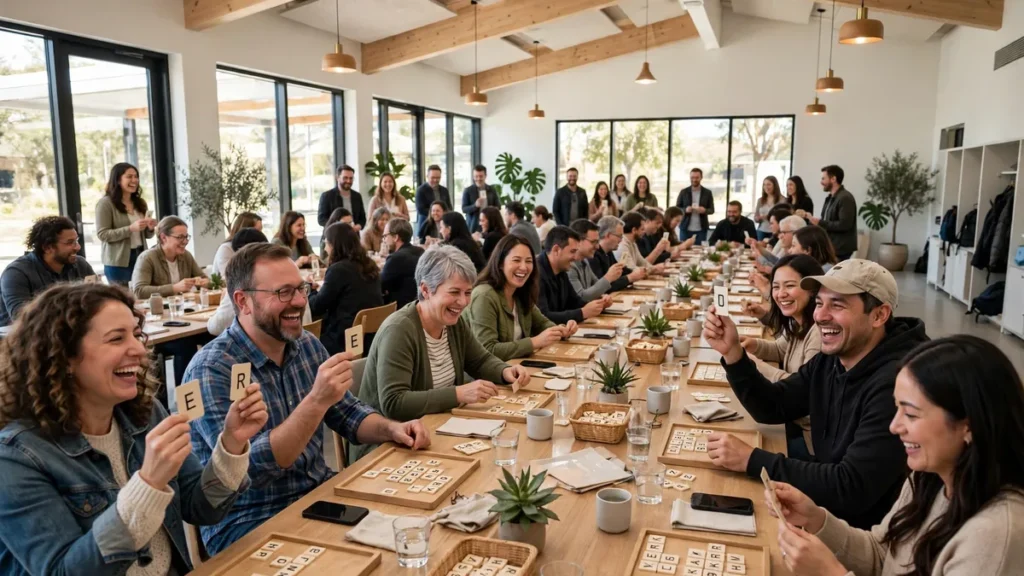
Finding the best word games for 321 players sounds impossible at first. Most word games are built for four to eight people around one table, yet word games are easy to scale, because they run on language, quick thinking, and team energy rather than boards, pieces, or turns that take forever.
The best word games for 321 players share three traits: they work in teams, they keep everyone playing at the same time, and they need almost no equipment. A game that makes 300 people wait will fail in ten minutes, while a game that splits the crowd into teams, gives every team the same challenge, and scores answers in real time will keep the whole room buzzing.
This guide covers the twelve best word games for 321 players, how to set them up, how to score them fairly, and how to run the event without chaos. Whether you are planning a school assembly, a company event, or a huge family reunion, these games will turn a giant crowd into one loud, laughing, word-loving team.
Key Takeaways
- Split 321 players into teams of 6 to 10 so everyone gets a real role and no one waits long for a turn.
- Choose games that run in parallel rounds, so all teams play at the same time.
- Use a projector, a microphone, and printed answer sheets to keep scoring fast and fair at this scale.
- Mix quick word games with longer team challenges to keep energy high from start to finish.
- Keep the rules simple enough to explain in under two minutes.
Why Word Games Work So Well for 321 Players
Word games scale better than almost any other kind of party game. A board game needs a board for every group, a physical game needs space and equipment, and a video game needs screens and controllers. A word game needs only a prompt, a timer, and a way to collect answers.
Word games also level the playing field, because age, fitness, and gaming experience matter very little when the challenge is to find words, solve clues, or build a sentence. A ten-year-old can beat a grown-up at an anagram round, and a quiet player can shine in a written word challenge.
How to Run Word Games for 321 Players
Running word games for 321 players is mostly about organisation, and getting the structure right before the event starts means the games will almost run themselves.
Split the Crowd Into Teams
Divide 321 players into teams of 6 to 10, aiming for teams of eight where possible. That gives you 40 teams with one player left over, who can join any team. Teams smaller than six leave some players doing all the work, while teams larger than ten let quieter players hide.
Give every team a name, a colour, and a table or a marked area. Names make scoring easier and give players something to cheer for, while colours help the host spot teams quickly. If you are short on tables, mark team zones with tape on the floor or numbered signs, because players need to know exactly where their team sits.
Use One Host and a Scoring Crew
One confident host should run the event with a microphone and a projector, reading the prompts, starting the timer, and announcing the answers. A scoring crew of four to six helpers collects answer sheets, checks them against the answer key, and updates the scoreboard, so the host never has to stop to count points.
Print answer sheets in advance, one per team per round, with the team name and round number already filled in. Loose scraps from 40 teams are slow to sort, while neat sheets stack and score quickly. A spreadsheet projected on a screen works well as a live scoreboard, and updating it between rounds keeps every team invested.
Keep Rounds Short and Timed
Keep each round between three and eight minutes. Short rounds keep energy high and stop the strongest teams from pulling too far ahead early. A strict timer on the projector adds excitement and stops debates from dragging on. When the timer ends, answers are locked, because fairness matters more than one extra point.
The 12 Best Word Games for 321 Players
These twelve games were chosen because they work at scale. Each one runs in parallel across all teams, needs little equipment, and can be explained in under two minutes.
1. Giant Word Bingo
Giant Word Bingo is the simplest game on this list and a great way to warm up a crowd of 321. Every player gets a bingo card filled with words instead of numbers, and the host calls out definitions or clues. The first team to complete a row, a column, or a full card wins the round.
Rotate through eight or ten card designs so neighbouring teams cannot copy each other, and call definitions instead of words so players must work out which word matches the clue. Play three short rounds with a small prize for each winning team.
2. Team Anagram Race
In a Team Anagram Race, every team gets the same set of jumbled letters and five minutes. Teams must build as many real words as they can from those letters, with longer words earning more points. Because every team works from the same letters, the winner is the team that found the most words or the longest word.
Choose a letter set with plenty of vowels and common consonants, such as the letters from “celebration night.” Award one point per three-letter word, two per four-letter word, and three for five letters or more.
3. Word Chain Relay
Word Chain Relay turns a simple word game into a race. Each team stands in a line, and the host gives a starting word. The first player says a word that begins with the last letter of the previous word, then tags the next player to continue the chain. A team scores a point for every valid word, until the timer ends or a player repeats a word.
With 321 players, run this game in waves, because a relay needs space and a clear line of sight. Send ten teams to the front at a time while the others watch, cheer, and prepare their chains. The audience becomes part of the game, which makes the relay one of the loudest rounds of the night.
4. Category Countdown
Category Countdown is a fast game that tests quick thinking. The host names a category, such as animals, countries, or foods, and a starting letter. Every team has sixty seconds to write down as many words in that category starting with that letter as they can. Unique answers earn more points than answers shared by many teams.
Play five or six quick categories in a row, changing the letter each time. The rule is simple: one point per valid word, plus a bonus point for any word no other team wrote down. If your crowd enjoys fast trivia-style rounds, the energy here feels very similar to the quick-fire rounds in the best trivia games for 321 players, and the two formats pair well in one event.
5. Mystery Word Guessing
Mystery Word Guessing works like a giant game of twenty questions played with words. The host thinks of a secret word and gives the crowd one clue at a time. Teams write down their guess after each clue, and the fewer clues a team needs, the more points it earns: five points after one clue, four after two, and so on down to one point.
Choose secret words that everyone knows but that are hard to pin down from a single clue, such as “umbrella,” “lighthouse,” or “backpack.” Start with a vague clue, such as “you can find me outside,” and get more specific each time. The tension builds as teams realise they know the answer but cannot quite prove it.
6. Sentence Builders
Sentence Builders is a creative game that rewards humour as much as vocabulary. Each team draws five random words from a hat or a printed list, and must write a single sentence that uses all five words. The host reads the best sentences aloud, and teams vote for their favourites, or a judging panel awards points for the funniest, cleverest, and most sensible sentences.
There is no single right answer, so every team can succeed. A team of children might write a gloriously silly sentence, while a team of adults writes something sharp and witty, and both can win points in different categories. Keep the word lists mixed, with one noun, one verb, one adjective, and two wildcards, so the sentences stay varied.
7. Word Search Sprint
A Word Search Sprint gives every team the same large word search grid and a list of twenty hidden words. Teams race to find as many words as they can in five minutes, circling each word they find. The team that finds the most words wins, with a tie-breaker going to the team that found the longest word first.
Print the grids large enough to read at arm’s length, because 321 players sharing small print will slow the game down. Use a theme for each grid, such as food, travel, or animals, so the hidden words feel connected rather than random. This game is a calm change of pace after loud rounds, and it suits players who prefer quiet focus to shouting.
8. Rhyme Time Challenge
Rhyme Time Challenge is exactly what it sounds like: teams race to list as many words as they can that rhyme with a given word. The host announces a word such as “light,” “day,” or “star,” and teams have ninety seconds to write down every rhyme they can think of. Real words only, and the host checks disputed answers against a dictionary.
This game is wonderfully simple to run and surprisingly competitive, because rhyming feels easy until the timer starts and the obvious words run out. Award one point per valid rhyme, with a bonus for the longest list in the room. Choose starting words with plenty of rhymes, such as “cat,” “ball,” or “tree,” and avoid words with only one or two rhymes. For groups that love pure wordplay, this game sits naturally alongside the classic formats in the best word games for 319 players, which uses the same team-based structure at a similar scale.
9. Crossword Relay
Crossword Relay adapts the classic crossword for a huge crowd. The host projects a large crossword grid on the screen, and teams take turns sending one player to the front to fill in a single answer. A correct answer earns a point, while a wrong answer passes the turn to the next team. The team with the most correct answers wins.
Design the crossword with a mix of easy and hard clues, so every team has a chance to score. Easy clues keep the game moving, while hard clues create drama when a confident player gets one wrong. Keep each player’s turn to thirty seconds, and use a large, clear font on the projector so the whole room can follow the grid.
10. Spelling Bee Showdown
A Spelling Bee Showdown for 321 players works as a team event rather than an individual contest. Each team nominates a speller for each round, and the host reads out a word. The speller must spell it correctly within thirty seconds. A correct spelling earns a point, while a wrong spelling passes the word to the next team, which can steal the point.
Rotate spellers so that every team member gets a turn across the session, because a spelling bee that uses the same player every round leaves most of the team watching. Mix the word list with easy words, tricky words, and a few genuinely hard words for the final rounds, so the difficulty rises as the scores tighten. The steal rule keeps every team listening even when it is not their turn.
11. Word Association Storm
Word Association Storm is a speed game that reveals how differently people think. The host shows a word on the screen, and every team has thirty seconds to write down the first five words that come to mind. Teams earn points when their words match the most popular answers across the room.
This game is a refreshing change from games that reward rare answers, because here the goal is to predict what most people will say. A prompt word like “summer” might bring “sun,” “beach,” “ice cream,” “holiday,” and “hot,” and the teams that guess the most common answers score highest. Announce the top five answers after each round, because the reveal is half the fun. The format also shares the same large-group energy as the best puzzle games for 321 players, which many hosts run in the same event.
12. Story Word Pass
Story Word Pass is the perfect closing game for a crowd of 321. Each team starts a story with one sentence that includes a word chosen by the host. After two minutes, teams pass their story to the next team, which continues it using a new word from the host. After four or five passes, the stories return to their starting teams, and the host reads the best ones aloud.
This game ends the session on a high note because it is creative, collaborative, and funny. The stories take unexpected turns as they pass between teams, and the final readings usually get the biggest laughs of the night. Award points for the funniest story, the most creative use of the host’s words, and the best ending.
Word Games for 321 Players at a Glance
Use this table to plan your session. It shows how long each game takes, what you need, and how much energy it brings, so you can build a balanced schedule.
| Game | Time per Round | What You Need | Energy Level | Best For |
|---|---|---|---|---|
| Giant Word Bingo | 10 minutes | Printed bingo cards, clues | Medium | Warming up the crowd |
| Team Anagram Race | 5 minutes | Letter sets, answer sheets | High | Quick thinking |
| Word Chain Relay | 15 minutes | Open floor space | Very high | Energy and laughter |
| Category Countdown | 6 minutes | Category cards, timer | High | Fast recall |
| Mystery Word Guessing | 8 minutes | Secret word list, clues | Medium | Building suspense |
| Sentence Builders | 10 minutes | Random word lists | Medium | Creativity and humour |
| Word Search Sprint | 5 minutes | Printed grids | Low | A calm change of pace |
| Rhyme Time Challenge | 5 minutes | Starter words, timer | High | Pure wordplay |
| Crossword Relay | 15 minutes | Projected grid, markers | High | Team spotlight moments |
| Spelling Bee Showdown | 12 minutes | Word list, microphone | High | Drama and steals |
| Word Association Storm | 5 minutes | Prompt words, screen | Medium | Quick crowd thinking |
| Story Word Pass | 15 minutes | Story sheets, prompt words | Medium | A fun closing game |
Checklist: Your 321-Player Word Game Setup
Run through this checklist before the event starts. Every item prevents a problem that is much harder to fix once 321 players are in the room.
- Teams are set in advance, with 6 to 10 players each, a team name, and a marked table or zone.
- Answer sheets are printed for every team and every round, with team names already filled in.
- A host, a microphone, a projector, and a visible timer are tested and ready before players arrive.
- A scoring crew of four to six helpers knows the answer keys and the scoring rules for every game.
- All game materials, including cards, grids, word lists, and prizes, are sorted by round and within easy reach.
- A live scoreboard is ready to update between rounds, and the schedule allows a short break halfway through.
Frequently Asked Questions
How do you split 321 players into teams for word games?
Split 321 players into teams of 6 to 10, aiming for teams of eight where possible. That gives you 40 teams of eight with one extra player, who can join any team.
What equipment do you need for word games with 321 players?
You need a microphone, a projector, a visible timer, printed answer sheets, pens, and the game materials for each round, such as bingo cards, word grids, or letter sets.
How long should a word game session for 321 players last?
Plan for about two hours with six to eight rounds and a short break in the middle. Each round should last between three and fifteen minutes depending on the game.
Can children and adults play these word games together?
Yes, most of these games work well for mixed-age groups, because they reward vocabulary, creativity, and quick thinking rather than age or strength.
How do you score word games fairly with 321 players?
Use printed answer sheets with team names, a scoring crew of four to six helpers, and a simple points system announced before each round. Collect sheets when the timer ends and check them against an answer key.
What is the best word game to start with for 321 players?
Giant Word Bingo is the best opening game, because it is easy to explain, everyone plays at the same time, and it warms up the crowd without putting anyone on the spot.
Bottom Line
The best word games for 321 players are the ones that let everyone play at once, keep the rules simple, and turn a giant crowd into teams that cheer, debate, and laugh together. Split the crowd into teams of 6 to 10, run short timed rounds with a clear host and a scoring crew, and mix quick games like Category Countdown with creative closers like Story Word Pass, and 321 players will feel like the biggest, loudest, most enjoyable word game night you have ever hosted.


