
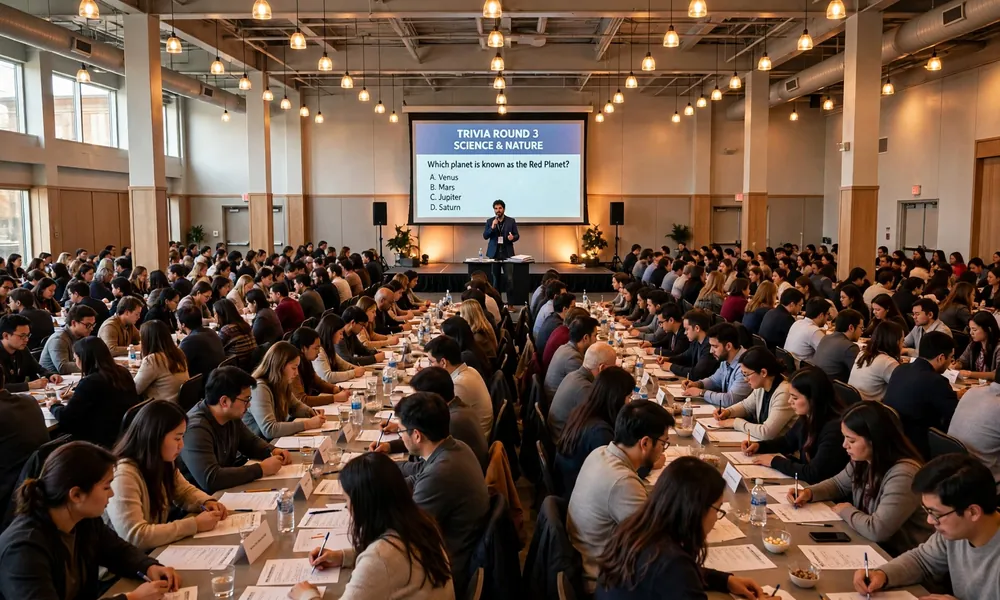
Finding the best trivia games for 320 players takes more than picking a popular quiz and hoping it scales. A game that works beautifully for a table of six can fall apart when three hundred people are trying to hear the questions, submit answers, and stay engaged at the same time. Sound, scoring, team size, and pacing all change once the crowd grows past a hundred, and the formats that survive at this scale are the ones built around clear questions, simple answer systems, and a host who can keep the energy up for two hours.
The good news is that trivia is one of the few party formats that genuinely works for a crowd of 320. Unlike games that need everyone to take turns, trivia lets every team play every question at the same time, so nobody sits idle waiting for their turn. With the right structure, 320 players become 40 or 50 teams competing in the same room, and the competition feels bigger and louder than any small-group game night ever could.
This guide covers the formats, games, and setup steps that actually work at this size. You will find nine game ideas ranked for huge groups, a comparison table to help you choose, a setup plan for the room and the tech, scoring systems that stay fair with dozens of teams, and a checklist you can run through before the night begins. Everything here is designed for real events: company parties, school fundraisers, community nights, and conferences where the guest list is long and the trivia has to deliver.
Key Takeaways
- Trivia scales to 320 players because every team answers every question at the same time, so nobody waits for a turn.
- Teams of six to eight players work best, giving you roughly 40 to 50 teams and a manageable scoring load.
- Digital answer systems such as phone-based buzzer apps remove the paper-handling bottleneck that slows down large games.
- A mix of five or six short rounds with varied categories keeps energy high and gives trailing teams a reason to keep playing.
- One confident host, a clear sound system, and a visible scoreboard matter more than the questions themselves.
What Makes Trivia Work for 320 Players
Trivia works at this scale for a simple reason: it is a parallel game, not a turn-based one. In a board game, 320 people would need dozens of copies and hours of waiting. In trivia, one question reaches the whole room at once, every team discusses it for thirty seconds, and every team submits an answer. The game moves at the speed of the host, not at the speed of the slowest player, and that keeps a huge crowd in sync.
Why Scale Changes the Game
Scale changes three things: sound, scoring, and attention. Sound is the first problem, because a host speaking to 320 people needs a proper microphone and speakers, not a raised voice. Scoring is the second, because collecting and marking 50 answer sheets by hand between rounds takes far longer than most hosts expect. Attention is the third, because a question that takes two minutes to explain will lose a room of this size, while a short, punchy question keeps everyone locked in.
The Best Trivia Games for 320 Players
The nine games below are ranked for a crowd of 320, starting with the formats that handle huge numbers most smoothly. Each one works with teams of six to eight, and each one can fill a two-hour event on its own or combine with others to build a full evening.
1. Classic Pub Quiz
The classic pub quiz remains the best trivia game for 320 players because it is simple, proven, and easy to run. Teams get a paper answer sheet, the host reads six rounds of ten questions, and volunteers collect and mark the sheets between rounds. Categories such as general knowledge, music, sport, geography, food, and history give every team a chance to shine, and a picture round adds variety without extra equipment. With 50 teams, you need about eight volunteers for scoring, and the whole evening runs cleanly in two hours including breaks.
2. Phone-Based Live Quiz
A phone-based live quiz is the fastest option for a crowd this size. Each team joins with one phone, answers on screen, and sees results instantly, which removes the entire paper-handling bottleneck. The host controls the pace from a laptop, questions appear on the big screen, and a live leaderboard keeps the room buzzing after every question. This format suits conferences and company events where most guests carry a phone, and it scales effortlessly because the software does the scoring. Make sure the venue Wi-Fi can handle 50 devices at once, or provide a dedicated hotspot.
3. Music Trivia Night
Music trivia is a crowd favourite because it turns the room into a singalong. The host plays short clips of well-known songs and teams name the artist, the title, or the year, with bonus points for extra detail. Ten-second clips keep the pace brisk, and mixing decades from the seventies to today means every age group in the room gets questions they can answer. A good sound system matters more here than in any other format, so test the speakers before the night and keep the volume high enough for the back tables.
4. Picture Round Extravaganza
A picture round works beautifully for 320 players because it is silent, visual, and easy to run in parallel. Teams receive a printed sheet of twenty images, such as famous landmarks, movie stills, logos, or celebrity faces, and work through them during a timed window. The host never has to read anything aloud, which gives the sound system a rest and lets teams talk among themselves. Picture rounds also make great tiebreakers, since a single tricky image can separate teams that are level on points.
5. General Knowledge Championship
A general knowledge championship suits competitive crowds who want a serious contest rather than a casual party game. Six rounds of ten questions cover science, history, geography, arts, sport, and current affairs, with a harder final round worth double points. The structure rewards broad knowledge and steady play, and the double-points finale keeps the leaderboard close until the last question. This format works well for school fundraisers and club competitions where teams take the result seriously.
6. Movie and TV Trivia
Movie and TV trivia draws on knowledge almost everyone shares, which makes it ideal for mixed groups of 320 strangers and colleagues. Questions can cover famous quotes, plot details, actors, theme songs, and box office records, with rounds split by era or genre so no single group dominates. A video round showing short clips adds drama, and a round on animated films or classic television gives younger and older players their own strengths. Keep the questions fair by mixing blockbusters with well-known classics rather than obscure cult films.
7. Sports Trivia Showdown
A sports trivia showdown brings out the competitive streak in any large crowd. Rounds can cover football, cricket, basketball, tennis, the Olympics, and famous sporting moments, with picture questions showing stadiums, trophies, and legendary players. The format works especially well for company events tied to a big tournament or for sports clubs hosting a fundraiser. Mix easy questions that casual fans can answer with harder ones for the superfans, and add a fastest-finger bonus round where the first team to answer correctly earns extra points.
8. Geography and World Trivia
Geography trivia suits diverse crowds because it draws on maps, flags, capitals, landmarks, and food from around the world. A flags round is always popular, and a landmarks picture round lets teams identify places from photographs without needing specialist knowledge. This format is a strong choice for international conferences and multicultural workplaces, where teams bring knowledge of different countries to the table. Include questions about rivers, mountains, and famous cities alongside the capitals so the rounds stay varied.
9. Rapid-Fire Buzzer Battle
A rapid-fire buzzer battle is the most exciting way to finish a 320-player night. The top eight teams from the earlier rounds come to the front, and the host asks quick questions with a buzzer or phone-based fastest-finger system. The crowd cheers, the tension builds, and the final winner is decided in front of everyone. This format only works as a finale, since 320 people cannot all buzz in at once, but as a closing act it turns a good trivia night into a memorable one.
Comparing the Top Formats for 320 Players
| Format | Teams | Scoring | Rounds | Best For |
|---|---|---|---|---|
| Classic pub quiz | 40 to 50 | Paper sheets | 6 rounds | Community nights |
| Phone-based live quiz | 40 to 50 | Automatic | 5 rounds | Conferences |
| Music trivia night | 40 to 50 | Paper or app | 5 rounds | Parties |
| Picture round | 40 to 50 | Paper sheets | 2 rounds | Fundraisers |
| General knowledge | 40 to 50 | Paper or app | 6 rounds | Competitions |
| Buzzer battle finale | Top 8 | Live points | 1 round | Finale only |
The classic pub quiz and the phone-based quiz are the two safest choices for a first event at this size. The pub quiz needs more volunteers but no technology, while the phone quiz needs reliable Wi-Fi but almost no scoring help. If you are unsure which to pick, ask the venue about its sound system and internet first, because those two answers will decide the format for you. For a slightly smaller crowd, the ideas in our guide to the best trivia games for 319 players use the same team structure and scale down easily.
How to Set Up a 320-Player Trivia Night
Setup starts with the room. Arrange long tables or rounds of eight, with every seat facing the stage and the main screen, and leave wide aisles so volunteers can collect answer sheets quickly. Place the host on a raised stage with a microphone, a laptop, and a clear view of the room, and put the scoreboard on a second screen or a large board where every team can see it. Test the sound from the back row before guests arrive, because a host who cannot be heard will lose the room in the first ten minutes.
Sound, Screens, and Lighting
Sound is the single most important technical element. Use a professional PA system with at least two speakers placed to cover the whole room, and give the host a wireless microphone so they can move around the stage. Screens should be large enough to read from the back, with questions shown in a large, high-contrast font and a visible countdown timer. Keep the lighting bright enough for teams to read and write, but dim the stage area slightly so the screen stands out. Run a full rehearsal with the sound and slides the day before if the venue allows it.
Scoring Systems That Scale to 320 Players
Scoring is where large trivia nights succeed or fail. The simplest system is one point per correct answer, with a bonus point for a perfect round, which is easy to explain and easy to mark. A slightly richer system adds double points for the final round and a joker card that lets each team double one round of their choice, which adds strategy without adding complexity. Whatever system you choose, print it on every answer sheet and announce it before the first question, because mid-game rule changes will frustrate a room of 320 people.
Tiebreakers deserve planning too. With 50 teams, ties are almost guaranteed, so prepare three tiebreaker questions in advance and use them in order until one team leads. A good tiebreaker asks for a number, such as the height of a famous building or the year a landmark opened, with the closest guess winning. This avoids endless rounds of extra questions and gives the audience a satisfying finish. The team-size and scoring ideas in our guide to the best trivia games for 318 players follow the same approach and work well as a reference for your own scoring sheet.
Team Sizes and Room Layout for 320 Players
Teams of six to eight are the sweet spot for a crowd of 320. Smaller teams mean more teams to score and more answer sheets to handle, while larger teams mean some players stop contributing because the table is too crowded to discuss. Eight is the maximum that can comfortably talk around one table, and six is the minimum that gives a team a good spread of knowledge. If your guest list divides unevenly, allow a few teams of five or nine rather than forcing awkward splits, and cap every team at nine so no single table dominates.
Your Pre-Event Checklist
Run through this checklist in the week before your event, and again on the day itself. Each item prevents a specific problem that regularly affects large trivia nights, from silent microphones to missing answer sheets.
- Confirm the venue sound system, microphones, screens, and Wi-Fi with a written test the day before the event.
- Print 55 answer packs, including five spares, with team numbers, the scoring rules, and a pen for every table.
- Brief your host, slide operator, scorekeepers, and floor helpers together, and run one full practice round.
- Prepare 60 questions plus 10 spares and three tiebreakers, and check every answer against two sources.
- Set up the leaderboard and the prize table before doors open, so the first teams see a finished room.
- Charge the host laptop, the spare microphone batteries, and the backup phone hotspot, and keep paper answer sheets as a fallback.
Common Mistakes to Avoid With 320 Players
The most common mistake is writing questions that are too long or too hard. A question that takes a minute to read will lose the room, and a round where most teams score two out of ten will kill the energy. Aim for a mix where the average team scores six or seven out of ten, with two easy questions, six medium ones, and two hard ones per round. That balance keeps teams feeling smart while still separating the leaders from the rest.
Frequently Asked Questions
How many teams should 320 players form?
Divide 320 players into 40 to 50 teams of six to eight players each. Teams of eight are the easiest to seat at round tables, while teams of six give every player more chances to contribute. Avoid teams larger than nine, because discussion becomes difficult and quieter players stop taking part.
How long does a trivia night for 320 players take?
Plan for two hours of play plus two ten-minute breaks, so the whole evening runs about two and a half hours from the first question to the prizes. Six rounds of ten questions take roughly ninety minutes, and the remaining time covers the welcome, the picture round, and the finale. A buzzer battle finale adds about fifteen minutes.
Do I need special software for 320 players?
No, a classic paper-based pub quiz works well with enough volunteers, but phone-based quiz software makes scoring faster and adds a live leaderboard. If you choose software, test it with 50 devices on the venue Wi-Fi before the event, and keep paper answer sheets as a backup in case the connection fails.
What prizes work best for a crowd this size?
Offer prizes for the top three teams, plus fun awards such as best team name and the wooden spoon for last place, so more teams have something to aim for. Gift vouchers, hampers, and trophies all work well, and a small prize for every team member keeps the winners happy without costing a fortune.
How do I keep 320 players engaged between rounds?
Update the leaderboard after every round, play music during breaks, and use the host to shout out funny team names and close scores. A picture round or a bonus challenge during the break gives teams something to do while scoring happens, and keeps the energy up instead of letting the room drift.
Can children play in a 320-player trivia night?
Yes, if the questions suit a mixed-age audience. Include family-friendly rounds such as animals, films, food, and geography, and allow teams to mix adults and children so younger players can contribute. Many of the formats here, including the picture round and the music round, work well for all ages, and a family event can use the same structure with easier questions. If you are planning a smaller family game, the format ideas in our guide to the best trivia games for 317 players adapt easily to mixed-age teams.
The Bottom Line
The best trivia games for 320 players are the ones that respect the size of the room: short questions, a visible timer, teams of six to eight, fair scoring, and a host who keeps the pace tight. Choose the classic pub quiz for simplicity, a phone-based quiz for speed, or a music night for pure fun, then add a picture round and a buzzer finale to give the evening shape. Get the sound, the seating, and the scoring right, and 320 players will feel like one big room playing together rather than fifty separate tables waiting their turn.


