The best dice games for 282 players share one clear quality: they scale. A game that works for six friends around a kitchen table will not automatically work for 282 people in a school hall, a community centre, or a company event space. The games that succeed at this size use cheap equipment, rules that take two minutes to explain, and rounds that move fast enough to keep every table playing at the same time. When those three qualities line up, a crowd of 282 stops feeling like a logistics problem and starts feeling like a festival.
A gathering of 282 players is a school assembly, a youth camp, a church social, a company celebration, or a community fundraiser. The organiser matters as much as the game, because 282 people need enough dice, enough score sheets, enough tables, and a format that lets late arrivals join without breaking the flow. The games in this guide were chosen for exactly that job. Each one welcomes complete beginners, needs no expensive board or electronic device, and plays well when dozens of tables run the same game side by side.
This guide shows how to run dice games for 282 players as a tournament, as a station rotation, or as one giant simultaneous round. You will find a comparison table that matches each game to a group size and a time slot, a practical checklist for the day itself, and answers to the questions organisers ask most often.
Key takeaways
- Choose games with rules that take two minutes to explain, so 282 beginners can start playing without a long briefing.
- Run the same game at many tables at once and link the tables with one shared leaderboard.
- Buy at least 300 dice, 300 score sheets, and 300 pencils, plus spares for lost or damaged items.
- Keep every round under 20 minutes, then rotate tables or start a new round to hold attention.
- Use simple scoring that any table captain can add up without a calculator or a phone.

Why Dice Games Work So Well for 282 Players
Dice games suit very large groups better than almost any other kind of table game. A pack of cards serves four players, a board game serves six, and a video game serves one screen, but a single cup of dice can serve a whole table, and a bulk box of dice can serve a whole hall. The equipment costs very little per player, the rules fit on one printed sheet, and the same game can run at 47 tables of six at the same time. That combination is hard to beat when the guest list reaches 282.
Speed matters just as much as cost. Most dice games finish a round in 10 to 20 minutes, which means a host can run three or four rounds inside a two hour session and still leave time for a break and a prize ceremony. Fast rounds also solve the waiting problem. In a slow game, half the room watches while a few people take long turns. In a fast dice game, every player rolls, scores, and cheers within the same minute, so nobody drifts away from the table.
Fairness is the third reason dice games work at this scale. Every table uses the same dice, the same rules, and the same score sheet, so results can be compared across the whole room. A player at table 40 has the same chance as a player at table 1, and the leaderboard reflects luck and judgement rather than table position. That fairness keeps competitive players engaged and keeps casual players relaxed, because a bad roll at one table never ruins the evening. Similar large group guides, such as the guide to dice games for 281 players, use the same multi table format for exactly this reason.
How to Organise Dice Games for 282 Players
Organisation decides whether 282 players enjoy the event or spend it confused. The game itself takes second place to the layout of the room, the clarity of the instructions, and the way tables report their scores. Plan the room first, the schedule second, and the prizes third, and the games will largely run themselves once the first round begins.
Table Layout for 282 Players
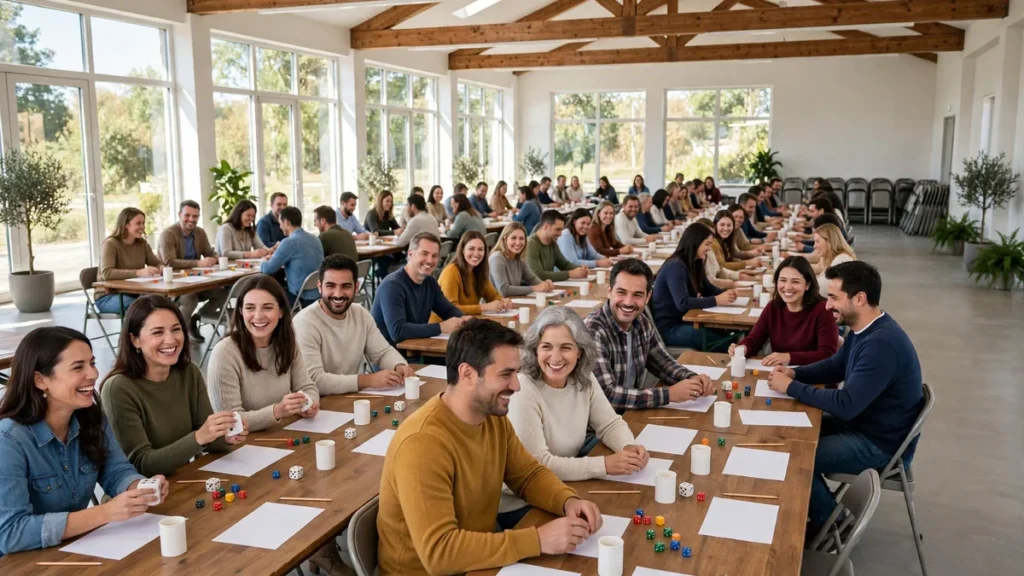
Seat six players at each table and you need 47 tables for 282 players. Leave a clear aisle between every row of tables so table captains can move, collect score sheets, and answer questions without squeezing past chairs. Place a printed rule sheet, a dice cup, and a pencil at every seat before guests arrive, so the first round can start the moment people sit down. Put the leaderboard where every table can see it, on a large screen or a whiteboard at the front of the room, and update it between rounds rather than during play.
Tournament Format for 282 Players
A tournament format gives 282 players a shared goal. Every table plays the same game for a fixed time, usually 15 minutes, then table captains hand in the top two scores from each table. The top 94 players move to a second round at 16 tables, and the top 24 from that round meet at four tables for a final. This structure keeps every player involved in round one, rewards strong play, and still finishes inside two hours. Announce the cut lines before play starts, so nobody feels surprised when a round ends.
Station Rotation for 282 Players
A station rotation suits events where guests want variety. Set up six stations, one for each game in this guide, with eight tables at every station. Groups of 47 players spend 15 minutes at a station, then move to the next station when a bell rings. After six rotations, every player has tried every game, and the leaderboard combines the best score from each station. Rotation works best when the stations sit far enough apart to stop noise from one game drowning out the instructions at the next station.
Best Dice Games for 282 Players
The six games below were chosen because they need little equipment, teach quickly, and play well at dozens of tables at once. Each game works as a standalone activity for a smaller group and as one station inside a larger event for 282 players.
Bunco
Bunco is the classic large group dice game, and it was built for exactly this kind of event. Players sit in groups of four at each table, roll three dice, and score points for matching the target number of the round. After each round, winners move up one table and losers move down one table, so players meet new opponents every 15 minutes. Bunco needs three dice per table, one score sheet per player, and a bell to signal the end of each round. A full game of six rounds takes about 90 minutes for 282 players.
Farkle
Farkle, also known as Ten Thousand, is a push your luck game that works brilliantly in tournament form. Each player rolls six dice, banks scoring combinations, and decides whether to roll again for more points or stop and keep the points already won. A player who rolls with no scoring dice loses the points from that turn, which creates loud cheers and groans at every table. Farkle needs six dice per table and one score sheet per player, and a round of six turns takes about 20 minutes.
Yahtzee Tournament
A Yahtzee tournament turns a familiar family game into a large group contest. Each player gets a score card with 13 categories, from three of a kind to a full house and a Yahtzee of five matching dice, and rolls five dice up to three times per turn to fill one category. Every table plays the same 13 rounds, then captains collect the total scores for the leaderboard. Yahtzee needs five dice and one score card per player, plus a cup to keep the dice on the table. The game rewards planning, because players must decide which category to sacrifice when the dice refuse to cooperate. For a slightly smaller crowd, the same tournament structure appears in the guide to dice games for 280 players.
Liars Dice
Liars Dice is a bluffing game that fills a hall with laughter. Each player shakes five dice in a cup, peeks at the result in secret, and then bids on how many dice of a certain value sit under all the cups at the table. The next player must raise the bid or challenge it, and the loser of a challenge gives up one die. The last player with dice left wins the table.
Left Center Right
Left Center Right is the fastest game on this list and the easiest to teach. Each player starts with three tokens, rolls three dice marked with L, C, R, and dots, and passes tokens left, right, or to the centre according to the dice. Dots mean the player keeps the tokens. The last player holding tokens wins the table. A full game takes about 10 minutes, which makes it perfect as a warm up game while late guests arrive, or as a quick tie breaker between tournament rounds. The game needs three special dice and 18 tokens per table, and it works for any table size from three to eight players.
Dice Bingo
Dice Bingo mixes the luck of dice with the familiar structure of bingo. Each player gets a bingo card printed with numbers, and a caller rolls two large dice at the front of the room and announces the total. Players mark the matching number on their cards, and the first player to complete a row, a column, or a full card calls out and wins the round. It needs one pair of large dice, one bingo card per player, and a marker pen for every seat.
Dice Games for 282 Players Compared
Use the table below to match each game to the time and the equipment you have available. Games with short rounds suit tight schedules, while games with more dice per table need a larger equipment budget.
| Game | Players per table | Round length | Dice per table | Best use |
|---|---|---|---|---|
| Bunco | 4 | 15 minutes | 3 | Main event, social mixing |
| Farkle | 4 to 6 | 20 minutes | 6 | Tournament play |
| Yahtzee | 4 to 6 | 30 minutes | 5 | Strategy contest |
| Liars Dice | 4 to 6 | 20 minutes | 25 | Rotation station |
| Left Center Right | 3 to 8 | 10 minutes | 3 | Warm up, tie breaker |
| Dice Bingo | Whole room | 15 minutes | 2 large | Opening or closing |
Equipment and Supplies for 282 Players
Buy equipment in bulk and count it twice. For 282 players, order 350 dice, 350 score sheets, 350 pencils, and 60 dice cups, which covers every table plus spares for dice that roll under furniture or score sheets that get torn. Bulk dice cost very little when bought in bags of 100, and matching dice in one bright colour make lost dice easy to spot on the floor. Print score sheets on thick paper so pencils do not tear through them during fast rounds.
Pack one kit per table before the event. Each kit holds the dice for that table, one score sheet per seat, one pencil per seat, and one rule sheet. Label every kit with a table number and stack the kits in number order, so setup takes 20 minutes instead of an hour. Bring a spare box with extra dice, extra pencils, extra score sheets, a bell, a whistle, tape, scissors, and a first aid kit. Assign two volunteers to equipment duty, one to hand out replacement items during play and one to collect kits at the end of the event.
Scoring Across Many Tables
Scoring must stay simple enough for a volunteer to run without training. Use total points for Farkle, Yahtzee, and Bunco, use table wins for Left Center Right and Liars Dice, and use completed lines for Dice Bingo. Ask each table captain to write the top three scores in large numbers on the score sheet, then collect the sheets at the end of each round and enter the numbers on the leaderboard. Never ask captains to calculate averages or percentages during play, because errors creep in and disputes follow.
Tie breaks need a plan before the event starts. The fairest tie break is a single roll of one die, highest roll wins, repeated until one player leads. Announce the tie break rule at the start of the evening so nobody can claim it was invented to favour one table. Keep a written record of every tie break result, because competitive players will ask how a close result was decided.
Checklist for 282 Players
Work through this checklist in the week before the event, and check every item off before the doors open.
- Book a hall with space for 47 tables of six, plus clear aisles and a visible leaderboard area.
- Order 350 dice, 350 score sheets, 350 pencils, and 60 dice cups, then count every item on arrival.
- Pack one labelled kit per table with dice, score sheets, pencils, and a printed rule sheet.
- Recruit 47 table captains and brief them on the rules, the scoring, and the tie break procedure.
- Print a running order with round times, rotation signals, break times, and the prize ceremony time.
- Test the bell, the microphone, and the leaderboard display the day before the event.
Frequently Asked Questions
How many dice do 282 players need?
Order at least 350 dice for 282 players. Most games in this guide need three to six dice per table, and 47 tables of six players use about 250 dice in play at any moment. The extra 100 dice cover spares for dice that roll away, dice that get damaged, and tables that need a fresh set between rounds. Bulk bags of 100 dice keep the cost low, and one bright colour makes stray dice easy to find.
How long does a dice games session for 282 players take?
A full session takes about two hours, including a welcome, four rounds of play, a short break, and a prize ceremony. Each round lasts 15 to 20 minutes depending on the game, with five minutes between rounds for score collection and table movement. A shorter event works well with three rounds in 90 minutes, while a full day event can run six rounds plus a Dice Bingo finale.
Can beginners play dice games for 282 players?
Yes, every game in this guide welcomes complete beginners. The rules fit on one printed sheet, a table captain explains each game in two minutes, and the first round is always a practice round with no scores recorded. Beginners often do well in Bunco and Dice Bingo, where luck matters more than experience, and they learn Farkle and Yahtzee quickly because every turn follows the same simple pattern. The organisers of similar events, covered in the guide to dice games for 279 players, report the same result with first time players.
What is the best game for a mixed age group of 282 players?
Bunco is the best choice for a mixed age group, because it needs no strategy, no reading of long rules, and no fast reactions. Children, parents, and grandparents can share one table, and the movement between tables after each round mixes the age groups across the whole room. Dice Bingo is a strong second choice for mixed ages, because the whole room plays together and younger players can share a card with an adult. Avoid Liars Dice for groups with very young children, because bluffing is harder to explain to players under ten.
How do you stop 282 players from getting too noisy?
Noise is part of the fun, but it needs limits. Use a bell or a whistle to start and stop each round, and ask table captains to lower their voices during scoring. Space the tables at least one metre apart, keep music off during play, and place the loudest games, such as Liars Dice and Farkle, at the far end of the hall from the scoring desk.
What prizes work best for dice games with 282 players?
Small prizes work better than one large prize, because 282 players deserve many chances to win. Offer a prize for the top three players overall, a prize for the best score at each table, and a fun prize for the lowest score of the night. Gift cards, board games, dice sets, and snack hampers all make good prizes, and a lucky draw at the end gives every player one last chance to win. Keep the prize ceremony under 10 minutes so the event ends on a high note.
Bottom Line
The best dice games for 282 players are the games that stay simple, fast, and fair at scale. Bunco leads the list for social mixing, Farkle and Yahtzee reward smart decisions, Left Center Right fills short gaps, Liars Dice brings laughter to a rotation station, and Dice Bingo unites the whole room for an opening or a finale. Pack one kit per table, brief your table captains, keep the scoring simple, and let the shared rhythm of 282 people rolling at once do the rest. With the right plan, a crowd of 282 becomes the best part of the game, not the hardest part of the day.