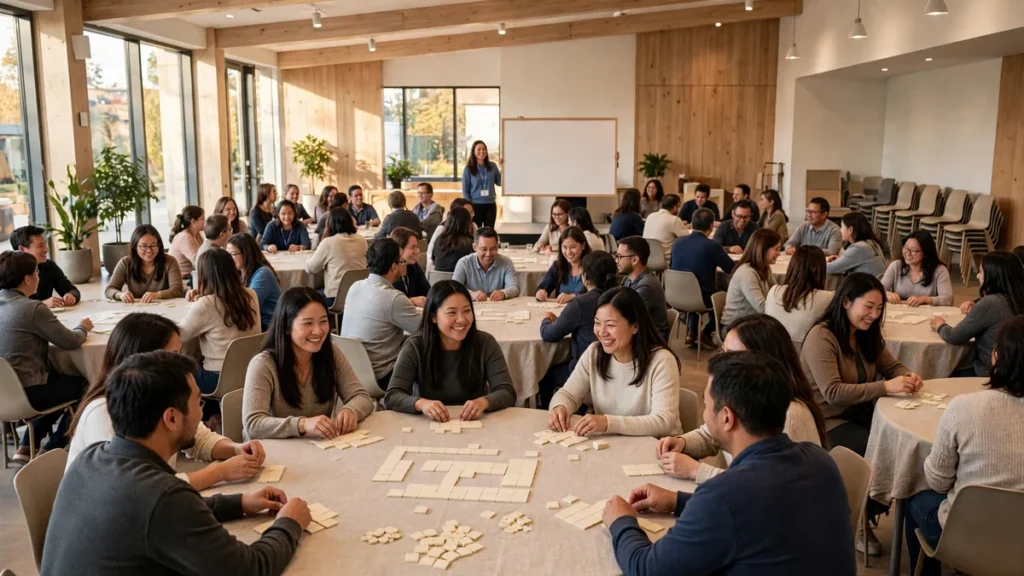
Planning the best word games for 172 players is a challenge that sounds almost impossible at first, and that is exactly what makes it so much fun to solve. A group of 172 people is not a living room game night. It is a whole hall, a school gym, a company offsite, or a community festival, and the word games that work beautifully for six friends around a kitchen table simply do not scale to a crowd this size without a plan. The good news is that word games are some of the easiest games in the world to scale, because words cost nothing, need almost no equipment, and let every single player think, shout, write, and compete at the same time.
The best word games for 172 players are the ones that split naturally into teams, run in parallel across many tables, or turn the whole room into one shared game. Team guessing games, simultaneous letter games, and whole-room word challenges all fit this format perfectly, because nobody has to wait twenty minutes for a turn and nobody sits on the sidelines watching other people play.
In this guide, you will find the honest truth about what 172 players really means, four proven formats that work at this scale, the eight best word games for 172 players with exact instructions for running each one, a comparison table, a setup timeline, a checklist, and answers to the most common questions.
Key takeaways
- No single word game seats 172 players at one table, so success comes from teams, multiple tables, tournaments, relays, and whole-room games.
- Split 172 players into teams of eight for about twenty-two tables, or teams of four for about forty-three tables, and keep every table playing the same game on the same clock.
- The strongest games for this scale are Codenames, Bananagrams, Scrabble tournaments, Scattergories, Taboo, Boggle, word ladder relays, and whole-room guessing games.
- One host with a microphone, a visible timer, and a simple score sheet matters more than expensive equipment.
- Keep rounds short, score simply, and rotate teams between games so everyone meets new people and nobody waits around.

The Honest Truth About 172 Players
Let us start with the fact nobody should hide from you: no single word game is designed for 172 players sitting around one table. Even the biggest party games top out at twenty or thirty players, and a game that tried to seat 172 people at once would collapse under its own weight, with turns so long that most players would check their phones before their first move. That does not mean your event is impossible.
Think of it the way a sports day works. Nobody expects 172 people to play one football match on one pitch at the same time. Instead, you have many pitches, many matches, a shared timetable, and a final that brings everyone together. Word games work the same way. Twenty-two tables of eight players each can all play the same game at the same time, with the same timer and the same word lists, and the winners of each table can advance to a grand final on stage.
The number 172 also has one practical advantage: it divides neatly. Split into teams of four and you get forty-three teams. Split into teams of eight and you get twenty-one teams of eight plus one team of four, which is easy to balance by making two teams of six instead.
How to Run Word Games for 172 Players: Four Proven Formats
Format 1: Teams of Eight at Shared Tables
This is the simplest format and the best starting point if you have never run an event this size. Divide 172 players into teams of eight, seat each team at its own table, and give every table the same game, the same materials, and the same time limit. One host runs the clock for the whole room from a microphone, calling out when each round starts and ends, so all twenty-two tables stay in step.
Format 2: Multiple Tables on One Clock
This format suits fast, simultaneous games such as Boggle, Bananagrams, and Scattergories, where everyone plays at the same time rather than taking turns. Set up as many tables as your room allows, put the same word lists or letter sets on every table, and run every round on a shared timer of three to five minutes.
Format 3: Tournament Brackets
If your crowd loves competition, a tournament bracket turns a simple word game into a proper event. Scrabble and word ladder relays work especially well here, because they have clear winners and clear scores. Start with forty-three teams of four playing short qualifying rounds, then take the top sixteen teams into quarter-finals, the top eight into semi-finals, and the top two into a grand final played on a stage where the whole room can watch.
Format 4: Whole-Room Games
Whole-room games are the simplest format of all and the best way to open or close your event. One host stands at the front, all 172 players stay in their teams, and everyone answers the same clue at the same time by writing it down, holding up a card, or shouting it together.
The 8 Best Word Games for 172 Players
These eight games were chosen for three reasons: they are easy to explain in under two minutes, they keep all 172 players busy at the same time, and they work inside at least one of the four formats above.
1. Codenames
Codenames is the single best word game for a crowd of 172 players, because it was built for teams and it turns guessing into a group conversation. Each team has a spymaster who gives one-word clues that connect several secret words on a grid, and the rest of the team debates which words the clue points to. For 172 players, split into teams of eight and use one Codenames set per two tables, or run a giant version on a projector where the host displays one grid for the whole room and every team guesses the same words.
2. Bananagrams Relay
Bananagrams is a fast letter-tile game in which every player builds their own crossword at the same time, racing to use up all their tiles first. A standard set serves about eight players, so for 172 players you need roughly twenty-two sets, one per table, or you can run it as a relay: each team of eight shares one set, with two players building at a time and swapping out every ninety seconds while their teammates shout suggestions. Run three rounds of eight minutes each on a shared clock, award points for finished grids, and give bonus points to teams whose grids contain the longest word.
3. Scrabble Tournament
Scrabble is the classic word game, and a tournament is the only honest way to run it for 172 players, since a single Scrabble board seats just two to four people. Set up forty-three boards, one per team of four, and run short fifteen-minute qualifying rounds in which each team plays as a pair against another pair, combining their scores. The top sixteen teams advance to quarter-finals on eight boards, then four boards, then a single board on stage for the grand final, with the finalists’ moves projected so the whole room can follow along. For a full guide to running a tournament-style event for a crowd this size, see our guide to the best board games for 172 players, which covers brackets, scoring, and stage finals in detail.
4. Scattergories Whole-Room Edition
Scattergories asks players to think of words that start with the same letter in a dozen categories, and it is one of the easiest games in the world to scale, because all you need is a printed answer sheet and a pencil per team. For 172 players, run it whole-room style: the host announces a letter and twelve categories, every team has three minutes to fill in their sheet, and then the host reads out the answers category by category while teams score one point for every unique answer nobody else thought of. Print one answer sheet per team rather than per player, so teammates must agree on their answers together, which is where the fun and the arguments live.
5. Taboo Team Edition
Taboo is a guessing game in which one player describes a word without using any of the forbidden words listed on the card, and it becomes a team sport when you play it with eight people at a table. For 172 players, split into teams of eight, give each table a deck of Taboo cards or a printed list of words with forbidden clues, and run ninety-second turns in which one player describes while the other seven shout guesses. Rotate the describer every turn so everyone gets a chance to perform, and award one point per word guessed correctly, with a point lost for every forbidden word accidentally spoken.
6. Boggle Simultaneous Rounds
Boggle is a sixteen-letter grid in which players race to find as many words as they can in three minutes, and it is perfect for 172 players because every table plays the same grid at the same time. You need one Boggle set per table, or you can project a single sixteen-letter grid on a screen and give every team a blank answer sheet, which is cheaper and easier and guarantees every team faces exactly the same puzzle. Run five rounds of three minutes each, with a new grid every round, and score one point per word, with bonus points for words of six letters or more.
7. Word Ladder Relay
A word ladder is a puzzle in which you change one letter at a time to turn one word into another, for example turning COLD into WARM in four steps, and a relay turns it into a team race. For 172 players, split into teams of eight and line each team up behind a table or along a wall. The host displays the first ladder on a screen, the first player in each team runs to the board and writes the first step, then tags the next player, who writes the second step, and so on until the ladder is complete. The first team to finish a correct ladder scores ten points, and every team that finishes within a minute scores five.
8. Whole-Room Wordle and Guess the Word
Whole-room Wordle is the simplest game in this guide and the best way to close your event. The host picks a five-letter word, and all 172 players, working in their teams, get six guesses to find it, with the host marking each guess on a big board or a projector so the whole room can see which letters are correct, in the wrong place, or not in the word at all. Every team writes its guesses on a shared sheet, discusses them together, and holds up its final answer when the host calls time. If your crowd enjoyed this one, our guide to the best word games for 171 players has more whole-room guessing formats that work with almost the same setup, and our guide to the best party games for 171 players covers the music, movement, and team games that pair well with a word game finale.
Word Games for 172 Players: Comparison Table
| Game | Best Format | Players per Table | Sets Needed for 172 | Round Length | Energy Level |
|---|---|---|---|---|---|
| Codenames | Teams of eight | 8 | 11 to 22 sets | 10 minutes | High |
| Bananagrams relay | Multiple tables, one clock | 8 | 22 sets | 8 minutes | High |
| Scrabble tournament | Tournament bracket | 4 | 43 boards | 15 minutes | Medium |
| Scattergories | Whole-room game | 8 | Printed sheets only | 3 minutes | Medium |
| Taboo team edition | Teams of eight | 8 | 22 decks or lists | 90 seconds per turn | Very high |
| Boggle | Multiple tables, one clock | 8 | 22 sets or one projector | 3 minutes | Low to medium |
| Word ladder relay | Whole-room relay | 8 | Whiteboard or projector | 5 minutes | High |
| Whole-room Wordle | Whole-room game | 8 | Projector and sheets | 10 minutes | Medium |
Setup Plan: Your 172-Player Game Night Timeline
A two-hour event for 172 players needs a timetable, because the moment the schedule slips, the room drifts. Arrive ninety minutes early with your volunteers, lay out twenty-two tables with eight chairs each, and put a team number card, an answer sheet, and pencils on every table. Test the microphone and the projector before a single player arrives, because a dead microphone in front of 172 people is the one problem you cannot fix gracefully once the event starts.
Open with a whole-room guessing game for fifteen minutes while latecomers find their seats, then run two table games of thirty minutes each, with a ten-minute break in the middle for drinks and snacks. After the break, run your loudest game, which is usually Taboo, for thirty minutes, then move into the tournament semi-finals or a Boggle round for twenty minutes, and close with whole-room Wordle as a fifteen-minute finale.
Checklist: Running Word Games for 172 Players
- Confirm the venue holds 172 players seated at twenty-two tables of eight, with space for a stage or a front area for the host.
- Print team lists in advance, assign team numbers, and prepare coloured wristbands or stickers so teams can find each other fast.
- Count your game sets before the day: twenty-two Codenames or Boggle sets, forty-three Scrabble boards for a tournament, or printed sheets for whole-room games.
- Test the microphone, projector, timer, and leaderboard before the first player arrives, and keep spare batteries and pens in a box by the host table.
- Recruit at least four volunteers: one scorekeeper, one timekeeper, one person at the welcome table, and one floater who solves problems as they appear.
- Prepare a simple score sheet, a printed timetable, and a prize for the winning team, then brief every volunteer on the schedule before the doors open.
Frequently Asked Questions
Can one word game really seat 172 players?
No, and any guide that tells you otherwise is not being honest with you. No single word game is designed for 172 players around one table. What works is running the same game across many tables at the same time, splitting players into teams, running a tournament bracket, or playing a whole-room game where one host runs the game for everyone at once.
How many teams should 172 players be split into?
Teams of eight give you twenty-one teams of eight plus one team of four, which you can balance by making two teams of six instead, and teams of eight are the best size for talking, guessing, and laughing together. Pick one size, print the lists in advance, and do not change it on the night.
What equipment do I need for 172 players?
For whole-room games, you need almost nothing: a microphone, a projector or a large whiteboard, printed answer sheets, and pencils. For table games, you need one game set per table, so about twenty-two sets for teams of eight, or forty-three Scrabble boards for a full tournament.
How long should a word game night for 172 players last?
About two hours is ideal. Open with a fifteen-minute whole-room warm-up, run two or three table games of thirty minutes each with a ten-minute break in the middle, and close with a fifteen-minute whole-room finale.
What if some players have never played these games before?
That is normal for a crowd of 172 people, and it is nothing to worry about. Choose games with rules you can explain in under two minutes, demonstrate one round on stage before the real rounds begin, and put at least one confident player on every team who can guide the others.
Can children and adults play together in a 172-player word game night?
Yes, and mixed-age teams are often the strongest, because children spot unusual words that adults miss and adults know the longer words children have not learned yet. Mix ages deliberately when you form teams, keep the word lists friendly, and avoid games that depend on adult knowledge or tricky vocabulary.
The Bottom Line
The best word games for 172 players are not the ones with the biggest boxes or the fanciest pieces. They are Codenames, Bananagrams, Scrabble tournaments, Scattergories, Taboo, Boggle, word ladder relays, and whole-room Wordle, run as teams of eight, on many tables with one shared clock, through a tournament bracket, or as a whole-room game with one host and one big board.


