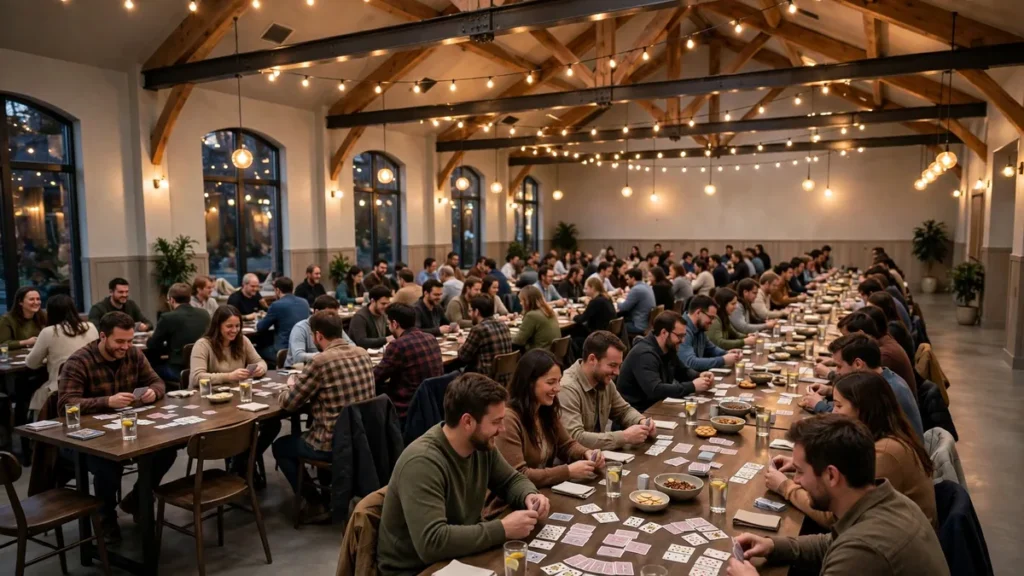
Best card games for 173 players start with an honest fact: no single card game seats 173 people around one table. The best card games for 173 players are not one giant game but a well-run system of tables, teams, and rounds that lets every single person play at the same time. When 173 friends, classmates, coworkers, or family members gather in one room, the magic comes from the format, not from forcing everyone into a game built for six.
A group of 173 players is a whole event, not a game night. It might be a school assembly, a company social, a wedding weekend, a church gathering, a camp reunion, or a community fundraiser. Whatever brings your crowd together, the goal is the same: nobody sits on the sidelines watching, nobody waits an hour for a turn, and nobody feels lost in the crowd. The games in this guide are chosen because they scale. They work across many tables, they keep rounds short, and they let scores travel from table to table so the whole room shares one competition.
This guide shows you exactly how to do it. You will find eight card games that work brilliantly at this scale, three proven formats for running them, a comparison table to help you choose, a room setup plan, a checklist, and answers to the questions every large-group host asks. Whether you have a hall full of tables or one big open room, you can give 173 players a card game night they will talk about for months.
Key takeaways
- No card game seats 173 players at one table, so split the room into tables of 4 to 10 players and run the same game everywhere at once.
- Team formats, tournaments, and relay rounds are the three structures that keep a crowd of 173 players engaged from start to finish.
- Short, simple games with rounds under 20 minutes work far better than long, complex games at this scale.
- One shared scoreboard, visible to the whole room, turns many small tables into one big competition.
- Buy or borrow multiple copies of each game, and assign one table host per table so rules questions never stall the night.

Why 173 Players Changes Everything
Most card games are designed for two to eight players. That is the first thing to accept, and it is good news rather than bad news, because it frees you from hunting for a mythical game that fits everyone. The best card games for 173 players are simply the best card games, played in parallel. Your job as host is to build the system around them: tables, teams, timers, and a scoreboard that ties the room together.
How to Run Card Games for 173 Players
The Multi-Table Tournament
The multi-table tournament is the most reliable format for 173 players. Set up tables of 4 to 10 players, depending on the game, and deal the same game at every table. Play three or four short rounds, then rotate players so everyone meets new tablemates. After each round, table winners report their scores to a central scoreboard. At the end of the night, the top scorers from all tables meet at a final table, or the top team takes the prize. This format works beautifully with Uno, Phase 10, and Exploding Kittens, because each table finishes a round at roughly the same time. If you enjoy this style of play, the Best Card Games for 172 Players guide uses the same tournament structure for a nearly identical crowd size.
The Team Relay
In a team relay, you divide the 173 players into teams of about 10 to 15 people, and each team splits across several tables. One team member plays at each table, and the team score is the sum of its members’ results. This format keeps friends together even when they sit apart, and it gives quieter players a team to cheer for. Team relays are perfect for Codenames, Wavelength, and Monikers, where team identity matters more than individual scores. Give each team a name, a colour, and a captain, and the room will buzz with team spirit within minutes.
The Whole-Room Game
Whole-room games involve all 173 players at once, usually with one host leading from the front. Ultimate Werewolf and Two Rooms and a Boom are built for this: everyone has a role card, and the game unfolds across the entire room rather than at separate tables. Whole-room games are spectacular as an opening or closing event, because they create a shared memory that the whole crowd carries home. They also need a confident host with a microphone, clear instructions, and a plan for keeping 173 people focused during the first five minutes.
Best Card Games for 173 Players Compared
| Game | Players per Table | Round Length | Best Format | Why It Works for 173 Players |
|---|---|---|---|---|
| Uno | 2 to 10 | 15 to 20 minutes | Tournament | Everyone knows the rules, and multiple decks cost very little. |
| Sushi Go Party! | 2 to 8 | 20 minutes | Tournament | Simple drafting and cute cards make it easy to teach fast. |
| Codenames | 4 to 8+ | 15 minutes | Team relay | Teams turn one table game into a room-wide rivalry. |
| Ultimate Werewolf | 5 to 75+ | 30 to 45 minutes | Whole room | Designed for huge groups, with roles for everyone. |
| Wavelength | 2 to 12 | 20 to 40 minutes | Team relay | Big debates and big laughs with almost no setup. |
| Monikers | 4 to 16 | 30 to 60 minutes | Team relay | Three rounds of clues keep every team involved. |
| Two Rooms and a Boom | 6 to 30+ | 15 minutes | Whole room | Fast rounds let you run several games in one hour. |
| Exploding Kittens Party Pack | 2 to 10 | 20 minutes | Tournament | The party pack seats ten per table, so you need fewer tables. |
Uno: The Safest Choice for a Huge Crowd
Uno is the easiest card game to run for 173 players, and that is exactly why it belongs at the top of this list. Almost everyone already knows how to play, which means you spend zero minutes teaching rules and all your time actually playing. Buy or borrow about twenty decks, one per table, and you can seat the entire room in under ten minutes. A standard Uno deck costs very little, and because the game is so familiar, players of every age and experience level can join in without feeling embarrassed.
Run Uno as a multi-table tournament with rounds of about 15 minutes. At the end of each round, each table reports its winner, and winners move up to a new table while other players shuffle into fresh groups. Keep a simple scoreboard where each round win earns a point, and after four rounds the players with the most points play a grand final at a centre table while the rest of the room watches and cheers. Add a twist to keep it fresh: play one round with a house rule, such as stacking Draw Two cards, and watch the whole room react at once.
Sushi Go Party!: Fast, Colourful, and Easy to Teach
Sushi Go Party! is a card drafting game where players pick a card from their hand, pass the rest along, and build the best little sushi menu they can. The rules take about three minutes to explain, the cards are bright and charming, and a full game lasts about 20 minutes. For 173 players, you will need around twenty-five copies, one per table of six to eight players, and the game is light enough that you can teach every table at once with a short demonstration from the front of the room.
Codenames: The Team Game That Unites the Room
Codenames is a word-and-card team game where a spymaster gives one-word clues to help their team find the right words on the table. It plays best in teams, which makes it a natural fit for a 173-player event. Divide the room into teams, seat each team across a few tables, and run Codenames at every table at the same time. The team with the most table wins takes the round, and the room quickly fills with the sound of teammates debating clues and celebrating clever guesses.
Ultimate Werewolf: One Game for the Whole Room
Ultimate Werewolf is the rare card game genuinely designed for a crowd. In each game, players receive secret role cards: most are villagers, a few are werewolves, and special roles add twists. The group debates, accuses, and votes, trying to find the werewolves before the werewolves outnumber the villagers. With the right edition, a single game can include dozens of players, and for 173 players you can either run several large games side by side or split the room into two giant games of about 85 players each.
This is your showpiece game. Put your most confident host in charge, give them a microphone, and let the whole room play together. The first ten minutes are the hardest, because 173 people need clear instructions before the game begins, so rehearse the introduction and keep it short. Once the game starts, the energy takes care of itself: accusations fly, alliances form, and even shy players get swept into the drama. Plan one big game of Ultimate Werewolf as your evening finale, and your crowd will leave talking about it. If you love this kind of large-group energy, the Best Party Games for 171 Players guide has more whole-room ideas for a crowd almost exactly this size.
Wavelength: Big Debates, Bigger Laughs
Wavelength is a team guessing game built around a target on a spectrum, such as hot versus cold or famous versus unknown. One player gives a clue, the team debates where the target sits, and everyone laughs at how differently people see the world. It plays two to twelve people per table, takes about 20 to 40 minutes, and needs almost no teaching: show one example round and the whole room understands it.
Monikers: Three Rounds of Pure Team Spirit
Monikers is a team clue game played in three rounds with the same deck of cards. In the first round, players describe the card in as many words as they like. In the second, they can use only one word. In the third, they act it out in silence. The cards feature famous people, characters, and ideas, and the shrinking rules make each round funnier than the last. A game takes 30 to 60 minutes, so it suits the middle of your evening, when the room is warmed up and ready for something bigger.
Two Rooms and a Boom: Fast Rounds, Maximum Energy
Two Rooms and a Boom is a social deduction game where players are split between two rooms, or two sides of one large hall, and must complete secret objectives before time runs out. Each round lasts only about 15 minutes, which means you can run four or five rounds in a single hour and give every player several chances to win. Role cards are dealt at random, so nobody knows who is on their team until the game unfolds, and the final minutes of each round are pure chaos in the best possible way.
Exploding Kittens Party Pack: Ten Players per Table
Exploding Kittens is a fast, funny card game where players draw cards and try to avoid the Exploding Kitten. The standard game seats five, but the Party Pack seats up to ten players per table, which is a genuine advantage when you need to fit 173 people into a hall. Fewer tables per game means fewer copies to buy, fewer hosts to recruit, and a simpler room layout. A round lasts about 20 minutes, and the rules are simple enough to teach in two minutes.
Run the Party Pack as a multi-table tournament, with about eighteen tables of ten players. Because the game is quick and chaotic, it is a wonderful choice for the last hour of your event, when the room is tired and wants something light. The humour of the cards keeps the mood bright, and the sudden eliminations give every table a burst of drama. One warning: the game involves player elimination, so eliminated players should have a nearby table to join or a snack station to visit, rather than sitting out the rest of the round. If your crowd also enjoys other table games at this scale, the Best Board Games for 172 Players guide rounds out the evening with board games that pair well with a card game tournament.
Setting Up the Room for 173 Card Players
Room setup decides whether your night feels smooth or stressful, so plan it before you buy a single game. You will need roughly twenty to twenty-five tables, depending on how many players each game seats, plus chairs for 173 people and a little elbow room at every table. Card games need flat, clear surfaces, so keep drinks and snacks on a separate table to protect the cards. Good lighting matters more than decoration: players must read small card text from across the table, so test the lighting at a real table before the event begins.
Checklist: Your 173-Player Card Game Night
- Count your players and confirm 173 seats, with a few spare chairs for late arrivals and hosts.
- Choose one format, tournament, team relay, or whole-room, and build your schedule around it.
- Buy or borrow enough copies: roughly twenty copies of your main game, plus spares for damaged decks.
- Recruit one table host per table and brief them with printed rules sheets before the event.
- Set up tables, lighting, a microphone, a visible timer, and a central scoreboard the whole room can see.
- Plan snacks, drinks, and a break halfway through so 173 players stay comfortable and energised.
Frequently Asked Questions
Can one card game really seat 173 players?
No single card game seats 173 players around one table, and any game that claims to is stretching the truth. The honest answer is to run the same game at many tables at once, or to play a whole-room game such as Ultimate Werewolf that is designed for very large groups. With twenty or so tables playing in parallel, all 173 players are playing at the same time, and a shared scoreboard makes it feel like one big game.
How many copies of a game do I need for 173 players?
Plan for one copy per table. If your game seats eight players per table, you need about twenty-two copies for 173 players. If it seats ten, like the Exploding Kittens Party Pack, you need about eighteen. Ask players to bring copies from home, borrow from a local game shop or library, or buy in bulk and resell or donate the spares afterwards. Always keep two or three spare copies in case a deck gets damaged or a card goes missing.
How long should a 173-player card game night last?
Plan for about three hours, including a break. That gives you time for a warm-up game, three or four tournament rounds, a whole-room finale, and prize-giving. Shorter nights feel rushed with a crowd this size, because seating and scoring take longer than you expect. Longer nights tire people out, so three hours with a proper break in the middle is the sweet spot for most groups.
What if some players have never played card games before?
Choose games with rules you can teach in under five minutes, such as Uno, Sushi Go Party!, or Wavelength, and put a friendly host at every table. New players learn fastest by playing, so start with a practice round that does not count toward the score. Mixing experienced and new players at each table also helps, because the experienced players can guide the newcomers without slowing the game down.
How do I keep score across 173 players?
Use one central scoreboard that everyone can see. Each table host reports the table winner and the scores after every round, either on a paper slip handed to the scorekeeper or through a simple shared form on a phone. Keep the scoring simple: one point per round win, or the points printed on the cards, added up across rounds. Announce the leaders between rounds so the whole room stays invested in the competition.
What prizes work best for a crowd of 173 players?
Give prizes that many people can enjoy, not one big prize for one winner. Award small prizes for the top team, the top table, the funniest moment, and the best team name, so several groups go home happy. Card game boxes, snack hampers, gift vouchers, and silly trophies all work well. A short prize ceremony at the end, with applause for every winner, is the perfect way to close a 173-player night.
The Bottom Line
The best card games for 173 players are the games your whole room can play at once, in parallel, with a shared scoreboard and a format that keeps everyone involved. Pick one format, choose two or three short and simple games from this guide, recruit a host for every table, and let the room do the rest. A crowd of 173 players is not a problem to solve; it is the best part of the night.


