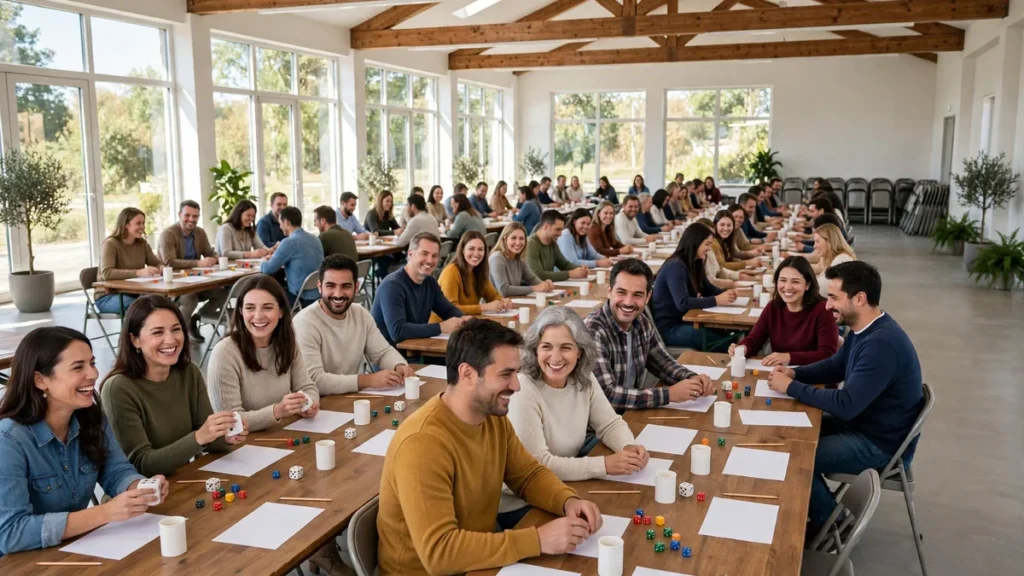
Best dice games for 161 players start with an honest fact: no single dice game seats 161 people around one table. A standard dice game works best with four to eight players, and even the most generous party versions top out at twenty or thirty. That does not mean a 161-player dice night is impossible. It means the night has to be built differently, with many tables running at once, teams sharing one scorecard, and a tournament structure that turns dozens of small games into one big event.
The best dice games for 161 players are therefore not just games. They are formats. Some work as whole-room games where all 161 players roll at the same time and one caller runs the show. Others work as multi-table tournaments where groups of six play short rounds, winners move up, and a final table decides the champion. A few work as relays, where teams pass dice down a line and every roll counts toward a shared total. The game you choose matters less than the structure you put around it, because the structure is what keeps 161 people playing instead of waiting.
This guide covers eight dice games that scale well, the equipment you need for a group this size, and a checklist that keeps the night moving. Every game here uses ordinary dice, paper scorecards, and rules that a new player can learn in two minutes. Nothing here needs a casino, a betting table, or money on the line. The stakes are points, bragging rights, and a small prize for the winning team, which is exactly how a family reunion, school event, church social, or company party should run.
- No single dice game seats 161 players, so plan for many tables, teams, and a tournament or whole-room format.
- Whole-room games like Dice Bingo and Roll-to-Answer Trivia let all 161 players roll and play at the same time.
- Multi-table games like Bunco, Farkle, and Yahtzee work best when tables of six play short rounds and winners advance.
- You need about 27 tables of six, at least 55 sets of dice, printed scorecards, and one clear caller or host.
- Keep rounds short, keep scorecards simple, and announce the standings often so nobody feels left out.

How 161 Players Actually Works
The first decision is the format, and there are only three that work at this size. The first is the whole-room game, where one host calls the rolls and every player plays along at the same time. Dice Bingo is the classic example. The host rolls, calls the number, and 161 players mark their cards. Nobody waits for a turn, nobody is eliminated early, and the whole room finishes together. Whole-room games are the easiest to run and the best choice when your group includes children, older guests, or people who have never played a dice game before.
The second format is the multi-table tournament. Divide 161 players into tables of six, which gives you 26 full tables and one table of five, or 27 tables if you add a host or a floater who fills in where needed. Each table plays the same game for a short round, usually ten to fifteen minutes. When the round ends, the top scorer at each table moves to a winners table, or the top two teams advance to the next round. After three or four rounds, you have a final table and a room full of people who have played several games instead of watching one long one. If you have run a slightly smaller night before, our guide to the best dice games for 160 players shows how one fewer player changes almost nothing about the setup, which is a useful reminder that the format matters far more than the exact headcount.
The third format is the team relay. Split the room into teams of seven or eight, give each team one set of dice and one scorecard, and let teammates take turns rolling while the rest of the team cheers, tracks the score, and plans the next move. Relays work well for Farkle and Pig-style games, because the team can discuss whether to keep rolling or bank the points. Relays also solve the table problem, because a team of eight can stand around one table or sit in a circle on the floor. The trade-off is that only one person rolls at a time, so the host needs to keep the pace brisk and the rounds short.
What You Need for 161 Players
The equipment list is simple, but the quantities are not. For 27 tables of six, you need at least 55 sets of dice, because every table needs two sets: one in play and one spare for the inevitable die that rolls under a chair. Buy standard six-sided dice in bulk, and choose two colours per table so that a stray die can be returned to the right table at a glance. You also need about 200 printed scorecards, because players will want a fresh card for every round and some cards will be filled in wrong and need replacing. Print the scorecard on one side of the page only, with large boxes and a short example at the top.
Beyond dice and paper, you need one host with a microphone, a timer everyone can see, and a simple scoreboard. A whiteboard works, a projector works better, and a large sheet of paper taped to the wall works fine if that is what you have. Plan the room before anyone arrives: arrange tables in rows with a clear aisle down the middle, put a numbered card on every table, and give every player a matching table number on their name tag. Keep a box of extra dice, pencils, and scorecards at the host table, and set up a spare table near the door for late arrivals.
The 8 Best Dice Games for 161 Players
Each game below is described as it works at full scale, not as it works for six friends at a kitchen table. The player counts, round lengths, and scoring notes all assume 161 players, 27 tables, and a host who keeps the pace. Pick one game for a short evening, or run two or three in sequence for a longer event, with a break between games for snacks and standings.
1. Whole-Room Dice Bingo
Dice Bingo is the simplest whole-room game on this list and the best opener for a 161-player night. Every player gets a bingo card printed with numbers from two to twelve, which are the possible totals of two dice. The host rolls two large dice where everyone can see them, calls the total, and every player who has that number marks it off. The first player to complete a row, column, or full card calls out and wins the round. A single round takes about ten minutes, and you can play three rounds in half an hour.
2. Team Farkle Tournament
Farkle is a push-your-luck game where players roll six dice, set aside scoring dice, and decide whether to roll again for more points or bank what they have. Rolling with no scoring dice is a Farkle, and the turn scores zero. At 161 players, Farkle works best as a team tournament. Each table of six forms one team, the team shares a single scorecard, and teammates take turns rolling while the rest of the team decides whether to keep going or stop. The shared decision is the fun of the game, because one cautious player and one bold player will argue about every roll.
3. Bunco for a Crowd
Bunco was made for large groups, and it is the most proven game on this list for a crowd of 161. Players sit in groups of four at each table, roll three dice, and try to roll the number of the current round. Rolling three of the round number is a Bunco and scores 21 points. After each round, winners move up a table and losers move down, so players meet new people all night. The movement is the heart of Bunco, and it is what keeps a huge room feeling social instead of split into small groups.
For 161 players, set up 27 tables and run six rounds of about ten minutes each, with a short break after round three. Pair the dice tables with the best party games for 160 players during the break, so guests who want a change of pace have something to do while scores are added up. Award prizes for the most wins, the most Buncos, and the most losses, because the last prize always gets the biggest laugh.
4. Multi-Table Yahtzee League
Yahtzee is a familiar game, and familiarity is a real advantage when you have 161 players and only a few minutes to explain the rules. Each player rolls five dice up to three times per turn, trying to fill thirteen categories on a scorecard, from ones through sixes to three of a kind, a full house, and a Yahtzee of five matching dice. At a large event, run Yahtzee as a league rather than a single game. Each table of six plays one full game, which takes about thirty minutes, and the top scorer at each table moves on to a championship table.
5. Dice Relay Race
A dice relay turns a quiet table game into a noisy team race. Split the room into teams of seven or eight, and give each team a lane, a set of dice, and a target number, such as 100. The first player rolls two dice and adds the total to the team score, then passes the dice to the next teammate. The first team to reach the target wins the heat. Add simple twists, such as rolling doubles lets the same player roll again, and rolling snake eyes sends the team back ten points, to keep the race close and the room loud.
6. Left Center Right Mega Game
Left Center Right, usually called LCR, is a game of pure luck that anyone can learn in one minute. Each player starts with three tokens, rolls three dice marked L, C, R, and dots, and passes tokens left, right, or to the centre according to the dice. Rolling a dot means keeping a token. The last player with tokens wins the pot. At a small table, LCR is a quick filler. At 161 players, it becomes a whole-room spectacle when you run it in waves.
7. Roll-and-Write Race
Roll-and-write games are a natural fit for a huge room, because one roll can serve every player at once. The host rolls a set of dice and calls the result, and all 161 players write the numbers into their own grid, trying to complete rows, columns, or patterns before anyone else. You can run a simple version with a printed grid and two dice, where players choose where to place each total, or a slightly richer version with coloured dice where each colour fills a different part of the sheet. Either way, the whole room plays the same roll at the same time.
The big advantage of a roll-and-write race is that it needs almost no equipment beyond printed sheets and pencils, and it works for players of every age and skill level. Print the sheets in large type, and project each roll so the back of the room can see it. Play three short sheets in a row, add up the scores, and crown a champion.
8. Roll-to-Answer Trivia Dice
Roll-to-Answer Trivia Dice mixes dice with questions, and it is the best game on this list for a mixed-age group. The host rolls a die to pick a category, reads a question, and the first table to agree on an answer and roll a matching number scores a point. A simpler version works just as well: the host rolls two dice, and the total picks a question card from a numbered set, so the dice decide the question and the players supply the answer. Either version keeps the dice at the centre of the game while the questions give everyone something to talk about.
Best Dice Games for 161 Players Compared
Use this table to pick the right game for your group. Whole-room games suit mixed ages and first-time players. Tournaments suit competitive groups that want a winner. Relays suit children and loud, energetic rooms. For nights when you want boards as well as dice, the best board games for 160 players use the same table and tournament ideas, so the two guides work well together when you plan a longer event.
| Game | Format | Players per table | Time per round | Best for |
|---|---|---|---|---|
| Whole-Room Dice Bingo | Whole room | All 161 | 10 minutes | Warm-up, all ages |
| Team Farkle Tournament | Teams, tournament | 6 | 15 minutes | Push-your-luck fans |
| Bunco for a Crowd | Tables, movement | 4 | 10 minutes | Social, mixed groups |
| Multi-Table Yahtzee League | League, tables | 6 | 30 minutes | Classic game lovers |
| Dice Relay Race | Team relay | 7 to 8 | 5 minutes | Children, energy |
| Left Center Right Mega Game | Waves, tables | 6 | 15 minutes | Quick, pure luck |
| Roll-and-Write Race | Whole room | All 161 | 15 minutes | Quiet, all skill levels |
| Roll-to-Answer Trivia Dice | Whole room, teams | 6 | 30 minutes | Mixed ages, finale |
Checklist: Setting Up Your 161-Player Dice Night
- Book a hall with space for 27 tables of six, a host table at the front, and a clear aisle down the middle.
- Buy or borrow at least 55 sets of standard dice, plus spare LCR dice if you plan to play Left Center Right.
- Print 200 scorecards and bingo cards, with large boxes, a worked example, and one-sided printing only.
- Number every table, put matching numbers on name tags, and set up a spare table near the door for late arrivals.
- Test the microphone, timer, and scoreboard before guests arrive, and keep extra dice, pencils, and scorecards at the host table.
- Plan the prize table in advance, including the main prize and fun awards for the highest roll, most improved table, and best team name.
Frequently Asked Questions
Can one dice game really seat 161 players?
No single table game seats 161 players, and any guide that claims otherwise is not being honest. What works is a whole-room game where everyone plays the same roll at once, a multi-table tournament where 27 tables play in parallel, or a team relay where teams share dice and a scorecard. Pick the format first, then the game.
How many tables do you need for 161 players?
Plan for 27 tables of six players, which seats 162, and use the extra seat for the host or a floater who fills in at a table that is short. If you play Bunco, which uses four players per table, you need 41 tables, so check the player count for your chosen game before you book the hall.
How many dice should you buy?
Buy at least 55 sets of dice, which is two sets per table, plus a spare set for the host table. Dice roll under chairs and get mixed up between tables, so a spare set per table is not a luxury. Use two colours per table so stray dice can be returned to the right place quickly.
How long does a 161-player dice night take?
A single game takes thirty to forty-five minutes including setup and scoring. A full evening with three games, a break, and a final takes about three hours. Keep every round timed, announce the standings between games, and resist the urge to let one long game run over.
What is the best dice game for children in a group of 161?
The dice relay race is the best choice for children, because the rules take one minute to explain, every child rolls often, and the team format means no child plays alone. Whole-room Dice Bingo is a close second, because children can play alongside adults with no disadvantage and nobody is eliminated early.
Do you need special dice for a large dice night?
Almost every game on this list uses ordinary six-sided dice, and you can run a full night without buying anything unusual. The only exception is Left Center Right, which needs dice marked L, C, R, and dots. Buy two sets of those in advance, and keep one set at the host table as a spare.
The Bottom Line
The best dice games for 161 players are the ones that fit the room, not the ones with the cleverest rules. Start with a whole-room game so everyone plays at once, move to a multi-table tournament so every table has a stake in the night, and finish with a relay or a trivia dice game that brings the whole room together. Bring plenty of dice, print simple scorecards, keep the rounds short, and announce the standings often. Do that, and 161 players will feel like one big game night, not 27 small ones happening in the same hall.