
Finding the best word games for 72 players starts with an honest fact: no boxed word game seats 72 people at one table. The games that work at this scale are the ones that split gracefully into teams, run across many tables at once, or turn a whole room into a single playing field. When the format is right, 72 players is not a problem to solve but an advantage, because a big crowd brings more ideas, louder reactions and a tournament atmosphere that a small game night can never match.
A group of 72 usually means a school event, a company social, a reunion or a community night, with players ranging from confident word lovers to people who have not played a word game in years. The best choices are therefore games with rules anyone can learn in two minutes, rounds that finish quickly, and scoring that rewards a whole team rather than one clever individual. Nobody should sit idle while two experts duel over a board.
This guide ranks ten word games that genuinely work for 72 players, explains how to run each one at that size, and gives you a setup plan, a scoring system and a checklist. Every game below scales through teams, tables, tournaments or whole-room play, and every format has been judged against the same question: will all 72 people actually be playing, or just watching?
Key takeaways
- No single word game seats 72 players, so the best formats use teams of six, multiple tables or whole-room play.
- Team Scrabble, Bananagrams relay and Codenames are strongest because they keep every player involved.
- Twelve teams of six is the simplest structure for 72 players, and it works for almost every game in this guide.
- Short rounds of ten to fifteen minutes keep energy high and stop weaker teams from falling too far behind.
- A host, a microphone, a visible scoreboard and a clear rotation plan matter more than the game itself.
How Word Games Work for 72 Players
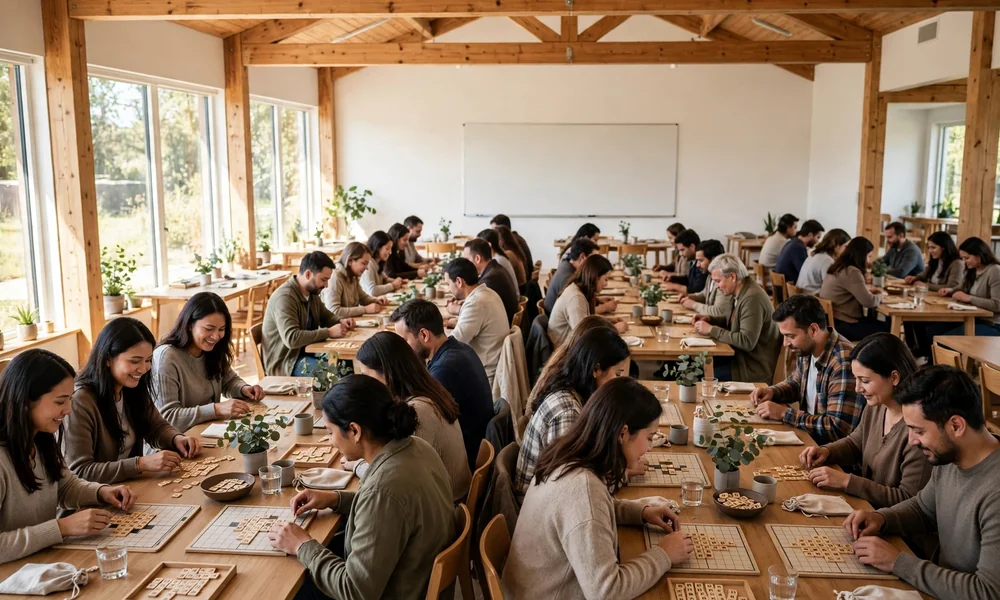
Four formats make a 72-player word night possible. The first is team play: split the room into twelve teams of six and give each team its own board or tiles, with every team playing at once. The second is the multi-table tournament, where teams rotate between tables and play short matches, carrying points forward. The third is the relay, where members take turns at a shared task so everyone contributes. The fourth is whole-room play, where a host runs the game from the front and every team answers at once.
Teams of six are the sweet spot for a group this size. Four is too few to fill a hall with energy, and eight is too many for everyone to get a turn speaking. Six gives each team enough brains to solve hard clues and a natural size for splitting into pairs during relay rounds. One tip applies to every format: appoint a host who is not playing. The host explains the rules, keeps time, reads the clues, updates the scoreboard and settles disputes. If you have played smaller versions of these games before, the closest starting point is our guide to word games for 71 players, which uses the same team structure and scales to 72 with one extra seat.
The 10 Best Word Games for 72 Players
The table below compares all ten games, including the best format at this size and the setup time. The sections that follow explain how to run each game for 72 players.
| Game | Best format for 72 | Players per team | Setup time | Why it works at this size |
|---|---|---|---|---|
| Team Scrabble Tournament | Multi-table tournament | 6 | 20 minutes | All six players discuss every word together. |
| Bananagrams Relay Race | Relay across 12 tables | 6 | 10 minutes | Fast and noisy, with quick rounds that reset often. |
| Codenames: Giant Team Edition | Whole-room team play | 6 | 15 minutes | One spymaster per team turns guessing into a group debate. |
| Scattergories Team Showdown | Simultaneous team rounds | 6 | 10 minutes | Every team answers the same categories at the same time. |
| Big Boggle Tournament | Timed rounds, rotating tables | 6 | 10 minutes | Three-minute rounds keep the pace high and the scoring simple. |
| Taboo Team Challenge | Relay with a host | 6 | 10 minutes | One clue-giver at a time keeps the room focused and laughing. |
| Whole-Room Wordle | Host-led, all teams at once | 6 | 5 minutes | Needs only a board and a host; everyone plays every round. |
| Crossword Race | Simultaneous team race | 6 | 15 minutes | Teams race the same puzzle to an exciting finish. |
| Word Association Chain | Whole-room elimination | 6 | 5 minutes | Zero equipment, instant to explain, and surprisingly tense. |
| Password-Style Team Guessing | Host-led, rotating pairs | 6 | 10 minutes | One-word clues create big moments the whole room reacts to. |
1. Team Scrabble Tournament
Set up twelve boards, one per team of six, and let the whole team discuss each move before it is played, so a beginner beside a strong player still contributes. Play twenty-minute rounds rather than full games, score each board at the end of the round, and rotate teams between tables, keeping a running total on a visible scoreboard. You will need twelve Scrabble sets, so borrow them before buying, and keep a printed list of two-letter words at each table to settle arguments, with the host’s decision final.
2. Bananagrams Relay Race
Each team of six gets a set of tiles, and members take turns building their shared crossword grid, swapping in a fresh player every two minutes. The rest of the team watches, shouts suggestions and spots missed connections, so everyone stays engaged even when they are not the active player. The first team to use all its tiles wins the round, so run a best-of-five series with rounds of eight to ten minutes. You will need twelve Bananagrams sets or one large set of tiles divided equally between tables. Forced rotation stops one player dominating a table, since everyone gets the same number of turns.
3. Codenames: Giant Team Edition
Codenames is a word association game in which a spymaster gives one-word clues connecting several secret words on a grid. Give each team its own grid, or project one large grid at the front and let all twelve teams play the same board at once, with each team’s spymaster giving clues in turn. The projected version suits a big room because the whole audience can follow the logic, groan at bad clues and cheer brilliant ones. Rotate the spymaster every round, score one point per correct word, and add a bonus for finding all words without hitting the assassin.
4. Scattergories Team Showdown
Scattergories fits a large group because every team answers the same twelve categories at the same time, using the same starting letter, and the only competition is who finds the most original answers. Give each team a printed answer sheet and a category list, call out a letter, and start a three-minute timer. Teams huddle, debate and write, and the host reads the best answers aloud afterwards, which is where most of the laughter comes from. Score one point for a valid answer and two for one no other team gave, rewarding creativity over speed. Themed category lists work well, and preparation is cheap: printed sheets, pens and a timer.
5. Big Boggle Tournament
Boggle is a race against the clock to find words in a grid of letters, and the tournament format makes it ideal for 72 players. Each team shares one grid, and all six players search it together for three minutes, calling out words and writing them down. Longer words score more points, and words found by more than one team are crossed off, so originality matters as much as speed. After each round, teams rotate to a new table with a fresh grid. Use twelve Boggle sets, or printed letter grids and a timer. Printed grids are the better choice at this scale because you can prepare them in advance, and announcing the leaders after every second round keeps the competition alive.
6. Taboo Team Challenge
Taboo is a guessing game in which one player describes a word without using any of the forbidden words on the card, and the team format turns it into a relay the whole room can enjoy. Each team sends one player to the front of their table to give clues for sixty seconds while the rest guess, then the role passes to the next player. Because only one person speaks at a time, the game stays focused even with twelve tables running at once, and the host can spotlight the funniest rounds on the microphone. Score one point per word guessed, run four to six rounds so everyone gets a turn as clue-giver, and use several Taboo card sets or a printed list of your own word cards.
7. Whole-Room Wordle
A host-led Wordle game needs almost no equipment and involves all 72 players at the same time, which makes it the most reliable game on this list. The host picks a five-letter word, and each team writes down a guess. The host marks letters that are correct, in the right place or in the wrong place, and every team uses that information for its next guess. Teams solving in fewer guesses score more points, and play continues until every team has solved it or six guesses have passed. All you need is a whiteboard or screen, paper and pens, and a list of at least fifteen five-letter words of mixed difficulty. Run eight to ten rounds with a running total. It is the best opener because it takes five minutes to explain.
8. Crossword Race
A crossword race gives twelve teams the same puzzle and a thirty-minute clock, and the first team to finish correctly wins. Print the same large-print crossword for every table, give each team a pen and a dictionary, and let pairs inside the team split the clues. Some players work on the across clues while others tackle the down clues, bringing the halves together as the grid fills in. The race adds urgency to a game normally played alone, and the finish is genuinely tense when two teams are one clue apart. Choose a medium-difficulty puzzle, because one that is too hard stalls every table and one that is too easy ends in ten minutes.
9. Word Association Chain
The word association chain is the simplest game here and one of the most dramatic. The host gives a starting word, and each team must answer with a connected word, with the chain passing from team to team around the room. A team that repeats a word, takes more than ten seconds, or gives a word the host rules out is eliminated, and the last team standing wins. The game needs no equipment, making it the perfect filler between bigger games or a backup if another game runs short. The host’s judgement is the heart of the game, so pick someone confident and fair, and agree in advance that rulings cannot be argued with.
10. Password-Style Team Guessing
In this password-style game, one player gives one-word clues to help their team guess a secret word, and the fewer clues the team needs, the more points it scores. The host reads the secret word to the clue-giver, who offers a single word as a clue, and the team gets one guess. If the team is wrong, the clue-giver offers another word, and the points drop with each extra clue. The tension is the clue-giver’s dilemma: a clue too obvious gives the answer away cheaply, while one too clever leaves the team guessing. Run it in pairs, with two teams facing each other, and prepare a list of at least forty secret words, from beach to eclipse.
How to Set Up a 72-Player Word Game Night
Setting up for 72 players is mostly a room problem, not a game problem. Arrange twelve tables of six with space between them so teams can talk without shouting over their neighbours, and place a scoreboard where every table can see it. Put the host at the front with a microphone and a timer, and keep a spare table nearby for equipment, pens, answer sheets and the prize. Arrive at least an hour early, because laying out twelve tables of materials takes far longer than most people expect.
Prepare a simple rotation plan before anyone arrives. Write the twelve team names on the scoreboard, decide the order of the games, and print a one-page schedule for each table so teams always know where they should be. The schedule should include two short breaks, because a three-hour evening with no pause will exhaust the room. For a wider set of big-group ideas beyond word games, our guide to party games for 71 players uses the same twelve-team layout and pairs well with this plan. Mix confident and quieter players on the same teams, and open with a short icebreaker, such as asking each team to invent a name in two minutes.
Scoring and Tournament Formats
The fairest scoring system is a simple league table. Award points per round by finishing position: twelve for first, eleven for second, down to one for last. This keeps every round meaningful even for teams at the bottom, because the gap between eighth and tenth is still worth fighting for. Keep the scoreboard visible after every round, and announce the top three teams before each break.
An alternative is the knockout format, where the top teams from each round advance to a semi-final and then a final. Knockouts create a dramatic ending, but they leave most teams with nothing to do in the last half hour, so they work best as a short finale after a league stage rather than as the whole evening. A good compromise is a league stage of four games followed by a grand final between the top four teams, played in front of the whole room. Mixing in a different kind of round also helps: alternating a word round with a round from our guide to trivia games for 71 players keeps the evening fresh and gives teams with different strengths a chance to shine.
Checklist: Your 72-Player Word Game Night
- Book a hall with twelve tables of six, a host microphone, a visible scoreboard and space between tables.
- Pick four to six games from this guide and prepare all materials, spares and printed answer sheets in advance.
- Appoint a host who is not playing, and give the host a timer, a whistle and the authority to settle disputes.
- Split the room into twelve teams of six, mix confident and quieter players, and let each team choose a name.
- Print a one-page schedule for every table showing the game order, the rotation plan and the scoring rules.
- Plan two short breaks, a grand final for the top teams, and a small prize for the winners and the best team name.
Frequently Asked Questions
Can one word game really seat 72 players?
No single boxed game seats 72 players at one table. The games here work because they are played in teams of six, across twelve tables, or as whole-room games run by a host. The number 72 describes the size of the event, not the size of one game.
How many teams should 72 players form?
Twelve teams of six is the best structure. Six is large enough for lively discussion and small enough that everyone gets a turn. If your group is slightly smaller or larger, teams of five to seven work just as well.
How long does a 72-player word game night last?
Plan for two and a half to three hours, including two short breaks, which allows four to six games with rounds of ten to twenty minutes each, plus a grand final. Ninety minutes works if you choose three fast games, such as whole-room Wordle, Bananagrams relay and the word association chain.
What equipment do I need for 72 players?
The essentials are twelve tables, pens, paper, printed answer sheets, a timer, a microphone and a visible scoreboard. Scrabble and Bananagrams need twelve sets each, so borrow them before buying. Whole-room games need almost nothing beyond a whiteboard and a host.
What if some players have never played word games?
Choose games with rules that take two minutes to explain, start with a whole-room game so everyone learns together, and mix experienced players with beginners in every team. Team play is forgiving because the team discusses each move, and nobody is put on the spot alone except in short, low-pressure relay turns.
How do I keep 72 players engaged for a whole evening?
Keep rounds short, rotate the games often, and keep the scoreboard visible. Give the host a microphone and the freedom to spotlight funny moments, and mix noisy games like Taboo with quiet ones like the crossword race so energy rises and falls. Two breaks and a grand final hold attention to the end.
The Bottom Line
The best word games for 72 players treat 72 as twelve teams of six rather than one impossible table. Team Scrabble, Bananagrams relay, Codenames, Scattergories and the rest of this list work because they give every player a role, a turn and a reason to care about the score. Pick four to six games, appoint a confident host, print the schedule, and let the size of the room do the rest: with 72 players, the noise, the debates and the celebrations are the game itself.


