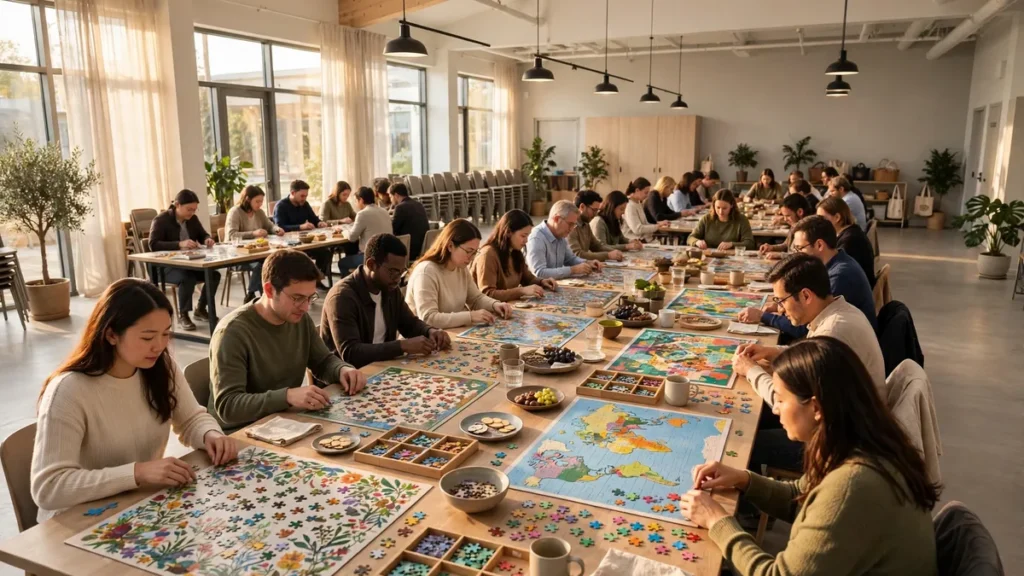
Sixty-one players is an unusual number for a game night, and that is exactly what makes it fun. Most puzzle games are built for four, six, or eight people, so a group of 61 forces you to think in teams, stations, and relays instead of a single table. The best puzzle games for 61 players are the ones that split the crowd into balanced teams, give every person a real job to do, and keep the whole room moving toward the same finish line at the same time.
Planning for 61 players starts with one honest decision: nobody should sit and watch. A puzzle night works at this size when the format is built around parallel play, where several teams solve the same puzzle at once, or around stations, where teams rotate through different challenges and earn points at each stop.
This guide covers the formats that actually work for 61 players, from giant jigsaw relays and team crossword races to puzzle hunts, logic tournaments, and escape-room style stations.
Key takeaways
- Split 61 players into six teams of ten plus one scorekeeper, or five teams of twelve plus one host, so every team is balanced and nobody sits out.
- Use parallel play or rotating stations so all teams solve at the same time and waiting time stays close to zero.
- Giant jigsaw relays, team crossword races, and puzzle hunts are the strongest formats for very large groups.
- Score every round on speed and accuracy together, with bonus points for teamwork, so fast teams cannot win by guessing.
- Prepare one puzzle set per team, identical in difficulty, and test every puzzle yourself before game night.
How to Run Puzzle Games for 61 Players
The first choice you make is the shape of the night. Parallel play means every team works on the same puzzle at the same time, and the first team to finish wins the round. Station play means teams rotate through a circuit of different puzzles, earning points at each stop, and the highest total wins. For 61 players, station play is usually the smoother option, because it spreads the crowd across the room and avoids a bottleneck at a single table.
Team size matters more than the puzzles themselves. Teams of ten to twelve keep every player involved without making decisions slow, because a team that large needs a captain, a timekeeper, and smaller pairs working on different parts of the same puzzle. Teams smaller than eight leave you with too many teams to manage, while teams larger than twelve let quieter players disappear into the crowd. If you are choosing between formats for a group just below this size, the best puzzle games for 60 players use the same team structures and round timings, and they adapt to 61 players with only one extra seat to place.
Assign the extra player a real role instead of squeezing them into a team. The 61st person makes an excellent scorekeeper, clue master, or roaming judge who checks answers, hands out the next round, and settles disputes. This keeps every team at exactly the same size, which matters when rounds are timed, and it gives the event a neutral referee the teams actually trust.
Space and supplies decide whether the night feels organised or chaotic. You need one table per team, with enough room for a puzzle board, answer sheets, and pens, plus a central station for the host. Lay out identical puzzle sets before anyone arrives, one sealed envelope or box per team per round, so no team gets a head start.
Best Puzzle Games for 61 Players
The games below are ranked for large groups, not for small tables. Each one works with six teams of ten, scales to five teams of twelve, and keeps all 61 players solving at the same time.
| Game | Teams | Time per round | Difficulty | Best for |
|---|---|---|---|---|
| Giant jigsaw relay | 6 teams of 10 | 20 minutes | Medium | Teamwork and patience |
| Team crossword race | 6 teams of 10 | 15 minutes | Medium | Word lovers |
| Puzzle hunt | 6 teams of 10 | 45 minutes | Hard | Active groups |
| Logic puzzle tournament | 6 teams of 10 | 15 minutes | Hard | Careful thinkers |
| Sudoku relay | 6 teams of 10 | 15 minutes | Medium | Number lovers |
| Word ladder chain | 6 teams of 10 | 10 minutes | Easy | Quick warm-up |
| Escape-room stations | 6 teams of 10 | 30 minutes | Hard | Mixed groups |
| Picture puzzle relay | 6 teams of 10 | 10 minutes | Easy | Visual thinkers |
1. Giant Jigsaw Relay
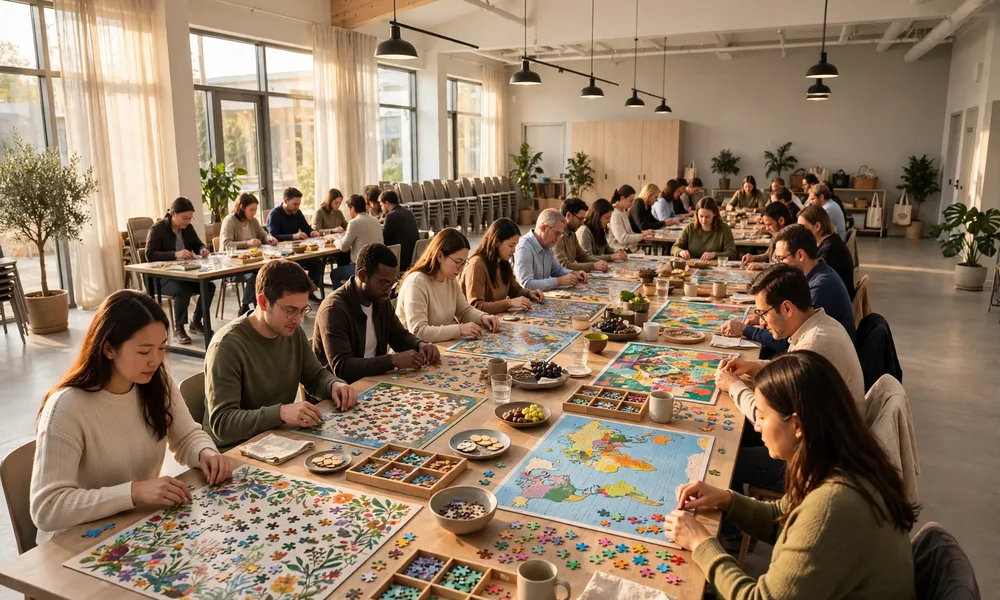
A giant jigsaw relay is the simplest large-group puzzle and the easiest to run fairly. Give every team the same 500-piece puzzle, or the same section of a larger 1,000-piece puzzle, and set a 20-minute timer. Team members split into pairs, with each pair owning one corner or one colour group, while the captain watches the picture and directs pieces to the right pair. The first team to finish wins the round, and teams that finish early earn bonus points for every minute left on the clock. Buy one identical puzzle per team, and open the boxes only when the round starts, so nobody can practise in advance.
2. Team Crossword Race
A crossword race turns a quiet solo puzzle into a loud team event. Print the same large crossword for every team, one per team, and let teams split the clues by direction, with some players on across clues and others on down clues. The captain fills in the grid from the answers the team calls out, which keeps the grid legible and stops two people writing over each other. Score one point per correct word, with a five-point bonus for the first team to finish and a two-point penalty for each wrong word, so teams check their answers instead of guessing.
3. Puzzle Hunt
A puzzle hunt sends teams around a venue solving a chain of clues, and it is the best choice when your group has energy to burn. Hide ten to twelve clue stations around the room or building, each with a small puzzle that reveals the location of the next station. Teams start at different stations so they do not crowd each other, and the hunt ends when a team reaches the final station and solves the closing puzzle. Keep each station puzzle short, no more than two minutes, because a hunt stalls when one team is stuck on a single hard clue while the rest of the group waits.
4. Logic Puzzle Tournament
A logic puzzle tournament suits groups that enjoy careful thinking more than speed. Give every team the same set of three logic grid puzzles, such as who owns which pet or who sits in which seat, and allow 15 minutes for the full set. Teams work best when they split the puzzles, with two or three players on each grid, and then cross-check each other’s answers before handing in the sheet. Score five points per correct puzzle, with a bonus for the team that finishes all three first, and print the grids large enough that four people can read the same sheet at once.
5. Sudoku Relay
A Sudoku relay works because the puzzle is familiar and the relay format keeps everyone involved. Set up one large Sudoku grid per team on a whiteboard or a big printed sheet, and let players take turns in relay order, with each player allowed to fill in only one number before tagging the next player. A player who writes a wrong number costs the team a 30-second penalty, which keeps the relay honest and stops players from rushing. Use medium-difficulty grids so the relay lasts the full 15 minutes without stalling, and prepare two grids per team so a finished team can start a second grid for bonus points.
6. Word Ladder Chain
A word ladder chain is the best warm-up game for 61 players, because it takes ten minutes, needs nothing but paper and pens, and gets every team talking. Give each team a starting word and a target word, and challenge them to change one letter at a time to reach the target, with every step a real word. Teams race to find the shortest chain, and the team with the fewest steps wins, with ties broken by speed. Play three short rounds with different word pairs, increasing the difficulty each time, and let teams compare their chains between rounds, because seeing a shorter chain teaches the group new strategies.
7. Escape-Room Style Puzzle Stations
Escape-room stations bring the most variety to a large puzzle night, because each station can use a different kind of puzzle. Set up six stations, one per team to start, with a lockbox, a coded message, a pattern puzzle, a riddle, a tangram set, and a maths puzzle. Teams spend five minutes at each station, earn points for every lock or puzzle they open, and rotate on the bell. The host resets each station between rotations, which takes about a minute, so the whole circuit runs in about 40 minutes including resets.
8. Trivia-Puzzle Hybrid
A trivia-puzzle hybrid mixes quick questions with puzzle solving, and it works well as a mid-evening round when energy starts to dip. Each round gives teams a set of ten questions, and every correct answer reveals one letter or one word of a hidden phrase. Teams that answer more questions reveal more of the phrase, and the first team to guess the full phrase wins the round. The format suits mixed groups, because a team does not need a puzzle expert to contribute, and a player who knows the trivia answers is as valuable as the player who spots the pattern in the revealed letters.
9. Picture Puzzle Relay
A picture puzzle relay is a fast visual round that suits players who think in images rather than words. Show each team the same set of ten picture puzzles, such as spot-the-difference pairs, hidden-object scenes, or rebus pictures, and let players solve them in relay order, one puzzle per player. Each correct answer earns a point, and the team with the most points after ten minutes wins. Print the pictures large, at least A4 size, and mount them on card so they survive being passed around a table of ten.
10. Puzzle Bingo
Puzzle bingo closes the evening well, because it is relaxed, social, and easy to run for 61 players at once. Give every player a bingo card where each square holds a small puzzle, such as a mini crossword clue, a number pattern, or a word scramble, instead of a number. Players solve squares on their own, then call out when they complete a row, a column, or the full card. The host checks the winning card against the answer key, and the game continues until three winners have been found.
Setting Up Teams for 61 Players
Balanced teams make the whole night fair, so build them deliberately instead of letting people choose their own groups. The simplest split is six teams of ten with one scorekeeper, which gives you six teams to manage and a neutral referee. The alternative is five teams of twelve with one host, which means fewer teams to track but larger tables and slower decisions. Choose six teams of ten if your room has six tables, and five teams of twelve if you have five large tables, because the room layout usually decides the split for you.
Mix skill levels across teams rather than letting all the puzzle enthusiasts sit together. Ask players to rate themselves from one to five on puzzles when they arrive, then deal them across teams like cards, so each team gets a similar mix of strong solvers, steady contributors, and beginners. The same team-building approach works for nearby group sizes, and the best puzzle games for 59 players follow the same captain and colour system, so you can reuse your team sheets and scoreboard with only the numbers changed.
Plan the room before the players arrive. Place team tables in a circle or a horseshoe with the host table in the middle, so the host can see every team and every team can see the scoreboard. Keep walkways clear between tables for station rotations, and put the puzzle supplies for each round in a labelled box at the centre of each table, so teams are not queuing at a supply table.
Scoring That Keeps 61 Players Engaged
Good scoring keeps all 61 players trying until the last round, so design it to reward both speed and accuracy. Award points for finishing first, but cap the speed bonus so a team that finishes one minute early does not take an unbeatable lead. A simple system is ten points for first place, eight for second, six for third, and four points for every other team that finishes, plus one point per correct answer in rounds that have many answers.
Publish the scores after every round, and keep the gap between first and last place visible but close. If one team pulls far ahead early, add a comeback round worth double points, such as a puzzle hunt or an escape-room circuit, so the trailing teams still have a reason to try. Announce the standings with a short comment on what each team did well, rather than just reading numbers, because players remember being praised for a clever solution long after they forget the score.
For groups that also enjoy board games alongside puzzles, the best board games for 60 players offer large-group formats that pair well with a puzzle night, and a combined evening of one puzzle circuit and one board game round gives 61 players two very different ways to play together.
Checklist for Puzzle Night with 61 Players
- Confirm the team split in advance: six teams of ten plus one scorekeeper, or five teams of twelve plus one host.
- Prepare one identical puzzle set per team for every round, and test each puzzle yourself before the night.
- Print answer sheets, score sheets, and a visible scoreboard, and check the timer and sound signal from the farthest table.
- Label every table with a team name and colour, and place each round’s supplies in a box at the centre of the table.
- Brief the captains on the rules, the scoring system, and the penalty for wrong answers before the first round starts.
- Pack spare puzzles, pens, and a first-aid kit for the evening, and plan a short break with drinks halfway through.
Frequently Asked Questions
What is the best puzzle game for 61 players?
The best puzzle game for 61 players is a giant jigsaw relay, because it is easy to run fairly, every team works on an identical puzzle, and all ten players on a team can contribute at the same time. Pair it with a team crossword race and a puzzle hunt across the evening for variety.
How do you split 61 players into teams?
Split 61 players into six teams of ten plus one scorekeeper, or five teams of twelve plus one host. The six-team split is easier to manage and fits rooms with six tables, while the five-team split suits larger tables and a smaller number of rounds.
How long should a puzzle night for 61 players last?
A puzzle night for 61 players should last about two to three hours, including a short break. Plan four to five rounds of ten to twenty minutes each, plus a 45-minute puzzle hunt or a 40-minute escape-room circuit if you want one long centrepiece event.
What supplies do you need for 61 players?
You need one identical puzzle set per team for every round, printed answer sheets, pens, a timer, a bell or sound signal, a visible scoreboard, and labelled tables.
Can beginners enjoy puzzle games with 61 players?
Yes, beginners enjoy large puzzle nights when teams are mixed by skill level and the games include easy rounds such as word ladders and picture puzzles. Captains should split each puzzle into small jobs, so a beginner can own one corner of a jigsaw or one set of crossword clues while stronger solvers handle the harder parts.
How do you keep 61 players from getting bored?
Keep 61 players engaged by using parallel play or rotating stations so nobody waits, by mixing fast and slow games, by publishing scores after every round, and by adding a double-points comeback round if one team pulls ahead early. Short rounds and visible timers also keep the pace high.
The Bottom Line
The best puzzle games for 61 players are the ones that turn an awkward number into a fair, fast, and social evening. Split the group into six teams of ten with one scorekeeper, run parallel rounds or rotating stations so everyone solves at once, and score on speed and accuracy together so every team stays in the contest. Start with a giant jigsaw relay, add a crossword race and a puzzle hunt, and close with puzzle bingo, and 61 players will leave having played together rather than having waited their turn.


