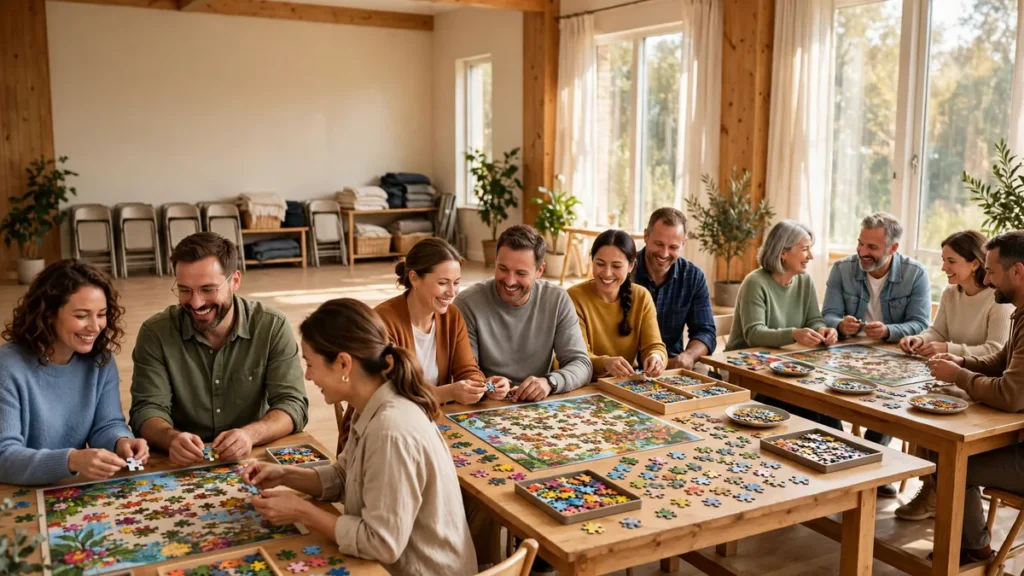
Finding the best puzzle games for 54 players is a very different challenge from picking a game for a family of four. Fifty-four people is a full hall, a whole school year group, a company department or a large community gathering, and most puzzle games were never designed for a crowd that size. A single jigsaw on one table leaves fifty people standing around, while a game that works for six players can collapse completely when nine teams are all trying to play at once.
The good news is that puzzle games scale beautifully when you choose the right formats. Team-based relays, parallel puzzle stations, escape-room style challenges and large-group word and logic games all let every one of the 54 players contribute at the same time. The trick is to split the crowd into teams of six, give every team the same puzzle at the same moment, and score the results so the whole room stays in the competition from the first clue to the final answer.
This guide covers the best puzzle games for 54 players in detail, from fast jigsaw relays and puzzle hunts to logic leagues, crossword races and escape-room challenges you can run without expensive equipment. You will find a comparison table to help you choose quickly, a step-by-step plan for organising nine teams of six, a checklist for the day itself, and answers to the questions organisers ask most often before a large puzzle night.
Key takeaways
- Split 54 players into nine teams of six, because six is the largest team size where everyone still gets a hands-on role in a puzzle.
- Choose parallel formats, such as relays, stations and simultaneous puzzle races, so no team ever waits for another team to finish.
- Mix puzzle types across the night, combining jigsaws, word puzzles, logic puzzles and physical puzzles so different strengths shine.
- Keep every round short, between 10 and 20 minutes, and score each round so teams that lose early can still win the night.
- Prepare identical puzzle sets for all nine teams and test every puzzle yourself before the event, because one faulty clue can stall the whole room.

The Best Puzzle Games for 54 Players at a Glance
Use this table to compare the strongest options before you read the detailed reviews below. Every game listed here works for 54 players when organised in teams, and each one needs only ordinary supplies or free printable materials.
| Game | Format | Round length | Best for | Equipment needed |
|---|---|---|---|---|
| Jigsaw Relay Race | Team race | 20 minutes | Fast, visual fun | Nine identical 500-piece puzzles |
| Escape Room Challenge | Station puzzle | 30 minutes | Drama and teamwork | Printed clues, locks, boxes |
| Puzzle Hunt | Room-wide hunt | 45 minutes | Large halls and mixed ages | Hidden clues, answer sheets |
| Crossword Race | Simultaneous race | 15 minutes | Word lovers | Printed crosswords, pens |
| Logic Puzzle League | League rounds | 15 minutes | Quiet, careful thinkers | Printed logic grids |
| Sudoku Relay | Team relay | 15 minutes | Number fans | Printed Sudoku grids |
| Tangram Team Build | Timed build | 10 minutes | Quick warm-up rounds | Nine tangram sets |
| Mystery Puzzle Night | Story challenge | 40 minutes | Evening centrepiece | Story cards, evidence packs |
| Word Puzzle Relay | Relay race | 15 minutes | High energy rounds | Word lists, whiteboards |
| Trivia Puzzle Hybrid | Quiz and puzzle mix | 20 minutes | Finale rounds | Question cards, puzzle sheets |
Why 54 Players Changes Everything About Puzzle Games
Most puzzle games are built for one to six players, so a group of 54 breaks the usual rules. A single puzzle cannot hold the attention of 54 people, and a game that asks players to take turns will leave most of the room idle for most of the night. The games that work at this scale are the ones that multiply the puzzle, not the players around one puzzle.
The simplest solution is the team model. Nine teams of six players each is the most reliable structure for 54 players, because six is small enough that everyone can see the puzzle, reach the pieces and speak without shouting, yet large enough to cover different skills. A team of six can include a fast pattern spotter, a careful reader, a numbers person and a steady organiser, and every one of them has a job. If you have run a slightly smaller night before, the best puzzle games for 52 players use the same team structure with only a small adjustment, which shows how well this format scales up and down.
How to Organise 54 Players Into Nine Teams of Six
Start by deciding how teams are formed. Random teams work best for mixed groups such as workplaces and community events, because they stop established friendship groups from dominating and help strangers talk to each other. Numbered wristbands, coloured lanyards or simple name badges with a team colour make it easy for players to find their table. For family gatherings and school events, let people choose their own teams but balance the ages across teams so no team is all children or all adults.
Scoring So Every Team Stays in the Game
Score every round and add the points to a running total, but keep the points close. Award points for finishing first, for finishing at all, and for partial progress, so a team that is slow at jigsaws but brilliant at word puzzles can still climb the table. A simple system works well: ten points for first place, eight for second, six for third, and two points for every other team that completes the round.
The 10 Best Puzzle Games for 54 Players
1. Jigsaw Relay Race
The jigsaw relay is the simplest large-group puzzle game and the best way to open the night. Buy nine identical 500-piece jigsaw puzzles, one per team, and give every team the same puzzle at the same moment. The first team to complete the puzzle wins the round, and every team that finishes within the time limit earns points. Five hundred pieces is the right size for a 20-minute round with six players, because the puzzle is large enough to be a real challenge but small enough that a focused team can finish it.
2. Escape Room Challenge
An escape room challenge brings the drama of a commercial escape room to a hall full of 54 players. Build nine identical sets of puzzles, each set hidden in a box or envelope, and give every team the same sequence of clues. Teams solve a code to open the first box, find the next clue inside, and work through four or five stages until they escape. A 30-minute time limit keeps the pressure on without making the game feel rushed.
3. Puzzle Hunt
A puzzle hunt turns the whole venue into the game board. Hide clues around the hall, in the garden or across several rooms, and give each team a starting clue that leads to the next. Teams move together, solve each clue to find the next location, and race to reach the final answer. A 45-minute hunt works well as the middle event of the night, when players need to stretch their legs after sitting at tables.
4. Crossword Race
The crossword race is the purest word puzzle on this list and one of the easiest to organise. Print nine copies of the same crossword, give one copy to each team, and start the clock. Teams work together to fill the grid, and the first team to complete it correctly wins. A 15-minute round suits a medium crossword of around 30 clues, while a harder cryptic crossword can fill 20 minutes.
For a wider set of word-based options for a crowd, the best word games for 52 players pair naturally with a crossword round and use the same team sizes.
5. Logic Puzzle League
A logic puzzle league is a series of short logic grids, such as who owns which house, which person arrived first, or which team scored what. Each round gives every team the same printed logic puzzle, and teams earn points for each correct answer. Run three or four rounds of 15 minutes each and add the scores together to crown a league champion.
6. Sudoku Relay
Sudoku works brilliantly as a team relay when you split the grid between players. Give each team a large printed Sudoku grid and let players take turns filling in numbers, with only one player writing at a time. A medium-difficulty Sudoku takes a team of six around 15 minutes, and the relay format means every player contributes instead of one expert doing the whole grid.
7. Tangram Team Build
Tangram is a fast, visual puzzle in which seven flat shapes are arranged to form a picture, such as a house, a bird or a boat. Give each team a tangram set and a silhouette card, and challenge them to fill the silhouette exactly. The first team to complete the shape wins, and a 10-minute round is enough for most silhouettes.
8. Mystery Puzzle Night
A mystery puzzle night gives 54 players a story to solve together. Each team receives an evidence pack containing witness statements, a map, a timeline and a set of clues, and must work out who committed the fictional crime, how it was done and where the evidence leads. The story unfolds in stages, with the host releasing new evidence every ten minutes, and teams submit their final accusation at the end of 40 minutes.
9. Word Puzzle Relay
The word puzzle relay is a high-energy game that mixes anagrams, word ladders and hidden words into a single race. Set up a whiteboard or a large sheet of paper at each table, and give teams a list of word puzzles to solve in order. Each solved word earns a point, and teams can skip a hard word and return to it later, which keeps the game moving.
10. Trivia Puzzle Hybrid
The trivia puzzle hybrid combines quiz questions with puzzle solving, which makes it the best finale game on this list. Each round of questions unlocks a piece of a larger puzzle, such as a coded message or a picture puzzle, and teams must answer correctly to earn the pieces. The first team to decode the final message wins the night, or the highest total across all rounds takes the title.
If your group also enjoys board games at this scale, the best board games for 52 players offer team formats that sit comfortably alongside a trivia puzzle finale.
A Sample Running Order for a Puzzle Night With 54 Players
A two-hour puzzle night for 54 players works well with six rounds and two short breaks. Open with the tangram team build as a warm-up, because it settles teams quickly and teaches them to work together. Follow with the jigsaw relay while energy is high, then take a ten-minute break for drinks and score updates.
After the break, run the crossword race as a calm round, then the escape room challenge as the dramatic centrepiece. Take a second short break, then run the puzzle hunt if your venue allows movement, or the logic puzzle league if players are staying seated. Finish with the trivia puzzle hybrid as the finale, announce the final scores, and award a small prize to the winning team. Prizes need not be expensive: a box of chocolates, a puzzle book or a simple trophy all work, and a prize for the best team name adds humour to the evening.
Checklist for Running Puzzle Games for 54 Players
Use this checklist in the week before your event and again on the day itself, so nothing is left to chance.
- Confirm the venue, the nine tables and the seating plan, and check that the host can be heard from every table.
- Prepare nine identical sets of every puzzle, test each puzzle yourself, and pack a spare set of each one.
- Print answer sheets, score sheets and a visible scoreboard, and prepare pens, pencils, trays and timers for every table.
- Form nine teams of six, assign team names and colours, and appoint a captain for each team.
- Brief the host and any helpers on the rules, the scoring system and the answers to the hardest puzzles.
- Arrive early, lay out the materials on every table, test the timer and the sound system, and start the first round on time.
Frequently Asked Questions About Puzzle Games for 54 Players
What is the best team size for 54 players?
Nine teams of six players is the best structure. Six players can all see the puzzle, reach the pieces and contribute, while nine teams keep the competition lively. Teams of nine or more leave too many players idle, and teams of three create eighteen teams, which is too many for one host to manage.
How long should a puzzle night for 54 players last?
Two to three hours is ideal. Six rounds of 10 to 30 minutes, plus two short breaks and time for scoring, fills an evening without tiring players out. Shorter events of 90 minutes work well with four rounds, while a full afternoon event can include a longer puzzle hunt or mystery night.
Do I need to buy nine copies of every puzzle?
Yes, for fair simultaneous play every team needs the same puzzle at the same time. For printed puzzles this costs almost nothing, because you print nine copies of the same sheet. For jigsaws and tangrams, buy nine identical sets, and choose puzzles that are good value so the cost stays reasonable.
What if some players have never played puzzle games before?
Start with the simplest game on the list, the tangram team build, and explain every game in under two minutes with a demonstration. Mixed teams help beginners, because experienced puzzlers can guide new players. Avoid games that need specialist knowledge, and choose puzzles where the rules are obvious from the materials.
How do I stop one strong team from winning every round?
Mix the puzzle types so different skills matter in different rounds, and use a scoring system that rewards completion as well as speed. Double-points bonus rounds near the end of the night also give trailing teams a real chance to catch up, which keeps the competition open until the finale.
Can puzzle games for 54 players work outdoors?
Yes, and a puzzle hunt is the best outdoor option. Use waterproof clue cards, weigh down papers so they do not blow away, and keep the written puzzles for sheltered tables. Outdoor puzzle nights suit summer evenings and large gardens, but always have an indoor backup plan in case of rain.
The Bottom Line
The best puzzle games for 54 players are the ones that give every player a job at the same time. Nine teams of six, identical puzzle sets, short rounds and a mix of jigsaws, word puzzles, logic puzzles and story challenges will fill an evening with competition that stays fair and fun from the first round to the last. Start with a simple warm-up, build to a dramatic centrepiece, and finish with a finale that lets every team score. Plan the room, test every puzzle in advance, and keep the scoring close, and your 54 players will leave asking when the next puzzle night is.


