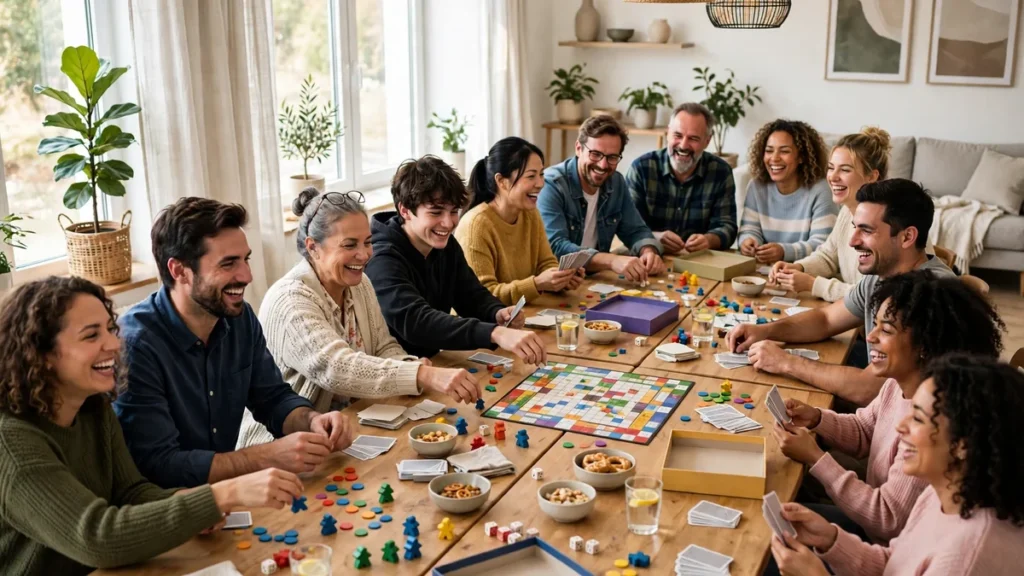
Finding the best board games for 53 players is a very different challenge from picking a game for a quiet evening with four friends. At this scale, you are not really choosing one game. You are designing an event. Fifty-three people need space to sit, clear rules they can learn in minutes, and a format that keeps everyone involved instead of leaving half the room watching from the sidelines. The good news is that a 53-player game night can be one of the most memorable gatherings you ever host, as long as you plan it like a tournament rather than a single table game.
Most board games are printed for two to six players, and that is where many hosts go wrong. They buy one big box, gather a huge crowd, and discover within ten minutes that most guests have nothing to do. The best board games for 53 players solve that problem in one of three ways: they split naturally into teams, they work in rounds where everyone plays at the same time, or they run as a series of short games across several tables. The games in this guide all do at least one of those things well, and several do all three.
This guide covers the formats that work, the specific games and game types that scale to 53 people, a comparison table to help you choose, and a practical checklist for the night itself. Whether you are planning a family reunion, a company social, a school event, or a community fundraiser, you will find a setup here that fits your group, your space, and your budget.
Key takeaways
- Split 53 players into teams of five to eight people so every guest stays involved in every round.
- Choose games where everyone plays at the same time, such as trivia, drawing, and word games, instead of games with long turns.
- Run several tables at once and rotate teams between rounds to keep the energy high and the waiting short.
- Keep scoring simple with one visible scoreboard so all 53 players can follow the competition.
- Plan for about two to three hours, with short games of 20 to 30 minutes and breaks between rounds.

Why 53 Players Changes the Game
A group of 53 changes the maths of game night completely. A standard board game with six players gives each person a turn every few minutes. Stretch that same game to 53 players and the wait between turns becomes unbearable. People drift away, conversations split off, and the game quietly falls apart. That is why the first rule of large-group gaming is simple: nobody should ever be waiting more than a minute or two for something to do.
Space matters just as much as the rules. Fifty-three people need roughly eight to ten tables if you seat six or seven per table, plus room to move between them. A group this size usually needs a community hall, a school gym, a church hall, or a big garden with covered seating. Before you choose a single game, measure your space and count your chairs. A brilliant game in a cramped room still feels like a bad night.
Noise is the third factor hosts forget. Fifty-three people talking, laughing, and cheering is loud, and that is a good thing, but it means quiet strategy games will not work. Games that need careful listening across a table will frustrate players. Games that thrive on noise, such as team trivia, drawing challenges, and party games, get better as the room gets louder. Pick games that use the energy of a big crowd instead of fighting it.
Finally, think about the range of ages and experience in your group. A 53-player event often mixes children, teenagers, parents, and grandparents. The best choices are games with rules that take less than five minutes to explain and no reading of long rulebooks at the table. Simple rules, visible scoring, and short rounds are what make a huge game night feel effortless.
How to Run a 53-Player Board Game Night
A great 53-player night is really a small tournament, and tournaments need a simple structure. The format below has been used at family reunions, school socials, and office parties, and it works because it keeps every player busy from the first minute to the last.
Split Into Teams That Actually Work
Divide your 53 players into eight teams. Seven teams of seven and one team of four sounds uneven, so a better split is five teams of seven and three teams of six, which gives you eight teams and a fair balance. Give each team a name, a colour, or a table number, and keep the teams fixed for the whole night so rivalries can build. Mixed teams work best: put confident players with quieter ones, and mix ages wherever you can so no single team feels stacked.
Each team sits at its own table for most games, and team members play together rather than against each other. This is the single most important decision you will make. Team play turns a 53-player problem into an eight-team competition, and eight teams are easy to manage. If you are looking for proven formats at a similar scale, the board games that work for 52 players use the same team structure and adapt to 53 players with one small adjustment to the team sizes.
Use a Rotation System Between Rounds
Run the night in rounds of 20 to 30 minutes. In each round, every team plays the same game at its own table, or teams rotate between game stations. A simple rotation is to set up four game stations and have two teams at each station, swapping after every round. After four rounds, every team has played every game. This keeps the night moving and stops any single game from wearing out its welcome.
Use a loud timer and a clear signal for the end of each round. A phone timer connected to a speaker works well, and a whistle or a bell is even better in a noisy hall. Those short breaks between rounds are when people compare scores and share stories from the last game, which builds the friendly rivalry that makes the night memorable.
Keep Score Simple and Visible
One visible scoreboard beats eight separate scoresheets. Use a whiteboard, a large sheet of paper on the wall, or a projected slide that everyone can see. Award points per round, such as ten points for first place, seven for second, five for third, and three for taking part, and update the board after every round. When all 53 players can see the standings, every round matters, even for teams at the bottom of the table.
Keep the scoring the same across every game so nobody has to learn a new system mid-evening. The host should announce the standings before each new round and build a little drama around the leaders. A simple prize for the winning team, such as a small trophy, a box of treats, or the honour of choosing the first game next time, gives the competition a satisfying finish without turning a friendly night into a serious contest.
The Best Board Games for 53 Players
The games below are grouped by type, because no single board game handles 53 players on its own. The winning approach is to combine two or three types across your tables so every team gets variety. The comparison table gives you a quick overview, and the sections that follow explain how each type works at this scale.
| Game type | Best for | Players per table | Round length | Setup needed |
|---|---|---|---|---|
| Team trivia | All ages, mixed groups | 6 to 8 | 20 minutes | Question cards, answer sheets |
| Drawing games | Creative groups, families | 5 to 8 | 20 minutes | Paper, pens, timer |
| Social deduction | Teenagers and adults | 7 to 10 | 25 minutes | Role cards |
| Word games | Quick thinking, mixed ages | 5 to 7 | 15 minutes | Letter tiles or cards |
| Relay and dexterity | High energy, outdoor space | 6 to 8 | 15 minutes | Simple props, open floor |
| Card games | Fast rounds, all ages | 5 to 8 | 15 minutes | Card decks |
| Classic board games | Strategy fans, tournaments | 4 to 6 | 30 minutes | One board per table |
1. Team Trivia Games
Team trivia is the most reliable choice for 53 players, and it should be the backbone of your night. Every team answers the same questions at the same time, so nobody waits for a turn, and the host controls the pace for the whole room. Write your own questions or use a published trivia game, and mix the rounds: general knowledge, music, food, sport, films, and a picture round.
Keep each trivia round to about ten questions and run two or three rounds across the evening. Vary the difficulty so that every team can answer some questions and no team can answer them all. Include a few questions about the group itself, such as the host family, the company, or the school, because personal questions get the biggest reaction.
2. Party Drawing Games
Drawing games are ideal for big groups because they are funny, fast, and need almost no equipment. One player draws a word or phrase while their team guesses, and the whole table shouts suggestions at once. At 53 players, drawing games work best as a station in your rotation, with each team taking turns to draw while the other teams watch and laugh.
Choose words that suit your group. Family events work well with animals, food, films, and everyday objects. Adult groups can handle trickier phrases and puns. For more high-energy formats that fit the same crowd, the party games built for 52 players adapt to 53 players without changing a single rule, and they pair perfectly with a drawing station.
3. Social Deduction at Scale
Social deduction games, where some players have a secret role and the rest must work out who they are, are made for large groups. Games in this style can handle ten or more players at a table, which makes them one of the few board game types that nearly fits a big crowd without splitting. With 53 players, run two or three deduction tables at once and let teams compare stories between rounds.
These games need a confident host or a strong player at each table to explain the rules and keep the discussion moving. They work best with teenagers and adults, because younger children can find the bluffing and debate confusing. The discussions these games create are often the most talked-about moments of the whole night.
4. Giant Word Games
Word games scale beautifully because they are simultaneous: every team works on the same puzzle at the same time. Large letter tiles, word cards, and anagram challenges all work well. One strong format is a word race, where each team gets the same set of letters and has three minutes to build as many words as possible. Another is a category game, where teams write down answers beginning with a chosen letter and score points for unique answers.
Word games are also the easiest to adapt for mixed ages. Younger players can contribute short words while adults chase longer ones, and every answer counts. They need very little setup, which makes them a good first round while latecomers arrive and teams settle in.
5. Relay and Dexterity Challenges
Not every game at a board game night needs a board. Relay and dexterity challenges, such as stacking cups, balancing tasks, quick building challenges, and timed sorting games, add movement and energy to an evening that might otherwise be all sitting down. These work best in a hall or garden where teams have space to stand and move without disturbing other tables.
Run dexterity games as a timed station: each team sends players one at a time to complete a short task, and the team with the fastest total time wins the round. These games are excellent for groups with children, because they level the playing field between ages. A ten-year-old can be just as fast as an adult at stacking cups. Keep the tasks safe, simple, and easy to reset between teams, and have a spare set of props ready in case anything breaks mid-round.
6. Card Games That Scale
Card games are the most flexible option for a 53-player night because decks are cheap, portable, and easy to replace. Fast card games with simple rules, where players match, collect, or react quickly, work best. The best choices are games where all players act at once, such as slap and reaction games, or team card games where partners work together against another pair.
Set up a card station with two or three different games so teams can switch between them during the round. If you need inspiration for formats that already work at this size, the card games for 52 players cover the strongest scalable card formats, and adding one extra player to a team changes nothing about how they play. Bring spare decks, because cards get the hardest use of anything on the night.
7. Classic Board Games, Tournament Style
Classic board games still have a place at a 53-player night, but only as a tournament. Set up one classic game per table, such as a strategy board game, a property trading game, or a route-building game, and run them as short heats. The winner of each table advances to a final table, while other players move to a different game. This gives strategy fans the depth they enjoy without forcing the whole room to play one slow game.
Keep the heats short by setting a time limit of 30 minutes and scoring by position when the timer ends, rather than playing to a full finish. Not every classic game suits this format, so choose games with clear scoring and a natural stopping point.
Your 53-Player Game Night Checklist
Use this checklist in the week before your event so nothing important is left to the last minute.
- Confirm the guest list and the space. Count 53 players, check you have enough chairs and tables, and confirm the venue can hold everyone comfortably with room to move between tables.
- Choose three or four game types from this guide. Pick a mix that suits your group, such as trivia, drawing, word games, and one card station, and prepare the materials for each one.
- Split the group into eight teams in advance. Write the team lists before the night starts so nobody is left standing around while teams are sorted out at the door.
- Prepare one visible scoreboard and a timer. Test the timer and the speaker beforehand, and make sure the scoreboard can be seen from every table in the room.
- Pack spares of everything. Bring extra pens, paper, card decks, and batteries. Small shortages cause the biggest delays at large events.
- Plan food, drinks, and breaks. Schedule a ten-minute break halfway through, put drinks where teams can reach them without leaving their tables, and keep snacks simple so hands stay clean for the games.
Frequently Asked Questions
What is the best board game for 53 players?
There is no single board game that fits 53 players around one table. The best approach is a team format: split the group into eight teams and play team trivia, drawing games, word games, and card games in rounds. Team trivia is the strongest single choice because every team plays at the same time and the host controls the pace for the whole room.
How do you split 53 players into teams?
The fairest split is five teams of seven and three teams of six, which gives you eight teams. Mix ages and experience levels across the teams so no team feels stacked, and keep the teams fixed for the whole night so rivalries can build. Give each team a name or colour to make scoring and announcements easy.
How long should a 53-player game night last?
Plan for about two to three hours. Run rounds of 20 to 30 minutes with two-minute breaks between them, and add a ten-minute break halfway through. Four rounds of different games, plus a short final, fills an evening nicely without tiring anyone out.
What space do you need for 53 players?
You need eight to ten tables seating six or seven people each, plus space to move between them. A community hall, school gym, church hall, or large garden usually works well. A normal living room is too small for a group this size, so book a venue early.
Can children play in a 53-player board game night?
Yes, and mixed-age teams work very well. Choose games with simple rules and simultaneous play, such as trivia with mixed difficulty, drawing games, word races, and dexterity challenges. Children often shine at fast reaction games, and team play means younger players always have teammates to help them.
What should I do if some players arrive late?
Late arrivals simply join a team. Team games absorb extra players without any rule changes, which is another reason they work so well at this scale. Start on time with the players you have, run a short and simple first round, and welcome latecomers into teams during the first break.
The Bottom Line
The best board games for 53 players are not the biggest boxes on the shelf. They are the games that let everyone play at once, split neatly into teams, and keep the waiting to a minimum. Build your night around team trivia, drawing games, word games, and card games, run them in short rounds across several tables, and keep the scoring simple and visible. Pick your games, split your teams, set the timer, and enjoy the noise.


