Finding great board games for 18 players is a different kind of challenge from picking a game for a regular family night. Most board games are built for two to six people, so a group of eighteen needs titles that scale up, split neatly into teams, or run as one big shared experience. The good news is that some of the most memorable party games ever made were designed exactly for crowds this size.
The best board games for 18 players share a few traits. They keep everyone involved at the same time, they explain in under five minutes, and they create moments worth talking about afterwards, whether that is a dramatic accusation, a perfectly wrong guess, or a team comeback in the final round. This guide rounds up twelve proven picks and explains how each one handles a group of eighteen.
Whether you are planning a birthday party, a holiday gathering, a work social, or a big family weekend, the games below cover every mood, from social deduction and wordplay to drawing, trivia, and pure silliness. Pick two or three that match your group, set up a simple rotation, and your eighteen-player game night will run itself.
Key takeaways
- Social deduction games such as Blood on the Clocktower and Ultimate Werewolf are the easiest way to keep all 18 players involved at once.
- Team games work best at this size: split eighteen players into two or three teams and let the teams compete head to head.
- Choose games that explain in five minutes or less so the night starts quickly and nobody loses interest during the rules.
- Run two tables in parallel for games with a ten-player limit, then bring everyone together for a big-group finale.
- Keep rounds short and rotate roles often so every player gets a turn in the spotlight.
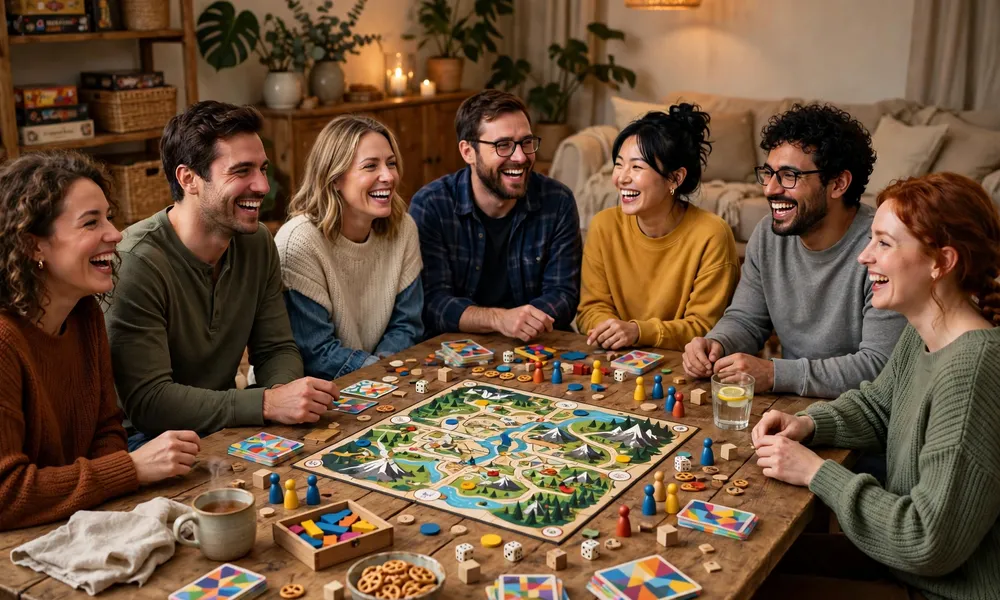
Why 18 Players Changes the Game
At eighteen players, the usual rules of game night stop applying. A game that works beautifully for four people can fall apart when six players are waiting twenty minutes between turns. Downtime is the enemy of a large group, because bored players check their phones and drift out of the game entirely. The games in this guide avoid that problem by keeping turns short, giving everyone something to do at the same time, or splitting the group into teams that play simultaneously.
Player count is the first thing to check on any box. Some games list a maximum of eighteen or more right on the cover, which makes the choice easy. Others list a smaller number but scale beautifully with teams, duplicate copies, or a simple house rule. If your group enjoyed our guide to the best board games for 17 players, the same team-play tricks work just as well with one extra person.
Space matters too. Eighteen people need a big table, or better, two tables pushed together with room to move around. Social deduction games need space for players to stand up, whisper, and form small huddles. Before the night starts, set up a main table, a second table for a parallel game, and a comfortable area where waiting players can watch the action.
How to Choose the Right Game for Your Group
Start by thinking about who is coming. A group of close friends who love arguing and bluffing will adore social deduction. A mixed group with children, grandparents, and shy guests will do better with cooperative word games and drawing games. A party where people barely know each other needs simple icebreaker games with quick rounds.
Next, think about time. Some games on this list finish in fifteen minutes, which is perfect for warming up the room. Others run for an hour or more and work best as the main event of the evening. A good eighteen-player game night usually mixes both: two or three short games to start, one long game in the middle, and a fast, loud finale.
Finally, think about energy. Loud, argumentative games are wonderful, but three hours of shouting is exhausting. Balance a high-energy deduction game with a quieter word game, and plan a snack break in the middle. The host should be ready to explain rules quickly, keep score, and gently move the night along when a game starts to drag.
The Best Board Games for 18 Players
Each game below includes its player count, typical play time, and the reason it works for a group of eighteen.
1. Blood on the Clocktower
Blood on the Clocktower is the gold standard for huge groups, supporting five to twenty players in a single game. One player is the storyteller, one is secretly the demon, and everyone else works together to find the demon before the whole town is destroyed. The game runs in day and night phases, with whispered conversations, public accusations, and dramatic votes that keep all eighteen players involved from start to finish.
What makes it perfect for eighteen players is that elimination does not mean boredom: dead players stay in the game as ghosts with a vote, so nobody sits out. A full game takes 45 to 60 minutes, and the storyteller role is so much fun that players will argue over who gets to run the next round.
2. Ultimate Werewolf
Ultimate Werewolf is the classic large-group hidden-role game, and it can handle up to 75 players, so eighteen is right in its sweet spot. Players are secretly villagers or werewolves. Each night the werewolves eliminate a villager, and each day the village debates and votes to eliminate a suspect.
A game with eighteen players takes about 30 to 45 minutes, and the rules can be taught in three minutes. The best part is the discussion: with eighteen people arguing, bluffing, and accusing each other, every round turns into a piece of theatre. Give the moderator role to your most confident friend.
3. Two Rooms and a Boom
Two Rooms and a Boom is built for large groups, supporting six to thirty players. The group splits into two rooms, and each player has a secret role and a secret team. Players move between rooms, share information, and try to work out who is on their team before the timer runs out. The final reveal is one of the most exciting endings in any party game.
With eighteen players, you get two rooms of nine, which is the ideal size for lively negotiation without chaos. A round takes only fifteen minutes, so you can play three or four rounds in an hour with different roles each time. It needs two separate rooms or spaces, which makes it perfect for a house party or a venue with more than one room.
4. Monikers
Monikers is a hilarious guessing game for four to twenty players, and eighteen is a perfect fit. Players write the names of famous people, characters, and things on cards, then take turns getting their team to guess as many as possible. The game runs in three rounds: first with any clues, then with a single word, and finally with silent gestures only.
Split eighteen players into three teams of six, and a full game takes 30 to 60 minutes. Monikers works because the cards come from the players themselves, so every game is personal and different.
5. Herd Mentality
Herd Mentality is a delightfully simple party game for four to twenty players. Each round, players secretly write down an answer to a fun question, such as the best pizza topping or the worst superpower. If your answer matches the majority, you earn points. If you are the odd one out, you get the pink cow.
The game takes about twenty minutes, and its genius is that it rewards thinking like the group instead of being clever or original. With eighteen players, the debates about the strangest answers are half the fun. It is the perfect warm-up game: simple, fast, funny, and impossible to take seriously.
6. Codenames
Codenames is a team word game that officially supports two to eight players, but it scales beautifully to eighteen with a simple team format. Split the group into two teams of nine, with one spymaster per team giving one-word clues that link several secret words on the table. The rest of each team debates the clue together, so everyone is involved in every turn.
A game takes about fifteen minutes, and the team discussion is where the magic happens: nine people arguing over whether the clue “Ocean” means “Whale” or “Ship” is pure entertainment. You can also run two copies side by side as a small tournament.
7. Wavelength
Wavelength is a social guessing game where players debate where a hidden target falls on a spectrum, such as “Hot versus Cold” or “Boring versus Exciting.” One player gives a clue, and the team argues about where it belongs on the scale. The game officially supports two to twelve players, but with eighteen you can play it as two teams of nine taking turns, which works perfectly.
Wavelength works because the debate is the whole game. A round takes 20 to 40 minutes, and it is an excellent choice for groups who love talking, laughing, and learning how differently their friends think.
8. Telestrations
Telestrations is the classic game of telephone played with drawings, and it is made for big groups. Players draw a word, pass the sketch on, and the next player guesses what it shows. By the end of the chain, the original word has turned into something wonderfully wrong, and revealing the books one by one is always the funniest part of the night.
The standard game supports four to eight players, but the 12-player party pack combined with a second set lets you run eighteen players as two groups of nine, or as one giant chain if you have enough sketch books. Drawing skill does not matter at all; the worse the drawings, the funnier the results.
9. Fishbowl
Fishbowl is a free, endlessly replayable party game with no real player limit, which makes it a natural fit for eighteen players. Everyone writes a few words or phrases on slips of paper and drops them into a bowl. The game then runs in three rounds: describing the word, saying only one word, and acting it out silently. Teams compete to guess as many slips as possible in sixty seconds.
With eighteen players, split into three teams of six and play for about 30 minutes. Fishbowl needs nothing but paper, pens, and a bowl, so it is the perfect backup game if a planned game falls flat or if extra guests arrive unexpectedly.
10. The Resistance: Avalon
The Resistance: Avalon is a social deduction game of hidden loyalty, quests, and betrayal, set in the world of King Arthur. Players are secretly loyal servants or minions of Mordred, and they vote on which teams go on quests. The game officially supports five to ten players, so for eighteen you run two tables of nine in parallel, which keeps the games fast and tense.
Each game takes 15 to 30 minutes, and you can swap players between tables after a few rounds. If you enjoy the bluffing and teamwork in our guide to the best board games for 16 players, Avalon delivers the same tension with a theme that makes every accusation feel dramatic.
11. Secret Hitler
Secret Hitler is a fast social deduction game for five to ten players, and with eighteen it runs best as two parallel tables of nine. Players are secretly liberals or fascists, with one player hidden as Hitler. Each round, the group elects a government and passes policies, while the fascists try to hide their identity and push their agenda through.
A game takes 15 to 30 minutes, and the rules are simple enough to teach in five minutes. The game creates brilliant moments of suspicion, because a single bad policy can turn the whole table against an innocent player.
12. Trivia Team Challenge
A trivia team challenge is not a single boxed game, but it is one of the best formats for eighteen players, and it uses games you probably already own. Split the group into three teams of six, pick a trivia game or a set of quiz cards, and run six rounds of ten questions across topics like music, movies, food, and sport. Award bonus points for the funniest wrong answers to keep the mood light.
A trivia night takes 45 to 60 minutes and suits every age and ability, because teams can pool their knowledge and everyone contributes something. More team-competition ideas are in our guide to the best party games for 12 players, which has more ideas for turning classic games into team competitions. Trivia is the ideal finale: easy to run, easy to score, and guaranteed to produce a winner.
Quick Comparison Table
Use this table to pick the right game at a glance.
| Game | Players | Play Time | Best For |
|---|---|---|---|
| Blood on the Clocktower | 5 to 20 | 45 to 60 minutes | One big shared game |
| Ultimate Werewolf | 5 to 75 | 30 to 45 minutes | Classic bluffing and debate |
| Two Rooms and a Boom | 6 to 30 | 15 minutes per round | Moving around and negotiating |
| Monikers | 4 to 20 | 30 to 60 minutes | Guessing and in-jokes |
| Herd Mentality | 4 to 20 | 20 minutes | Quick warm-up fun |
| Codenames | 2 teams of 9 | 15 minutes | Team wordplay |
| Wavelength | 2 teams of 9 | 20 to 40 minutes | Debate and discussion |
| Telestrations | 2 groups of 9 | 30 minutes | Drawing and laughing |
| Fishbowl | Unlimited | 30 minutes | Free, fast icebreaker |
| The Resistance: Avalon | 2 tables of 9 | 15 to 30 minutes | Hidden roles and quests |
| Secret Hitler | 2 tables of 9 | 15 to 30 minutes | Quick deduction rounds |
| Trivia Team Challenge | 3 teams of 6 | 45 to 60 minutes | Grand finale for everyone |
How to Run an 18-Player Game Night
Good hosting makes a bigger difference than the games themselves. Start the evening with a short, simple game like Herd Mentality or Fishbowl while everyone arrives and settles in. This warms up the room, breaks the ice, and gives latecomers a chance to join without disrupting a long game. Save the big deduction game for the middle of the evening.
Plan the evening in blocks of about 45 minutes, with a short break between each block for snacks, drinks, and conversation. Announce the plan at the start so players know what is coming and can choose which games to join. If you run two tables in parallel, ask a confident player to host the second table.
Keep score simply. A small whiteboard or a sheet of paper with team names and points is enough, and a running total across the night gives the evening a sense of friendly competition. End by announcing the winning team and handing out a silly prize, such as a homemade trophy.
Game Night Checklist
Run through this checklist before your guests arrive so the night goes smoothly.
- Pick two or three games from this guide that suit your group, and read the rules in advance.
- Set up two tables with enough chairs, good lighting, and space for players to move around.
- Prepare team lists in advance, mixing ages and friendships so every team is balanced.
- Lay out snacks, drinks, pens, paper, and a timer where everyone can reach them.
- Choose a confident host for the second table if you plan to run two games at once.
- Plan a short break in the middle and a fun finale, such as a trivia round or a group photo.
Frequently Asked Questions
What is the best board game for 18 players?
Blood on the Clocktower is the best single choice, because it officially supports up to twenty players in one game and keeps everyone involved even after elimination. Ultimate Werewolf and Two Rooms and a Boom are close seconds.
Can you play Codenames with 18 players?
Yes. Split eighteen players into two teams of nine, with one spymaster per team. The whole team discusses each clue together, so everyone takes part in every turn. You can also run two copies of the game side by side as a small tournament.
How do you split 18 players fairly?
Split eighteen into two teams of nine or three teams of six, depending on the game. Mix close friends across teams rather than letting friendship groups stay together, and rotate team members between rounds so everyone plays with different people across the night.
What if some players have never played board games?
Start with the simplest games on this list, such as Herd Mentality, Fishbowl, or Telestrations. They explain in under five minutes and need no gaming experience.
How long should an 18-player game night last?
Plan for two and a half to three hours, including a break. That gives you time for a warm-up game, a main game, and a finale. It is always best to finish while everyone is still laughing.
Do I need two copies of every game?
No. Only games with a hard ten-player limit, such as Avalon or Secret Hitler, benefit from a second copy for a parallel table. Most games on this list handle eighteen players in a single game, and team formats cover the rest.
The Bottom Line
The best board games for 18 players are the ones that turn a big crowd into one shared experience instead of a waiting room. Blood on the Clocktower, Ultimate Werewolf, and Two Rooms and a Boom let all eighteen play together at once, while Monikers, Codenames, Wavelength, and the trivia challenge turn the group into teams that compete head to head. Pick two or three games that match your guests, set up the room with space to move, and keep the rounds short and the energy high. With the right games and a little planning, eighteen players is the reason the night will be unforgettable.