Finding great party games for 18 players is a different challenge from picking a game for a small group. With eighteen people in the room, most ordinary board games break down: turns take too long, half the group waits around, and the energy drops before the first round ends. The best party games for 18 players solve that problem by design, keeping everyone involved at the same time through teams, simultaneous play, or fast rounds where nobody sits out for long.
The games in this guide all work for a group of eighteen, whether you are hosting a birthday, a holiday gathering, a work party, or a family reunion. They favour talking, guessing, laughing, and teamwork over long rules and quiet concentration, and most of them need little or no special equipment. Several can be played with nothing more than paper, pens, and a phone, while others use a single box that the whole room can share.
We have focused on games that scale cleanly to eighteen, that keep rounds short, and that give quieter guests a real role instead of leaving them on the sidelines. Use the comparison table to match a game to your time, your space, and your group, then follow the hosting checklist at the end to run the night smoothly from the first round to the last.
Key takeaways
- Choose games built for teams or simultaneous play, so all 18 players stay involved instead of waiting for a turn.
- Split eighteen players into three teams of six or two teams of nine for the fairest, liveliest games.
- Keep rounds short, at 10 to 20 minutes, and rotate teams or roles between rounds.
- Mix one guessing game, one active game, and one creative game for a balanced party night.
- Most of the best options need only paper, pens, and a phone, so setup takes minutes.
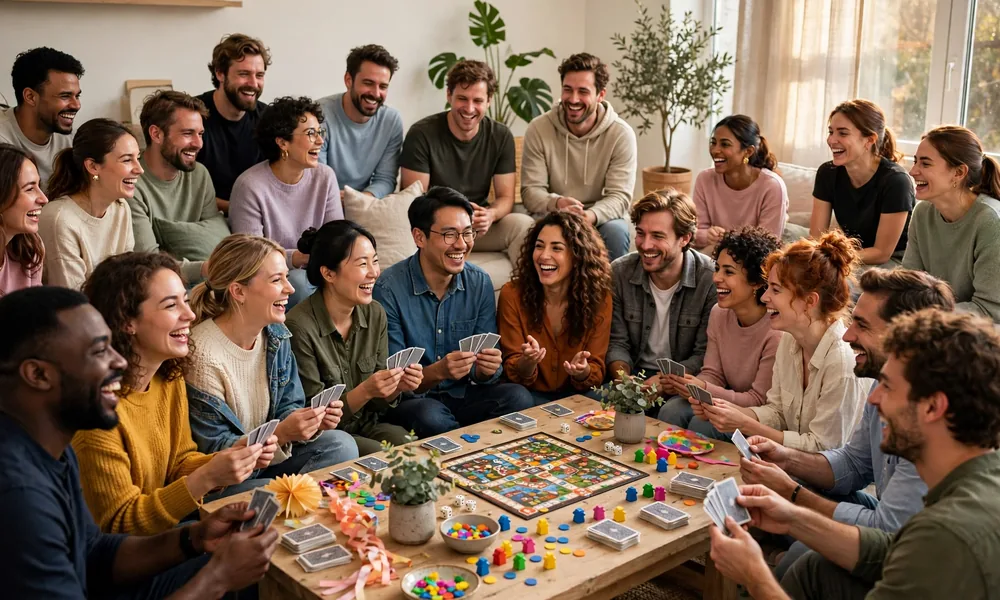
How to Choose Party Games for 18 Players
Eighteen is a wonderful party size, but it is also the point where many popular games stop working. A game designed for four to six players becomes slow and frustrating when three times as many people have to take turns. Before you pick anything, check three things: how many people play at once, how long a round lasts, and how much talking the game creates.
The best choices let everyone act at the same time. In a guessing game, the whole team shouts answers together. In a drawing game, several people draw at once. In a social deduction game, every player has a secret role and a reason to talk. If a game makes seventeen people watch one person play, save it for a smaller night.
Space matters too. Eighteen people need room to move, to form teams, and to hear each other. A game that needs players to whisper across a table works better in a quiet room, while a loud, active game suits a garden, a hall, or a large living room with the furniture pushed back. Think about noise as well: neighbours, sleeping children, and shy guests all shape which games will feel right.
Finally, match the game to your guests. A mixed-age family group will enjoy simple, friendly games with easy rules. A group of close friends may love bluffing and teasing. A work party needs games that are fun without putting anyone on the spot. When in doubt, pick a game with simple rules that you can explain in under two minutes.
The Best Party Games for 18 Players
The twelve games below are ordered to give you a full evening: quick warm-ups first, then the big team games, then relaxed wind-down options. Each one works for eighteen players, and each one brings a different kind of fun to the room.
1. Two Rooms and a Boom
Two Rooms and a Boom is one of the best large-group games ever made, and it was designed for exactly this kind of crowd. Players are split into two rooms, each with a secret team, and they have a short time to find out who is on their side. The president and the bomber are hidden among the players, and the game ends in a single dramatic reveal.
With eighteen players, split into two rooms of nine. Rounds last about fifteen minutes, and the game rewards talking, bluffing, and quick thinking rather than luck. It needs a little space, since you need two separate rooms or areas, but the payoff is a game where every single person matters.
2. Werewolf and Mafia
Werewolf, also known as Mafia, is a classic social deduction game that only gets better with more players. At night, the werewolves secretly choose a victim. During the day, everyone debates, accuses, and votes to remove a suspect. With eighteen players, you can include several werewolves, a seer, a doctor, and other special roles.
A round takes twenty to thirty minutes, and the game needs no equipment at all, just a moderator and a way to assign roles. Keep the pace brisk, limit long speeches, and play two or three short rounds rather than one very long one.
3. Codenames
Codenames is a word-guessing team game that scales beautifully to eighteen players. Two teams compete to find their secret words on a grid, guided by one-word clues from their spymaster. With a large group, split into two teams of nine, and let the whole team discuss each clue together.
A game lasts about fifteen minutes, and the rules take two minutes to explain. It is quiet enough for a living room, clever enough for word lovers, and friendly enough for mixed ages. The large team size actually helps, because more minds mean more ideas, and the debate over each clue is half the fun.
4. Fishbowl
Fishbowl is a fast, hilarious game that combines charades, password-style clues, and one-word guessing. Everyone writes a few words or phrases on slips of paper and drops them into a bowl. Teams then take turns pulling out slips and getting their team to guess them, first by describing, then by acting, then by saying a single word.
With eighteen players, form three teams of six. Each round takes about ten minutes, and the game gets funnier as the rounds go on, because the same words keep coming back in new ways. It costs almost nothing to play, needs only paper and pens, and works for almost any group.
5. Monikers
Monikers is similar to Fishbowl but uses a deck of cards full of famous people, characters, and ideas. Teams take turns giving clues to get their team to guess the card, moving through rounds where clues get shorter and shorter. The shared jokes build quickly, and by the final round a single word can send the whole team into laughter.
The game officially supports large groups, and with eighteen players you can split into three teams of six. A full game takes thirty to forty-five minutes, so it suits the middle of the evening.
6. Wavelength
Wavelength is a social guessing game where teams try to read each other’s minds. A target sits somewhere on a scale between two opposites, such as hot and cold or popular and unpopular, and one player gives a clue to help their team find it. The discussion that follows is the heart of the game.
With eighteen players, split into two teams of nine. Rounds are quick, about five minutes each, and the game is easy to learn. It suits groups who enjoy conversation and friendly debate, and it works well as a relaxed game between more active ones.
7. Telestrations
Telestrations is often called the game of telephone pictionary, and it is at its best with a large group. Each player starts with a word, draws it, passes the sketch on, and the next player guesses what the drawing shows. The results get stranger and funnier with every pass around the table.
The standard game supports up to eight players, so for eighteen you need two sets of the game, or two groups of nine playing side by side. That works well: two tables, two games, and a shared show-and-tell at the end where the funniest chains are read aloud.
8. Heads Up and Charades
Heads Up, the phone-based guessing game, and classic charades both work wonderfully for eighteen players. In Heads Up, one player holds a phone to their forehead while their team shouts clues. In charades, players act out words, films, or songs without speaking. Both games are fast, loud, and easy to join.
Split into three teams of six and play in short timed rounds of one or two minutes. The team format keeps everyone involved, and the short rounds mean nobody waits long for a turn.
9. Trivia Night
A trivia night is one of the most reliable ways to entertain eighteen players. Split into three teams of six, prepare five or six rounds of ten questions, and cover a mix of topics: music, food, films, sport, general knowledge, and questions about the guests themselves. A quizmaster reads the questions, teams write down their answers, and scores are tallied between rounds.
A full trivia night takes forty-five to sixty minutes, so it can anchor the whole evening or fill the middle of the party. It suits every age group, it lets quieter guests contribute their knowledge, If you want ready-made inspiration, the best party games for 16 players guide has a similar large-group structure that adapts easily to eighteen.
10. Murder Mystery Party
A murder mystery party turns eighteen guests into suspects, detectives, and witnesses for the evening. Each player receives a character with a background, secrets, and clues, and the group works together, and against each other, to solve the crime. Ready-made kits are available for groups of this size, and many can be printed at home.
A murder mystery takes one to two hours, so it suits a dedicated evening rather than a short gathering.
11. Minute to Win It Challenges
Minute to Win It challenges are short, silly tasks that players complete in sixty seconds: stacking cups, moving biscuits from forehead to mouth, or bouncing a ball into a cup. With eighteen players, run them as a team tournament, with three teams of six taking turns to send a player forward for each challenge.
Each challenge takes only a minute, so a full tournament of ten challenges takes about thirty minutes. The games are active, visual, and very funny to watch, which makes them perfect for a party where some guests prefer to watch rather than play every round.
12. Scavenger Hunt and Human Bingo
A scavenger hunt and human bingo are two relaxed games that get eighteen people talking and moving. In a scavenger hunt, teams race to find or photograph items from a list around the house, garden, or neighbourhood. In human bingo, each player has a bingo card of facts, such as has been to Paris or can play the piano, and must find other guests who match each square.
Both games take twenty to thirty minutes and work well as warm-ups or wind-downs. They are especially good for groups where not everyone knows each other, because they give people a reason to start conversations.
Party Games for 18 Players Compared
Use this table to pick the right game for your time, space, and group. The best evenings mix a quick game, a team game, and a relaxed game, rather than playing the same style all night.
| Game | Players | Time | Best For | Equipment |
|---|---|---|---|---|
| Two Rooms and a Boom | 10 to 30 | 15 minutes | Main event | Game box, two rooms |
| Werewolf and Mafia | 8 to 30 | 20 to 30 minutes | Talking and bluffing | None |
| Codenames | 4 to 18 | 15 minutes | Word lovers | Game box |
| Fishbowl | 6 to 30 | 10 minutes | Quick warm-up | Paper and pens |
| Monikers | 4 to 18 | 30 to 45 minutes | Big laughs | Game box |
| Wavelength | 2 to 12 per set | 20 minutes | Relaxed debate | Game box |
| Telestrations | 4 to 8 per set | 20 minutes | Creative groups | Two game sets |
| Heads Up and Charades | 6 to 30 | 15 minutes | Fast and loud fun | Phone or paper |
| Trivia Night | 6 to 30 | 45 to 60 minutes | Mixed ages | Questions and pens |
| Murder Mystery Party | 12 to 20 | 1 to 2 hours | Themed evening | Printed kit |
| Minute to Win It | 6 to 30 | 30 minutes | Active fun | Household items |
| Scavenger Hunt | 6 to 30 | 20 to 30 minutes | Meeting new people | Printed lists |
How to Run a Party Night for 18 Players
A great party night needs a little structure. Start with a warm-up game that anyone can join, such as Fishbowl or human bingo, while guests arrive and settle in. Then move to your main team game, such as Two Rooms and a Boom or a trivia night, when everyone is present. Finish with a relaxed game, such as Wavelength or Telestrations, as the evening winds down.
Keep the energy up by changing the pace between games. Follow a loud, active game with a quieter one. Rotate teams between games so people play with different guests. Appoint a host or quizmaster to explain rules, keep score, and keep rounds moving. The host does not need to play every game; their job is to make sure everyone else is having fun.
Think about food and breaks too. Eighteen people will need drinks and snacks within easy reach, and a short break between games gives everyone a chance to chat, refill, and reset. Plan for about two to three hours of games in total, with breaks, and you will have a full evening without anyone feeling tired or bored.
If your group is smaller on the night, or you are planning a future party with a different size, the best board games for 17 players guide is a useful companion, since many of its team formats and large-group tips work just as well for eighteen. The same team sizes, round lengths, and hosting ideas apply, and you can mix games from both guides across the evening.
Party Night Checklist
Use this checklist before the party starts, so the games run smoothly and nobody is left waiting for rules or equipment.
- Split eighteen players into three teams of six or two teams of nine before the first game.
- Choose one warm-up game, one main team game, and one relaxed game for the evening.
- Prepare all equipment in advance, including paper, pens, cards, and any printed lists.
- Explain each game in under two minutes, and play a short practice round first.
- Keep rounds to ten to twenty minutes, and rotate teams or roles between games.
- Appoint a host to keep score, keep time, and keep the pace lively all evening.
Frequently Asked Questions
What is the best party game for 18 players?
Two Rooms and a Boom is the best choice for a main event, because it was designed for large groups and keeps every player involved. For a simpler option, Fishbowl or a trivia night works for almost any group and needs very little setup.
Can you play Codenames with 18 players?
Yes, Codenames works well with eighteen players when you split into two teams of nine. The whole team discusses each clue together, so the large team size makes the game more interesting rather than slower.
What party games need no equipment for 18 players?
Werewolf, Fishbowl, charades, trivia, and human bingo all need little or no equipment. Werewolf needs nothing at all, while Fishbowl needs only paper and pens, and trivia needs only a list of questions.
How do you split 18 players into teams?
The fairest splits are three teams of six or two teams of nine. Three teams work well for tournaments and short rounds, while two teams suit head-to-head games such as Codenames and Wavelength. Mix the teams up between games so people play with different guests.
What are good party games for 18 adults?
Good options for adults include Two Rooms and a Boom, Werewolf, Monikers, Wavelength, and a murder mystery party. These games favour conversation, bluffing, and teamwork, and they work well with drinks and a relaxed evening atmosphere.
How long should a party games night for 18 players last?
Plan for two to three hours of games, including breaks. Start with a ten-minute warm-up, play a main game for thirty to sixty minutes, and finish with a relaxed game. Short rounds and regular breaks keep the energy high all evening.
The Bottom Line
The best party games for 18 players are the ones that keep everyone playing at the same time. Choose team games and simultaneous games, split the group into teams of six or nine, and keep rounds short so nobody waits long for a turn. Mix a quick warm-up, a big team game, and a relaxed wind-down, and you will have an evening that works for every guest in the room.
If you are planning a slightly smaller gathering as well, the best party games for 15 players guide offers more large-group ideas that scale up easily to eighteen with the same team sizes and formats.