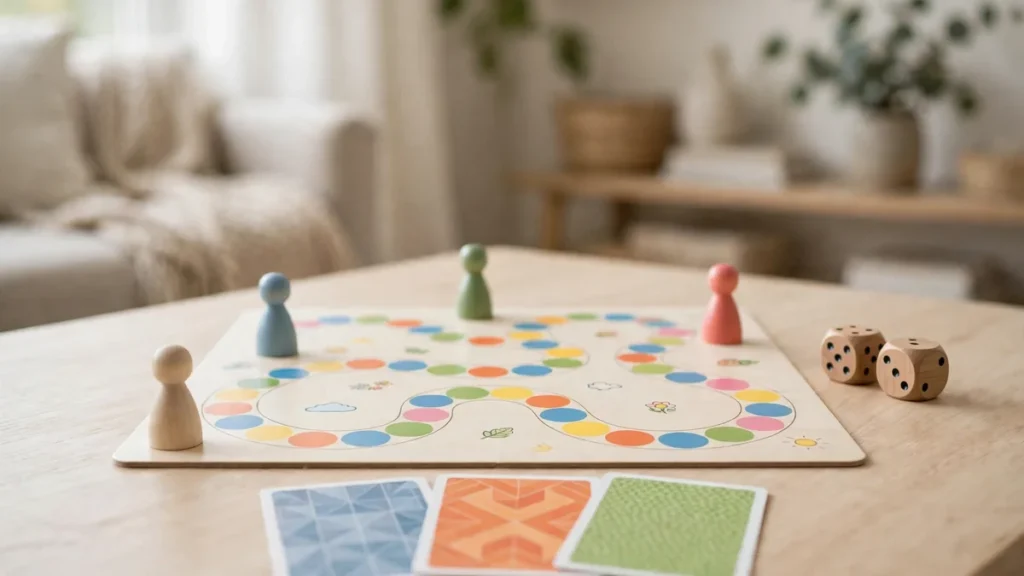
The best kids board games turn an ordinary evening into something a family actually looks forward to. The right game keeps a four-year-old giggling, gives a seven-year-old a real challenge, and still holds the attention of the adults at the table. That balance is rare, which is why the same handful of classics keep showing up on birthday lists and holiday wish lists year after year.
Choosing well matters more than most parents expect. A game that is too hard ends in tears and a box that never leaves the shelf. A game that is too easy bores everyone within a week. The best kids board games sit in the sweet spot: simple enough to learn in five minutes, deep enough to stay interesting for months, and short enough that nobody checks the clock halfway through.
This guide rounds up the strongest board games for children of every age, from first games for preschoolers to strategy games that tweens genuinely love. For each pick you will find the ideal age range, what your child actually learns while playing, how long a game takes, and who it suits best, so you can pick with confidence instead of guessing in the toy aisle.
Key takeaways
- The best kids board games match the child’s age: colour-matching games for ages 3 to 5, light strategy for ages 6 to 8, and real tactics for ages 9 and up.
- Short play times of 15 to 30 minutes keep younger players engaged and make family game night easy to fit in after dinner.
- Cooperative games like Hoot Owl Hoot are ideal for children who find losing hard, because everyone wins or loses together.
- Classic games such as Candy Land and Chutes and Ladders teach counting, colours and taking turns without any reading at all.
- Look for sturdy pieces, clear rules and replay value before you buy — a game your child asks for again is worth far more than a clever box.

How to Choose the Best Kids Board Game
Start with age, not with the picture on the box. Age ratings on board games are usually honest, and they exist because a game designed for a six-year-old and a game designed for a ten-year-old are built around completely different skills. A preschooler needs big pieces, bright colours and rules that can be explained in one sentence. A child of eight or nine is ready for choices, light planning and the occasional bluff.
Next, think about how your child handles losing. Some children bounce back instantly; others take a loss personally for the rest of the evening. If your child is in the second group, a cooperative game is a gift — everyone works together against the game itself, so there is no single loser at the table. Many families keep one cooperative game in the cupboard for exactly those nights.
Play time matters too. For children under six, aim for games that finish in about fifteen minutes. For ages six to nine, twenty to thirty minutes is the sweet spot. Older children can happily sit through forty-five minutes if the game keeps giving them interesting decisions. A game that runs longer than a child’s attention span will not get played twice, however good it looks.
Finally, consider who will actually be playing. A game for two players is perfect for a parent and child, while a game that seats up to six works better for bigger families and playdates. The strongest family games scale well, staying fun whether two people or five are sitting down. When you are comparing options, it also helps to look at the makers behind the box — our roundup of the best board game brands explains which publishers consistently produce sturdy, well-tested games for children.
Best Kids Board Games at a Glance
| Game | Best Age | Players | Play Time | What It Teaches |
|---|---|---|---|---|
| Candy Land | 3 to 5 | 2 to 4 | 15 minutes | Colours, turn-taking |
| Chutes and Ladders | 3 to 6 | 2 to 4 | 20 minutes | Counting, patience |
| Hoot Owl Hoot | 4 to 7 | 2 to 4 | 15 minutes | Teamwork, colour matching |
| Connect 4 | 6 and up | 2 | 10 to 20 minutes | Planning, pattern spotting |
| Guess Who? | 6 and up | 2 | 15 to 20 minutes | Asking questions, logic |
| Operation | 6 and up | 1 to 4 | 10 to 20 minutes | Steady hands, focus |
| Outfoxed! | 5 to 8 | 2 to 4 | 20 minutes | Deduction, memory |
| Sleeping Queens | 8 and up | 2 to 5 | 20 minutes | Simple maths, strategy |
| Ticket to Ride: First Journey | 6 and up | 2 to 4 | 15 to 30 minutes | Planning, geography |
| The Game of Life Junior | 5 to 9 | 2 to 4 | 30 minutes | Money basics, choices |
The Best Kids Board Games, Reviewed
1. Candy Land
Candy Land has been a first board game for generations, and it still earns its place. Players draw a coloured card and move their gingerbread pawn to the next matching square on a bright, winding path through a candy kingdom. There is no reading and no counting, so a three-year-old can play a full game without help, and the simple rules mean grandparents and older siblings can join in without explaining anything twice.
Age range: 3 to 5 years. Learning value: colour recognition, taking turns, and following the order of play. Play time: about 15 minutes. Best for: a child’s very first board game, and for families with a preschooler who is not ready for numbers yet. The only real drawback is that luck decides everything, so older children outgrow it quickly — but for its age group, few games are this welcoming.
2. Chutes and Ladders
Chutes and Ladders is the classic counting game, and it teaches a surprisingly useful lesson: sometimes you slide backwards, and the game goes on anyway. Players spin a number, move that many spaces, climb ladders when they are lucky and slide down chutes when they are not. The board itself does the teaching, because children count each square out loud as they move.
Age range: 3 to 6 years. Learning value: counting to 100, number order, and coping with setbacks. Play time: about 20 minutes. Best for: preschoolers and early readers who are learning their numbers. The game runs a little long for the youngest players, so it helps to play it as a family game where an adult keeps the pace moving.
3. Hoot Owl Hoot
Hoot Owl Hoot is a cooperative game, which makes it one of the kindest first games you can buy. Players work together to help the owls fly home before the sun comes up, playing colour cards to move the owls along the path. Because everyone wins or loses together, there is no gloating and no tears — just a shared goal and plenty of discussion about which card to play next.
Age range: 4 to 7 years. Learning value: colour matching, teamwork, and simple planning. Play time: about 15 minutes. Best for: children who find competitive games upsetting, and for quiet evenings when you want a calm game rather than a noisy one. It is also a lovely choice for a first game night with a younger sibling in the mix.
4. Connect 4
Connect 4 looks simple — drop coloured discs into a grid and be the first to line up four — but it is a genuine strategy game in disguise. Children quickly learn to watch what their opponent is doing, block a run of three, and set traps of their own. Games are fast, so a child who loses can demand a rematch immediately, and that rematch is often where the real learning happens.
Age range: 6 years and up. Learning value: forward planning, pattern recognition, and thinking about the other player’s next move. Play time: 10 to 20 minutes per game. Best for: two-player battles between siblings, or a quick game before bed. The sturdy plastic grid survives years of use, and the game travels well because the pieces store inside the frame.
5. Guess Who?
Guess Who? turns children into detectives. Each player picks a mystery character, then asks yes-or-no questions — does your person wear glasses, do they have curly hair — to narrow down the field. The genius of the game is that it teaches children to ask good questions. A vague question wastes a turn; a clever one can eliminate half the board at once.
Age range: 6 years and up. Learning value: logical thinking, asking precise questions, and sorting information. Play time: 15 to 20 minutes. Best for: two players who enjoy chatting and thinking out loud. It works beautifully as a travel game too, since the flip-down boards keep everything tidy and there are no loose pieces to lose.
6. Operation
Operation is pure, silly fun with a genuine skill at its heart: a steady hand. Players use tweezers to remove plastic ailments from a patient without touching the sides, and the buzzer sounds the moment they slip. The tension is delicious, the sound effects always get a laugh, and children develop real focus and fine motor control while they play.
Age range: 6 years and up. Learning value: hand-eye coordination, patience, and staying calm under pressure. Play time: 10 to 20 minutes. Best for: energetic children who need a game that rewards careful, quiet concentration — and for rainy afternoons when everyone needs a laugh. The game needs batteries, so keep spares in the drawer.
7. Outfoxed!
Outfoxed! is a whodunit for young detectives, and it is one of the best games ever made for the five-to-eight age group. A fox has stolen a pie, and players roll dice, move around the board, gather clues and use a special decoder to rule out suspects. It feels like a real mystery, but the rules stay simple enough for a five-year-old to follow with a little help.
Age range: 5 to 8 years. Learning value: deduction, memory, and working out what a clue actually proves. Play time: about 20 minutes. Best for: children who love stories and mysteries, and for families who want a cooperative game with more excitement than a simple colour-matching game. The clue decoder is the star of the show and makes every game feel different.
8. Sleeping Queens
Sleeping Queens is the hidden gem of this list. Created by a six-year-old, it is a card game about waking sleeping queens with matching number cards, while knights, dragons and jesters stir up trouble along the way. The twist is that the cards use simple addition, so children practise maths without ever realising they are doing homework.
Age range: 8 years and up. Learning value: addition, memory, and light strategy. Play time: about 20 minutes. Best for: children aged eight to twelve who have outgrown the simplest games and want something with real decisions. It is also one of the most portable games on this list, since it is just a deck of cards in a small box.
9. Ticket to Ride: First Journey
Ticket to Ride: First Journey is the child-friendly version of one of the most popular board games in the world. Players collect coloured train cards and claim routes between cities on a simplified map, racing to connect six destinations first. It introduces real strategy — should you grab that route now, or save your cards for a longer one — without any of the complexity of the adult game.
Age range: 6 years and up. Learning value: planning ahead, basic geography, and weighing risks. Play time: 15 to 30 minutes. Best for: families ready to graduate from simple games to something with genuine tactics, and for children who love maps and trains. When your child outgrows this version, the full Ticket to Ride is a natural next step.
10. The Game of Life Junior
The Game of Life Junior turns the classic life-simulation game into a cheerful adventure for younger players. Children pick a character, spin, move around the board and collect stars by doing fun activities, with small choices about money along the way. It is lighter and faster than the adult version, and the theme of choosing what to do with your day gives parents a natural opening to talk about money and decisions.
Age range: 5 to 9 years. Learning value: counting money, making choices, and understanding that different choices lead to different results. Play time: about 30 minutes. Best for: family game nights with mixed ages, since the rules are easy enough for a five-year-old and still entertaining for a nine-year-old. It is a good first step towards the more strategic games older children enjoy, and when your child is ready for deeper thinking, our guide to the best chess sets for beginners is a strong place to start.
Best Kids Board Games for Older Children
Children aged nine and up often want games that feel grown-up without being overwhelming. This is the age where strategy games start to shine. Chess is the obvious landmark, and a child who enjoys Connect 4 or Sleeping Queens is usually ready to learn it — the key is a set designed for learners, with clear pieces and a simple guide to the rules.
Word games and puzzle games also come into their own at this age. A child who likes solving things will enjoy games built around clues, patterns and wordplay, and these make excellent gifts for tweens who have outgrown the toy aisle but are not ready for adult strategy games. Our list of the best puzzle games for teens is a good next stop once your child is looking for a bigger challenge than the games on this list.
For mixed-age families, the trick is to pick games with a little luck built in. A game that is pure strategy will always be won by the oldest player, which quickly kills the fun for everyone else. A game that mixes skill with dice rolls, card draws or a spinner gives younger players a real chance and keeps the whole table engaged until the end.
Checklist: Choosing a Kids Board Game
- Check the age rating first — it is the single most reliable guide to whether a game will work for your child.
- Match the play time to your child’s attention span: about 15 minutes for under-sixes, 20 to 30 minutes for ages six to nine.
- Decide between competitive and cooperative play, especially if your child finds losing difficult.
- Count the players — make sure the game seats everyone who will actually be playing, from two-player duels to whole-family nights.
- Look for sturdy pieces and a strong box, because children’s games get handled hard and stored roughly.
- Pick games with replay value: different cards, dice or routes each time, so the tenth game is as fun as the first.
Frequently Asked Questions
What is the best first board game for a 3-year-old?
Candy Land is the classic choice, because it needs no reading and no counting — children simply match the colour on the card to the colour on the board. Hoot Owl Hoot is another excellent first game, and its cooperative play means nobody loses. Either one teaches turn-taking and the basic rhythm of a board game.
How long should a board game for kids last?
For children under six, aim for about 15 minutes. For ages six to nine, 20 to 30 minutes is ideal. Games longer than 45 minutes suit children of ten and up, and only when the game keeps offering interesting decisions. A game that ends while everyone is still having fun will be requested again.
Are cooperative board games good for kids?
Yes — cooperative games are excellent, especially for younger children and for children who find losing upsetting. They teach teamwork, shared planning and celebrating a win together. Many families keep at least one cooperative game, such as Hoot Owl Hoot or Outfoxed!, for evenings when a competitive game would end in tears.
What board games help kids learn maths?
Sleeping Queens builds addition into every turn, Chutes and Ladders teaches counting to 100, and The Game of Life Junior introduces simple money handling. Board games are one of the most painless ways to practise numbers, because children count and add in order to win, not because they are being tested.
How do I keep board games from getting boring?
Rotate the games on the shelf, play with different combinations of people, and add small house rules once a game is mastered — for example, playing Connect 4 with a time limit, or letting the youngest player draw two cards in Candy Land. A game with dice, cards or a spinner naturally plays differently every time, which is why those games stay popular longest.
What is a good board game gift for a 7-year-old?
Outfoxed! is a wonderful gift for a seven-year-old who likes stories and mysteries, while Guess Who? and Connect 4 suit children who enjoy a head-to-head challenge. If you are buying for a child you do not know well, Ticket to Ride: First Journey is a safe, impressive choice that works for a wide range of ages.
Bottom Line
The best kids board games are the ones that get played again and again: Candy Land and Chutes and Ladders for the youngest players, Hoot Owl Hoot and Outfoxed! for families who prefer teamwork, and Connect 4, Guess Who? and Sleeping Queens for children ready for real thinking. Match the game to the child’s age, keep the play time short, and choose sturdy games with replay value — and family game night will take care of itself.


