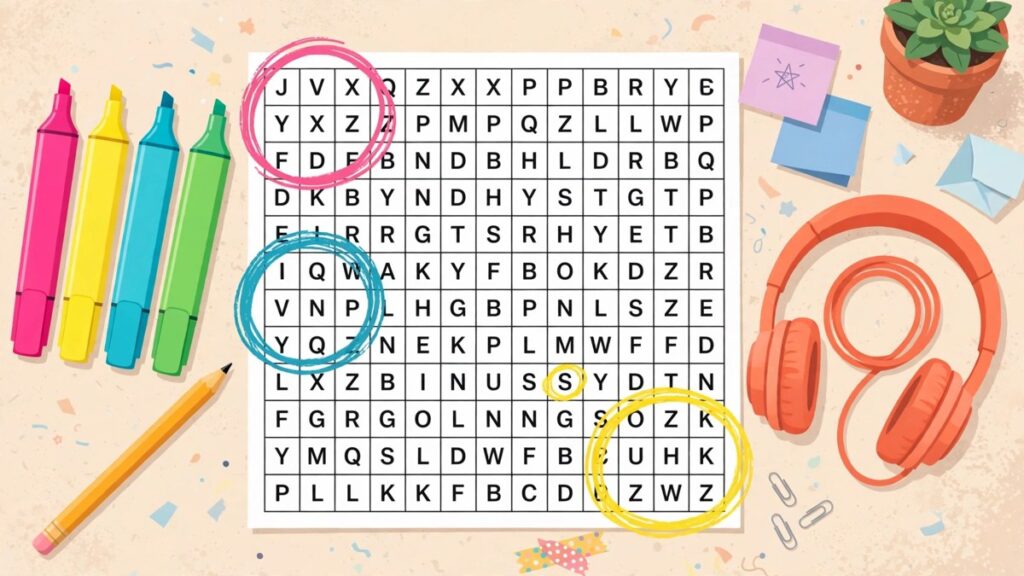
Word search puzzles have a strange superpower: they look simple, yet they can hold a teenager’s attention far longer than most homework ever will. There is something deeply satisfying about scanning a grid of jumbled letters, spotting a hidden word, and circling it with a pen. For teens, that small rush of discovery never really gets old, whether the puzzle is printed on paper during a long car ride or opened on a phone during a study break. The best word search puzzles for teens hit a sweet spot — challenging enough to feel like a real game, but never so hard that they turn into a chore.
What makes a word search great for this age group is variety. Teens are not one audience; they are music fans, athletes, gamers, readers, artists, and future engineers, all with different interests and vocabularies. A puzzle built around pop lyrics will light up one teen, while another would rather hunt for football terms or coding vocabulary. The puzzles that earn a permanent place in a teen’s routine are the ones that speak their language, match their skill level, and fit the moment — a quick five-minute puzzle before class, or a long, meaty grid for a rainy weekend afternoon.
This guide rounds up the best word search puzzles for teens across every style that matters: themed word lists built around music, sports, movies, school, tech, and travel; difficulty levels from easy warm-ups to genuinely tricky expert grids; printable puzzles for classrooms and road trips; and app-based options for teens who prefer a screen. You will also find practical tips for focus and vocabulary building, plus several ready-to-play mini word lists you can turn into your own puzzles in minutes.
Key takeaways
- The best word search puzzles for teens match the solver’s interests, with themed lists covering music, sports, movies, school, tech, and travel.
- Difficulty matters: start with easy forward-only grids and work up to diagonal, backwards, and overlapping words.
- Printable puzzles are ideal for classrooms, road trips, and screen-free time, while apps add timers, hints, and daily challenges.
- Word searches quietly build vocabulary, spelling, and focus — especially when teens solve them regularly and try new themes.
- Ready-to-play mini word lists in this guide let any teen or teacher build a fresh puzzle in under five minutes.

Why Word Search Puzzles Work So Well for Teens
Teenagers live in a world of constant notifications, and their attention is pulled in a dozen directions at once. A word search does the opposite: it asks for one thing only — find the words. That single focus is relaxing, and it is also genuinely useful. Studies of puzzle play consistently show that regular word hunting strengthens pattern recognition, the same skill used in reading comprehension and even in learning to code. When a teen scans rows and columns for a hidden word, the brain practices visual scanning, working memory, and sustained attention all at once.
Vocabulary is the other quiet benefit. A word search built around a theme introduces new terms in a low-pressure way. A teen solving a space-themed puzzle meets words like nebula, orbit, and rover without opening a textbook. A music-themed grid teaches genre names, instrument vocabulary, and artist names almost by accident. Because the words appear in context — grouped by theme and hunted one by one — they stick far better than words memorised from a list.
There is also a social side that adults often miss. Word searches are one of the few puzzles teens happily do together: racing a friend to finish first, trading puzzles in class, or solving a big grid as a family on a Sunday evening. They are competitive without being stressful, and they work just as well solo as they do in a group. For parents and teachers, that makes them one of the easiest screen-free activities to suggest — and one of the few that rarely gets an eye roll.
Themed Word Lists Teens Actually Love
A word search is only as good as its word list, and themed lists are what turn a generic grid into something a teen wants to finish. The themes below are the ones that consistently get the best response from teenagers, because they connect to what teens already care about. Each theme works for beginners and experts alike — the difference is grid size, word length, and how the words are hidden.
Music Word Searches
Music-themed puzzles are the most popular word searches for teens, and it is easy to see why. A grid packed with genres, instruments, and chart vocabulary feels personal, like the puzzle was made for the solver. Good music word lists mix the familiar with the new: pop, rock, hip hop, jazz, indie, guitar, drums, piano, melody, rhythm, chorus, verse, concert, festival, playlist, and encore. For a harder version, add artist and band vocabulary, album names, and music production terms like remix, sample, and studio. A music puzzle also makes a great classroom warm-up before a lesson on sound, culture, or media studies, because every teen has an opinion about music.
Sports Word Searches
Sports grids work brilliantly for athletic teens and for anyone who follows a team. The vocabulary is huge: football, basketball, tennis, cricket, goal, referee, stadium, trophy, captain, coach, penalty, victory, training, and marathon. Team-specific puzzles are even better — a grid built around a single sport, with positions, equipment, and famous tournament names, can keep a sports-mad teen busy for a long time. Sports puzzles also travel well: they are a favourite for long journeys to away games and for waiting rooms before practice. Pairing a sports word search with a quieter puzzle, like the ones in our guide to the best puzzle games for teens, makes a great boredom-busting duo.
Movies and TV Word Searches
Film and television themes are perfect for movie nights and sleepovers. Words like director, actor, script, camera, popcorn, sequel, superhero, animation, thriller, comedy, and premiere give the grid a cinematic feel, and harder puzzles can hide character names, famous quotes, and genre vocabulary. A movie-themed word search is also a fun party game: print one per guest, set a timer, and see who finishes first. For teens who love a franchise, a puzzle built around that world — its places, characters, and catchphrases — feels like a fan activity rather than homework, which is exactly the point.
School and Study Word Searches
School-themed puzzles are the secret weapon of teachers and tutors. A grid built around a subject turns revision into a game: biology terms like cell, nucleus, and photosynthesis; history words like empire, revolution, and treaty; or maths vocabulary like algebra, fraction, and geometry. Because the words are hidden, the brain has to recognise each term by its spelling, which reinforces exactly the kind of recall exams reward. The trick is to keep the lists focused — ten to fifteen words on one topic beats thirty random words every time. A short school-themed puzzle at the start of a lesson also settles a class down far faster than a lecture does.
Tech and Gaming Word Searches
Tech-themed word searches speak directly to the digital generation. Words like computer, keyboard, robot, coding, software, internet, pixel, avatar, server, and virtual feel natural to teens who grew up with devices in their hands. Gaming grids go further, with terms like quest, level, player, console, joystick, dungeon, and leaderboard. These puzzles are especially good for teens who say they hate puzzles, because the vocabulary itself is the hook. A tech word search also works as a gentle introduction to computer science vocabulary before a coding club or a school IT lesson.
Travel Word Searches
Travel-themed puzzles are ideal before a holiday, a school trip, or a geography lesson. Lists built around places, transport, and culture — passport, airport, beach, mountain, map, journey, hotel, adventure, landmark, and souvenir — build excitement for a trip while quietly teaching geography vocabulary. A destination-specific grid is even better: words connected to one city or country turn the puzzle into a mini travel guide. Travel puzzles are also a staple of long flights and road trips, where a paper puzzle beats a dead phone battery every time.
Difficulty Levels: From Easy Warm-Ups to Expert Grids
Not all word searches are created equal, and difficulty is where many puzzle collections go wrong for teens. A puzzle that is too easy feels babyish and gets abandoned; one that is too hard feels like a punishment. The best collections offer a clear ladder, so a teen can start low and climb. Easy puzzles use small grids, usually ten by ten, with words hidden only forwards and across or down. They are perfect for younger teens, for first-timers, and for quick five-minute breaks.
Medium puzzles raise the stakes with larger grids, longer words, and diagonal placements. This is the level most teens enjoy most, because it demands real scanning without becoming frustrating. Hard puzzles add backwards words, overlapping letters, and words that share letters with each other, so a found word can hide another one. Expert grids push further still: big twenty-by-twenty grids, twenty or more words, and themes where the words are long and similar, like science vocabulary or foreign place names. A good rule is to let the teen choose the level, and to keep a mix on hand — an easy puzzle for a tired evening, a hard one for a weekend challenge.
Printable Puzzles vs. Word Search Apps
The printable versus app debate comes down to context, and the honest answer is that both are excellent. Printable word searches are unbeatable for classrooms, road trips, and any situation where screens are unwelcome or batteries are low. They are cheap, shareable, and easy to customise — a teacher can print thirty copies in a minute, and a parent can tuck one into a lunchbox. Paper puzzles also encourage a slower, more deliberate style of solving, with a pen in hand and no timer ticking. Younger teens often prefer print, and so do teens who already spend all day on screens.
Apps, on the other hand, add features paper cannot match: built-in timers, hint buttons, daily challenges, leaderboards, and the ability to generate a fresh puzzle in seconds. Many apps let teens build puzzles from their own word lists, which turns the solver into a puzzle maker. The best approach is a mix — print for quiet, screen-free moments, and apps for travel, waiting rooms, and competitive play with friends. If you are building a puzzle collection for a classroom or a family, keep both options available and let each teen pick their favourite. Families with younger children will also enjoy the gentler grids in our roundup of the best word search puzzles for kids, which use shorter words and bigger grids.
Tips for Focus and Vocabulary Building
Word searches are fun on their own, but a few simple habits turn them into a genuine learning tool. First, set a timer. A ten-minute timed solve sharpens focus and adds a light competitive edge, even when the teen is playing alone. Second, read the word list aloud before starting. Hearing each word once helps the brain recognise it faster in the grid, and it quietly reinforces pronunciation and spelling. Third, circle or highlight in a consistent direction, so the eyes learn a scanning pattern instead of jumping randomly around the grid.
Fourth, keep a notebook for new words. When a teen meets an unfamiliar word in a themed puzzle, writing it down with a one-line definition turns a game into vocabulary study without any extra effort. Fifth, vary the themes. A teen who only solves music puzzles will plateau; rotating through sports, science, travel, and tech keeps the vocabulary fresh and the brain working harder. Sixth, try solving without the word list. Covering the list and hunting for words from memory is an advanced challenge that builds recall, and it is surprisingly addictive. Finally, make your own puzzles. Building a word search for a friend forces the maker to think about spelling, word length, and grid design — and it is often more fun than solving one.
Ready-to-Play Mini Word Lists
The fastest way to start is to take one of the lists below and turn it into a puzzle. Draw a grid, hide the words forwards, backwards, across, down, or diagonally, fill the empty squares with random letters, and hand it to a friend. Each list has twelve words, which is the ideal size for a fifteen-by-fifteen grid.
Music Mini List
MELODY, RHYTHM, GUITAR, PIANO, DRUMS, CHORUS, CONCERT, PLAYLIST, FESTIVAL, ENCORE, VOCAL, STAGE. This list mixes instruments, song structure, and live music vocabulary, so it works for casual listeners and serious musicians alike. For a harder version, add REMIX, STUDIO, and HEADPHONES.
Sports Mini List
GOALKEEPER, STADIUM, TROPHY, REFEREE, CAPTAIN, PENALTY, VICTORY, TRAINING, MARATHON, CHAMPION, STRIKER, DEFENCE. Twelve classic sports words that suit any ball sport, with a couple of longer words to keep the grid interesting. Add TOURNAMENT and SCOREBOARD for an expert twist.
Movies Mini List
DIRECTOR, CAMERA, SCRIPT, POPCORN, SEQUEL, PREMIERE, ACTOR, THRILLER, COMEDY, ANIMATION, SUPERHERO, CINEMA. A crowd-pleasing film list that works for movie nights and sleepovers, with enough long words to challenge confident solvers.
School Mini List
ALGEBRA, HISTORY, BIOLOGY, GEOGRAPHY, CHEMISTRY, LIBRARY, HOMEWORK, TEACHER, SCIENCE, EXAM, ESSAY, LESSON. A revision-friendly list that covers the school day from first lesson to final exam. Teachers can swap in subject-specific words for a targeted revision puzzle.
Tech Mini List
COMPUTER, KEYBOARD, ROBOT, CODING, SOFTWARE, INTERNET, PIXEL, AVATAR, SERVER, VIRTUAL, PROGRAM, NETWORK. A digital-age list that feels modern and relevant, and a great warm-up before a coding session or an IT lesson.
Travel Mini List
PASSPORT, AIRPORT, BEACH, MOUNTAIN, JOURNEY, HOTEL, ADVENTURE, LANDMARK, SOUVENIR, VOYAGE, MAP, TICKET. A holiday-ready list that builds excitement for a trip and quietly teaches travel vocabulary at the same time.
How to Choose the Right Word Search Puzzle
Choosing well comes down to three questions. First, who is solving it? A thirteen-year-old who is new to puzzles needs a smaller grid and familiar words, while a seventeen-year-old word lover will want a big grid and a tricky theme. Second, where will it be solved? A car journey calls for a printed puzzle and a pen; a study break calls for a quick app puzzle with a timer. Third, what is the goal? Pure fun, vocabulary building, classroom revision, or a party game all point to different themes and difficulty levels. Answer those three questions and the right puzzle almost picks itself.
It is also worth keeping a small rotation of puzzle types so the habit never goes stale. Word searches are at their best as part of a broader puzzle routine, alongside crosswords, logic puzzles, and brain teasers. Teens who enjoy word hunting often enjoy the gentle challenge of grids made for older solvers too, and many families share puzzles across generations — the same grid can entertain a teen and a grandparent, which is why our collection of the best word search puzzles for seniors is a popular companion to this guide.
| Puzzle type | Best for | Grid size | Difficulty | Where to use it |
|---|---|---|---|---|
| Themed music puzzle | Music fans, party games | 12 x 12 to 15 x 15 | Easy to medium | Home, sleepovers, classrooms |
| Sports puzzle | Athletes, team trips | 12 x 12 to 18 x 18 | Medium | Car journeys, away games |
| Movies and TV puzzle | Film lovers, movie nights | 15 x 15 | Easy to medium | Home, parties |
| School revision puzzle | Exam preparation | 10 x 10 to 15 x 15 | Medium | Classrooms, study sessions |
| Tech and gaming puzzle | Gamers, coders | 15 x 15 to 20 x 20 | Medium to hard | Apps, coding clubs |
| Travel puzzle | Holidays, geography | 12 x 12 to 15 x 15 | Easy to medium | Flights, road trips |
| Expert mixed-theme grid | Confident solvers | 20 x 20 | Hard to expert | Weekends, competitions |
Checklist: Building a Great Word Search Habit
- Pick a theme that matches the teen’s interests, from music and sports to tech and travel.
- Match the difficulty to the solver, starting easy and moving up to diagonal and backwards words.
- Keep both printable puzzles and a word search app on hand for different situations.
- Solve for ten focused minutes a day rather than in one long, tiring session.
- Write down any new words found in a puzzle, with a one-line definition for each.
- Rotate themes weekly and try building a puzzle of your own at least once a month.
Frequently Asked Questions
What age are word search puzzles for teens best suited to?
Word search puzzles for teens are generally designed for ages thirteen to nineteen, with easy grids suiting younger teens and expert grids challenging older ones. The theme matters as much as the age range: a music or gaming puzzle will engage a thirteen-year-old, while a science or travel grid may suit a seventeen-year-old better. The best collections offer several difficulty levels so each teen can find their own fit.
Are word search puzzles good for vocabulary?
Yes, word searches are a surprisingly effective vocabulary tool. Hunting for a word forces the brain to recognise its spelling letter by letter, and themed lists introduce new terms in context. The effect is strongest when solvers note down unfamiliar words and when they rotate themes regularly, so they meet fresh vocabulary instead of the same words every time.
Should teens use printable puzzles or apps?
Both work well, and most teens benefit from a mix. Printable puzzles are ideal for classrooms, road trips, and screen-free time, while apps add timers, hints, daily challenges, and the chance to build puzzles from custom word lists. Let the teen choose based on the situation — print for quiet focus, apps for quick competitive play.
How long should a teen spend on a word search?
Ten to twenty minutes is the sweet spot for most teens. Easy puzzles take around five minutes, medium grids take ten to fifteen, and expert puzzles can take thirty minutes or more. Short daily sessions build focus and vocabulary better than occasional marathon sessions, so a quick puzzle during a study break is often more useful than a long one.
Can word searches help with school revision?
Absolutely. A word search built around a subject — biology terms, history vocabulary, or maths language — turns revision into a game and reinforces spelling and recall. Teachers often use them as lesson starters or as low-pressure homework, and students can build their own revision puzzles from their notes, which is an even stronger learning activity.
How do I make my own word search puzzle for a teen?
Pick twelve to fifteen words on one theme, draw a grid of fifteen by fifteen squares, and hide the words forwards, backwards, across, down, or diagonally. Fill the remaining squares with random letters, list the words to find beside the grid, and test it by solving it yourself. The mini word lists in this guide are a ready-made starting point, and free puzzle-maker tools can turn a list into a printable grid in seconds.
The Bottom Line
The best word search puzzles for teens are the ones that feel made for them: themed around their music, their sports, their films, and their world; pitched at a difficulty that challenges without frustrating; and available in whatever format fits the moment, print or app. A good puzzle is more than a way to pass the time. It builds vocabulary, sharpens focus, and gives teens a quiet, screen-optional activity they actually enjoy — one that works on a bus, in a classroom, or on a rainy afternoon at home.
Start with the theme your teen loves most, pick a difficulty one step above their comfort zone, and keep the habit short and regular. Use the mini word lists in this guide to build a first puzzle today, rotate the themes each week, and watch a simple grid of letters turn into a daily habit worth keeping.
Note: Word search puzzles are a leisure and learning activity, not a substitute for formal study. For exam preparation, combine puzzles with textbooks, class notes, and teacher guidance.