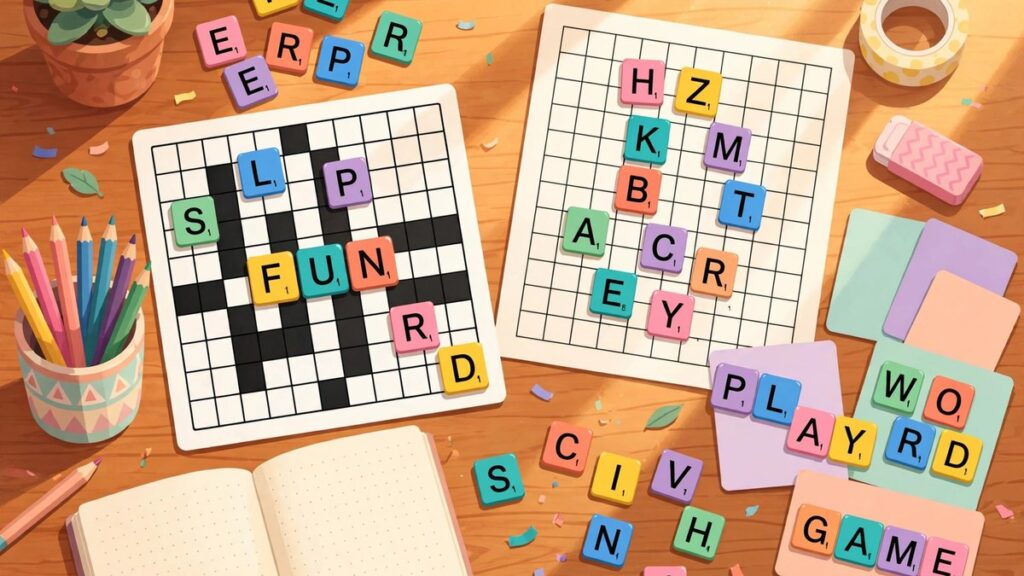
Word games have quietly become one of the best ways for teenagers to spend their free time, and the options in 2027 are better than ever. Whether it is a five-minute Wordle streak before school, a loud family round of Bananagrams on a Friday night, or a competitive Scrabble match with friends over video chat, word games give teens something screens rarely offer: a challenge that actually makes them sharper. They build vocabulary, speed up spelling, sharpen pattern recognition, and teach the kind of flexible thinking that helps in essays, exams, and everyday conversation.
What makes a word game great for teens is a tricky balance. It has to be genuinely fun, not a disguised homework assignment, but it also has to offer enough depth that it does not get boring after a week. The best games on this list hit that sweet spot. Some are quick solo puzzles you can play on a phone in the car, others are party games that turn a quiet evening into a shouting match over whether “qi” is a real word, and a few are clever hybrids that mix words with strategy, teamwork, or bluffing. There is something here for every kind of teenager, from the quiet bookworm to the loud competitor.
In this guide, we have played, tested, and compared the best word games for teens in 2027, looking at how fun they are, how much they actually help with language skills, how easy they are to learn, and how well they work for solo play, family nights, and playing with friends. Every game below is safe, age-appropriate, and widely available, and each one earns its place for a different reason. By the end, you will know exactly which game to buy, download, or print out first.
Key takeaways
- Wordle, Wordscapes, and the NYT Spelling Bee are the best free daily word games for teens who want a quick solo challenge.
- Scrabble, Bananagrams, and Boggle are the classic board and tile games that work best for family game nights.
- Codenames and Letter Jam are the top picks for teens who love teamwork, bluffing, and party-style play with friends.
- The best word game for your teen depends on whether they prefer solo puzzles, head-to-head competition, or cooperative play.
- Even fifteen minutes of word play a day builds vocabulary, spelling confidence, and faster thinking over time.
1. Wordle
Wordle remains the word game that started a daily habit for millions of teenagers, and in 2027 it is still the simplest, most satisfying puzzle you can play in five minutes. You get six guesses to work out a five-letter word, with green, yellow, and grey tiles telling you exactly how close you are. There is no timer, no score chasing, and no pressure, which is exactly why teens love it. It feels like a tiny mystery to solve each morning, and the shared daily word means everyone in a class or family is solving the same puzzle, which makes it endlessly discussable.
What makes Wordle so good for teens is how much strategy hides inside such a simple game. Choosing a strong opening word, learning which letter combinations appear most often, and knowing when to burn a guess to test letters are real skills, and teenagers get noticeably better at them within weeks. It also builds a quiet kind of vocabulary knowledge: teens start to notice patterns like common endings, double letters, and unusual consonant pairings. The streak system adds just enough motivation to come back tomorrow without turning the game into an addiction, and because there is only one puzzle a day, it never eats into homework time.
Wordle is free, works on any phone or computer, and needs no download, no account, and no friends list. It is the perfect first word game for a teenager who says they do not like word games, because almost everyone who tries it for a week gets hooked on the streak. Play it together at breakfast and compare guesses, or let your teen build their own opening-word strategy and watch their average guesses drop over a month.
2. Scrabble
Scrabble is the grandparent of all word games, and it still earns its place on this list because no other game rewards vocabulary quite like it. Players take turns placing letter tiles on a crossword-style board, earning points for each word, with bonus squares that can turn a modest word into a game-winning play. For teenagers, Scrabble is the ultimate test of word knowledge, board strategy, and nerve: do you play the safe seven points, or risk a triple-word score with a word you are only half sure is legal?
The learning value of Scrabble is enormous. Teens who play regularly start to remember two-letter words, unusual spellings, and high-value letters like Q, Z, and X, and they learn to spot prefixes and suffixes that can be added to words already on the board. It also teaches patience and planning, because the best players think two or three moves ahead and block their opponents from the best squares. A full game takes about forty-five minutes, which makes it ideal for a family evening, and the classic board version works beautifully alongside the many digital versions that let teens play friends remotely.
One tip for families: use a dictionary app during the game for challenges rather than arguments, and consider the junior or travel versions for younger teens who are still building confidence. Scrabble can feel slow for very competitive teens who want constant action, but for those who enjoy a deep, thoughtful game, nothing else comes close.
3. Bananagrams
If Scrabble is a slow chess match, Bananagrams is a sprint. Every player grabs a pile of letter tiles and races to build their own crossword grid, shouting “peel” to take more tiles and “bananas” when they finish. There is no board, no turns, and no waiting around, which makes it one of the most energetic word games a teenager will ever play. Games last five to ten minutes, so it is easy to squeeze in a round before dinner or play a quick best-of-five tournament.
Bananagrams is brilliant for teens because it rewards speed and flexibility. Words have to be rearranged constantly as new tiles arrive, which trains the brain to see anagrams and letter patterns quickly. It also levels the playing field in a way Scrabble does not: a teen with a smaller vocabulary can still win by being fast and clever with short words, while a bookish teen has to think on their feet instead of planning in silence. The banana-shaped pouch is portable enough to throw in a school bag, and the game works for two to eight players, so it fits everything from a car journey to a party.
The only downside is that very competitive players sometimes find the luck of the tile draw frustrating, and the game can feel chaotic with more than six players. But for pure fun-per-minute, Bananagrams is hard to beat, and it is one of the few word games teenagers will ask to play again immediately after losing.
4. Boggle
Boggle is the classic shake-and-find word hunt: sixteen letter dice are shaken in a grid, and players have three minutes to find as many words as they can by tracing connected letters. The longer the word, the more points it scores, and words found by more than one player are crossed out, which means the real skill is finding the unusual words nobody else spots. It is fast, noisy, and wonderfully tense as the timer runs down.
For teenagers, Boggle is a superb training ground for visual scanning and quick word recognition. It teaches the brain to spot letter patterns at a glance, and regular players start to see prefixes like “un” and “re” and endings like “ing” and “tion” almost automatically. The three-minute rounds make it perfect for short attention spans, and the game is easy enough that a twelve-year-old can compete with an adult, especially with the junior version’s simpler grid. The modern digital versions add solo modes and online leaderboards for teens who want to play alone.
Boggle works best with two to four players, and it is one of the few word games that feels just as good as a quick two-player duel as it does in a group. Keep a pad and pencil handy, set a timer, and watch how quickly your teen’s word-finding speed improves over a few weeks of regular play.
5. Codenames
Codenames is the word game for teenagers who love teamwork, deduction, and a little bit of drama. Two teams each have a spymaster who gives one-word clues that link several secret words on a grid, and teammates have to guess which words belong to their team without accidentally picking the assassin word and losing instantly. It sounds simple, but it produces some of the funniest, tensest moments in any party game, as a single vague clue can send a whole team down the wrong path.
What makes Codenames so valuable for teens is that it is really a game about communication. The spymaster has to think about how other people think, choose words with exactly the right associations, and avoid clues that could be misunderstood. Teammates have to listen carefully, debate respectfully, and make decisions together under pressure. It builds empathy and flexible thinking in a way few games manage, and it is genuinely hilarious when a clue goes wrong. The game supports four to eight or more players, making it perfect for parties, youth groups, and family gatherings.
There are several versions, including a pictures edition and a two-player duet edition, and a free online version lets teens play with friends remotely. Codenames needs at least four players to shine, so it is not a solo game, but for group play it is one of the best word games ever made.
6. Words With Friends
Words With Friends is essentially Scrabble on a phone, and for teenagers who live on their devices, it is the most natural way to play a word game with friends. You take turns placing words on a board against a friend, with chat built in so the game becomes a slow, friendly conversation that stretches over days. It is free, works on any smartphone, and lets teens play multiple games at once against different friends.
The social side is what makes this game special for teens. It turns a word game into a way of staying in touch, and the asynchronous format means there is no pressure to reply instantly, which suits busy school schedules. The game also includes solo challenges, daily goals, and a word-of-the-day feature that quietly builds vocabulary. Power-ups and bonus tiles add a light strategic layer, though purists sometimes feel they make the game less about pure word skill.
Parents should note that the free version includes ads and in-app purchases, and the chat feature means it is worth a quick conversation about only playing with people your teen knows in real life. With those basics covered, Words With Friends is a friendly, low-pressure way for teens to keep their word skills sharp while staying connected with friends.
7. Wordscapes
Wordscapes is the relaxing puzzle game that millions of teens play to unwind, combining a crossword-style word fill with beautiful scenery backgrounds and gentle music. You are given a set of letters and a crossword grid, and you swipe through the letters to form words that fit. Early levels are easy, but later ones introduce longer words and trickier grids that demand real thinking. It is free, endlessly replayable, and oddly calming.
For teenagers, Wordscapes is the perfect wind-down game. It builds spelling and vocabulary without any timer or opponent, and the sense of progression through thousands of levels gives a satisfying feeling of achievement. It is also genuinely useful for younger teens who are still building confidence with spelling, because the game gently teaches word patterns and rewards experimentation. The daily puzzle adds a reason to return, and the offline mode means it works on planes, buses, and anywhere without Wi-Fi.
The game does include optional in-app purchases for hints, so it is worth showing teens how to play without spending money. As a free, calm, and genuinely educational word game, Wordscapes is one of the best solo options on this list.
8. NYT Spelling Bee
The New York Times Spelling Bee gives players seven letters arranged around a central letter, and the challenge is to make as many words as possible using the middle letter in every word. Longer words score more, and finding the pangram that uses all seven letters is the ultimate goal. It is a daily puzzle with a clever ranking system, from “Solid” up to “Genius” and the coveted “Queen Bee” for finding every word.
Teenagers who like a challenge love the Spelling Bee because it rewards deep vocabulary and creative thinking. Unlike Wordle, there is no single answer, so every player has a different experience, and the rankings give a clear target to aim for each day. It teaches teens to look for plurals, verb forms, and unusual words, and it is surprisingly addictive: the jump from “Great” to “Amazing” to “Genius” keeps players hunting for just one more word. The game is part of the NYT Games app, which also includes Wordle and the crossword, making it good value for puzzle-loving families.
The Spelling Bee can feel hard at first, especially for teens with a smaller vocabulary, but the ranks are generous and progress comes quickly. It is best for teens aged thirteen and up who enjoy a proper mental workout.
9. Crossword Puzzles
Crosswords are the oldest word game on this list and still one of the best for building a teenager’s general knowledge. A good crossword mixes wordplay, trivia, history, science, and pop culture, so solving one is as much about what you know as how well you spell. The daily mini crossword is a perfect five-minute habit, while a full Sunday puzzle is a satisfying weekend project for an ambitious teen.
What crosswords teach is breadth. Teens learn the odd little words that only appear in crosswords, but they also pick up facts about geography, literature, music, and current events with every clue they solve. The cryptic crossword, popular in Britain and Australia, adds a whole extra layer of wordplay that clever teens find irresistible once they learn the rules. Books of crosswords make excellent gifts, and free crossword apps mean a teen never runs out of puzzles.
Start with the mini crossword or a themed puzzle book aimed at younger solvers, and encourage your teen to solve with a pencil and a dictionary nearby. Crosswords reward curiosity, and a teenager who does one a day will quietly build a remarkable store of general knowledge over a year.
10. Scattergories
Scattergories is the party word game that turns a simple idea into pure chaos: players get a list of categories, roll a letter die, and race to write an answer for every category starting with that letter. “A fruit that starts with P” is easy, but “a famous person that starts with P” under a two-minute timer is a different story. The fun comes from the creative answers: the more original your answer, the more points you score, and duplicate answers are crossed out.
For teens, Scattergories is a brilliant creativity workout. It forces quick thinking, lateral associations, and the confidence to defend an unusual answer, which is a skill that transfers directly to class discussions and creative writing. It works best with three to six players, making it ideal for sleepovers and family nights, and the junior version uses simpler categories for younger teens. There are also themed editions and a free online version for remote play.
The game needs a timer and a little bit of honesty about duplicates, but it is one of the loudest, funniest word games you can play, and teenagers who claim to hate word games usually end up loving Scattergories.
11. Quiddler
Quiddler is a clever card game that blends the word-building of Scrabble with the hand management of a game like Rummy. Each round, players are dealt more cards, and they must arrange their letter cards into words, with bonus points for using the most cards or the longest word. It is quick to learn, takes about thirty minutes, and works beautifully for two to eight players.
Teenagers enjoy Quiddler because it feels like a proper card game rather than a spelling test. The short words and double-letter cards keep the game moving, and the strategy of when to discard and when to hold out for a better word adds real depth. It is also wonderfully portable: a deck of cards fits in a pocket, so it is perfect for holidays, camps, and long car journeys. The game quietly builds spelling and anagram skills, and the bonus-point system rewards ambitious play.
Quiddler is less well known than Scrabble or Boggle, which is a shame, because it is one of the most teen-friendly word games ever made. If your family already owns the classics and wants something fresh, this is the one to try next.
12. 7 Little Words
7 Little Words gives players seven short clues and a bank of letter tiles, and the challenge is to work out which tile groups combine to form the answers. It is a gentle, clever puzzle that feels like a cross between a crossword and a jigsaw, and it is perfect for teenagers who like to solve things at their own pace. The daily puzzle is free, and packs of extra puzzles are available for keen players.
The game is excellent for vocabulary and spelling because it teaches teens to think about word structure: prefixes, suffixes, and roots. It is also very satisfying, since every solved clue reveals part of the next answer, creating a lovely chain of small victories. There is no timer, no opponent, and no pressure, which makes it ideal for anxious teens or those who prefer quiet, focused play. The app version is clean and ad-light, and the puzzle books are great for screen-free time.
7 Little Words is best for teens who enjoy puzzles more than competition, and it pairs beautifully with a daily crossword or a round of Wordle as part of a morning brain-training routine.
Best Word Games for Teens Compared
| Game | Best For | Players | Time | Price | Skill Focus |
|---|---|---|---|---|---|
| Wordle | Daily solo habit | 1 | 5 min | Free | Spelling, deduction |
| Scrabble | Family game night | 2-4 | 45 min | Board game | Vocabulary, strategy |
| Bananagrams | Fast, energetic fun | 2-8 | 10 min | Board game | Speed, anagrams |
| Boggle | Quick word hunts | 2-4 | 15 min | Board game | Pattern spotting |
| Codenames | Parties and teamwork | 4-8+ | 20 min | Board game | Communication, deduction |
| Words With Friends | Playing with friends online | 2 | Ongoing | Free | Vocabulary, social play |
| Wordscapes | Relaxing solo puzzles | 1 | 10 min | Free | Spelling, vocabulary |
| NYT Spelling Bee | Daily challenge | 1 | 15 min | Subscription | Vocabulary depth |
| Crosswords | General knowledge | 1-2 | 5-60 min | Free / books | Knowledge, wordplay |
| Scattergories | Sleepovers and parties | 3-6 | 30 min | Board game | Creativity, quick thinking |
| Quiddler | Portable card play | 2-8 | 30 min | Card game | Spelling, anagrams |
| 7 Little Words | Calm solo solving | 1 | 15 min | Free | Word structure |
How to Choose the Right Word Game for Your Teen
Start by watching how your teenager likes to play. A teen who enjoys quiet time alone will love Wordle, Wordscapes, 7 Little Words, and the daily crossword, while a teen who is always organising friends will get far more from Codenames, Scattergories, and Bananagrams. There is no single best word game, only the best fit for your teenager’s personality, and the right choice is the one they actually ask to play again.
Think about age and confidence too. Younger teens and those still building their vocabulary do best with forgiving games like Bananagrams, Wordscapes, and Boggle, where speed and creativity matter as much as knowing rare words. Older teens who enjoy a real challenge will prefer Scrabble, the NYT Spelling Bee, and cryptic crosswords, where deep word knowledge pays off. If your teen enjoys puzzles of every kind, the best logic puzzles for teens make a natural next step after word games, since they train the same flexible thinking in a different format.
Consider the setting as well. A game for a family holiday needs to be portable and quick to learn, which is where Bananagrams and Quiddler shine. A game for a classroom or youth group needs to handle a crowd, which makes Codenames and Scattergories the obvious picks. And a game for the daily commute or the ten minutes before bed should be a phone puzzle like Wordle or Wordscapes, which needs no setup at all. Many families find that one board game for the living room plus one daily phone puzzle covers every situation.
Finally, do not overlook the value of mixing word games with other brain games. Teens who love the deduction in Codenames often enjoy the best brain teasers for teens, and those who enjoy the competitive trivia feel of Scattergories will have a great time with the best trivia questions for teens on family quiz nights. Rotating between word games, brain teasers, and trivia keeps things fresh and builds a wider range of thinking skills than any single game could on its own.
Checklist: Picking a Word Game Your Teen Will Actually Play
- Match the game to your teen’s style: solo puzzles for quiet teens, party games for social teens.
- Check the player count: make sure it works for your family size or your teen’s usual friend group.
- Look at the time per game: five-minute games suit busy school days, longer games suit weekends.
- Test the difficulty: the game should stretch your teen without making them feel defeated every time.
- Try the free version first: most phone word games are free, so test before buying a board game.
- Rotate regularly: keep two or three word games in play so no single game gets boring.
Frequently Asked Questions
What is the best word game for teenagers?
Wordle is the best word game for most teenagers because it is free, takes five minutes, and builds a daily habit that improves spelling and deduction. For family play, Scrabble and Bananagrams are the top picks, and for parties, Codenames is the best choice. The right game depends on whether your teen prefers solo play, family competition, or group games with friends.
Are word games good for teens?
Yes, word games are genuinely good for teenagers. Regular play builds vocabulary, improves spelling, sharpens pattern recognition, and strengthens flexible thinking. Studies of puzzle play consistently link word games with better verbal reasoning, and unlike many screen activities, word games reward patience, planning, and attention to detail.
What word games can teens play for free?
Wordle, Wordscapes, 7 Little Words, Words With Friends, and the daily mini crossword are all free to play, and Codenames has a free online version. Most of these work on any phone or computer without a download or account, making them the easiest way for a teenager to start playing word games today.
What is the best word game for a family game night?
Scrabble is the classic family word game, but Bananagrams is often the better choice for families with teenagers because it is faster, louder, and less punishing for players with smaller vocabularies. Boggle and Scattergories are also excellent family options that keep everyone involved from start to finish.
Can word games help with school work?
Yes. Word games build the vocabulary and spelling skills that help directly with English essays, reading comprehension, and exam answers, and the pattern recognition they teach supports learning in other subjects too. A teenager who plays word games regularly will usually notice new words in their reading and feel more confident using them in writing.
What age are these word games suitable for?
Most of the games on this list suit ages twelve and up, with junior versions of Scrabble, Boggle, and Scattergories available for younger players. Wordle, Wordscapes, and 7 Little Words work well from around age ten, while the NYT Spelling Bee and cryptic crosswords are best for ages thirteen and up.
The Bottom Line
The best word games for teens in 2027 are the ones that make language feel like play rather than work. Wordle is the perfect daily habit, Bananagrams and Scrabble anchor the family game night, Codenames owns the party, and Wordscapes and 7 Little Words are ideal for quiet solo time. Start with one free phone game and one board game, play together for a few weeks, and let your teenager’s preferences guide what you try next. The vocabulary, spelling, and quick thinking they build along the way are a bonus on top of the real prize: time spent laughing, competing, and thinking together.
Note: Prices and availability change over time, and some games offer optional in-app purchases. Check the current price before buying, try free versions first where available, and supervise younger teens on games with chat features so they only play with people they know.


