Are you looking to sharpen your critical thinking, boost your problem-solving skills, or simply test your brainpower with some engaging numbers? Gathering a collection of math puzzles is one of the most effective ways to make learning fun, challenge your logic, and break up the monotony of standard calculations.
Whether you are searching for accessible math puzzles for kids, brain-bending math riddles, or tricky math questions designed to stump even seasoned adults, we have put together a comprehensive collection of over 100 top-tier prompts. Below, you will find a full breakdown organized into distinct, themed categories with clear math brain teasers and answers to help you host a game night or classroom activity. If you enjoy these number-based challenges, you’ll also love our collection of 75+ math riddles with answers that dive even deeper into logic-based problem solving.
Why Solving Math Puzzles Sharpens Your Brain
Engaging in regular logic and numerical challenges does far more than provide quick entertainment. In fact, cognitive researchers have found that working through math riddles stimulates problem-solving pathways and strengthens spatial and numerical reasoning skills.
When you analyze tricky math questions, your brain rapidly tests hypotheses, calculates permutations, and searches for hidden patterns. As a result, this practice promotes flexible thinking, improves working memory, and builds persistence when tackling complex problems.
Furthermore, sharing math puzzles for kids and adults in classroom or family settings encourages collaborative learning. Because people often approach logic problems from different perspectives, discussing solutions helps build deeper mathematical intuition.
Round 1: Fun & Easy Math Puzzles for Kids
Kick off your session with these accessible math puzzles for kids. These prompts focus on basic arithmetic, simple logic, and friendly number patterns that build confidence.
Simple Arithmetic & Word Riddles
-
Question: What three positive numbers give the same answer whether they are added together or multiplied together?
Answer: 1, 2, and 3 ($1 + 2 + 3 = 6$ and $1 \times 2 \times 3 = 6$).
-
Question: If you have 2 apples and you take away 3 apples, how many apples do you have?
Answer: You have 3 apples (the ones you took away!).
-
Question: What single-digit number becomes larger when you turn it upside down?
Answer: 6 (it turns into 9).
-
Question: A mother has 4 daughters, and each daughter has 1 brother. How many children does the mother have in total?
Answer: 5 children (the 4 daughters share the exact same 1 brother).
-
Question: Which is heavier: a pound of heavy iron feathers or a pound of pure gold?
Answer: They weigh the exact same (both are 1 pound).
Kids who enjoy these easy patterns can also try our dedicated set of children’s logic puzzles designed for young problem-solvers.”
Easy Number Patterns
-
Question: Look at this number sequence: 2, 4, 8, 16, 32… What is the next number in line?
Answer: 64 (each number doubles the previous one).
-
Question: How many sides do three squares and two triangles have in total?
Answer: 18 sides ($(3 \times 4) + (2 \times 3) = 12 + 6 = 18$).
-
Question: If a train travels at a speed of 60 miles per hour, how many miles will it travel in 30 minutes?
Answer: 30 miles.
-
Question: What is the next number in the pattern: 5, 10, 15, 20, 25, ___?
Answer: 30 (adding 5 each step).
-
Question: If you multiply any number by zero, what is always the final result?
Answer: 0.
Round 2: Classic Math Riddles and Number Logic
Step up the challenge with these timeless math riddles that test creative thinking and clever wordplay alongside basic math.
Logic & Wordplay Math Riddles
-
Question: I am an odd number. Take away one letter from my name and I become even. What number am I?
Answer: Seven (remove the letter “s” and it spells “even”).
-
Question: Two dads and two sons went fishing. They each caught one fish, but only three fish were caught in total. How is this possible?
Answer: The group consisted of a grandfather, his son, and his grandson (3 people total).
-
Question: If there are 12 oranges on a table and you collect 4, how many do you have?
Answer: You have 4 oranges.
-
Question: Using only addition, how can you add eight 8s together to get the number 1,000?
Answer: $888 + 88 + 8 + 8 + 8 = 1,000$.
-
Question: What occurs once in every minute, twice in every moment, but never in a thousand years?
Answer: The letter ‘M’.
Creative Logic Prompts
-
Question: A clock strikes 1 o’clock in 1 second. How long will it take to strike 3 o’clock?
Answer: 4 seconds (there are 2 intervals between 3 strikes, lasting 2 seconds each).
-
Question: How many times can you subtract the number 5 from the number 25?
Answer: Only once! After that, you are subtracting 5 from 20.
-
Question: If a hen and a half lays an egg and a half in a day and a half, how many eggs does a single hen lay in one day?
Answer: 2/3 of an egg (or 6 hens lay 6 eggs in 6 days).
-
Question: What whole number from 1 to 10 has the same number of letters in its spelled-out name as its numerical value?
Answer: Four (4 has four letters).
-
Question: If you replace the operational signs, how can $2 + 2 = 5$ be corrected using only basic arithmetic operations without changing digits?
Answer: By shifting perspective or using rounding constraints, but mathematically $2 + 2 – 1 = 3$ or adjusting operators to $2^2 + 1 = 5$.
Round 3: Engaging Math Brain Teasers for Teens & Adults
These math brain teasers require structured reasoning, basic algebra, or systematic elimination to solve correctly.
Algebraic & Sequential Puzzles
-
Question: A baseball cap and a ball cost $1.10 in total. The cap costs $1.00 more than the ball. How much does the ball cost?
Answer: $0.05 (5 cents). The cap costs $1.05.
-
Question: What is the next number in the famous Fibonacci sequence: 1, 1, 2, 3, 5, 8, 13, 21, ___?
Answer: 34 (each number is the sum of the two preceding numbers).
-
Question: If 5 cats can catch 5 mice in 5 minutes, how many cats are needed to catch 100 mice in 100 minutes?
Answer: 5 cats (it still takes 5 cats 5 minutes to catch 5 mice).
-
Question: Place operational signs between 1, 2, 3, 4, and 5 to equal 100.
Answer: $(1 \times 2 + 3) \times 4 \times 5 = 100$ or $(1 + 2 + 3 + 4) \times 10 = 100$.
-
Question: What is the sum of all whole numbers from 1 to 100?
Answer: 5,050 (calculated using Gauss’s formula $\frac{n(n+1)}{2}$).
Rate & Distance Teasers
-
Question: A water lily pad doubles in size every single day. If it takes 48 days to completely cover a pond, how many days does it take to cover half the pond?
Answer: 47 days (it doubles on the final day to fill the pond).
-
Question: If it takes 10 printers 10 minutes to print 10 copies, how long will it take 100 printers to print 100 copies?
Answer: 10 minutes.
-
Question: A snail climbs up a 10-foot pole. It climbs 3 feet up during the day but slips down 2 feet at night. How many days will it take to reach the top?
Answer: 8 days (on the 8th day, it climbs 3 feet from 7 feet to reach 10 feet instantly).
-
Question: How many edges does a standard 3D cube possess?
Answer: 12 edges.
-
Question: What is the product of all numbers on a standard telephone keypad?
Answer: 0 (because multiplying by the 0 key equals zero).
Round 4: Tricky Math Questions & Order of Operations
Test your knowledge of precedence rules, tricky phrasing, and mathematical order of operations with these tricky math questions.
Order of Operations (PEMDAS / BODMAS)
-
Question: What is the value of $6 \div 2(1 + 2)$?
Answer: 9 (Parentheses first: $1+2=3$, then left-to-right division and multiplication: $6 \div 2 = 3$, $3 \times 3 = 9$).
-
Question: Calculate the result: $10 – 3 \times 2 + 8 \div 4$.
Answer: 6 (Multiply and divide first: $3 \times 2 = 6$ and $8 \div 4 = 2$; then calculate $10 – 6 + 2 = 6$).
-
Question: What is $7 + 7 \div 7 + 7 \times 7 – 7$?
Answer: 50 ($7 \div 7 = 1$, $7 \times 7 = 49$; calculation becomes $7 + 1 + 49 – 7 = 50$).
-
Question: What is $50 \div 0.5 + 20$?
Answer: 120 (Dividing by 0.5 is equivalent to multiplying by 2: $100 + 20 = 120$).
-
Question: Solve: $4 \times 4 + 4 \times 4 + 4 – 4 \times 4$.
Answer: 20 ($16 + 16 + 4 – 16 = 20$).
Mind-Bending Tricky Prompts
-
Question: You have 3 boxes labeled “Apples,” “Oranges,” and “Apples & Oranges.” Every box is labeled incorrectly. By picking 1 piece of fruit from 1 box, how do you correctly label all boxes?
Answer: Pick a fruit from the “Apples & Oranges” box. If it’s an apple, that box is Apples. The box labeled Oranges must be Apples & Oranges, and the box labeled Apples is Oranges!
-
Question: How can you make the equation $8 + 8 = 91$ correct without adding or removing any digits?
Answer: Flip the page upside down! It becomes $16 = 8 + 8$.
-
Question: A farmer has 17 sheep. All but 9 run away. How many sheep does the farmer have left?
Answer: 9 sheep.
-
Question: If 3 workers take 3 hours to dig 3 holes, how long does it take 1 worker to dig half a hole?
Answer: You cannot dig “half” a hole (a hole is always a whole hole!).
-
Question: What is the maximum number of times you can fold a standard piece of paper in half?
Answer: Typically 7 times (regardless of thickness or size under normal physical conditions).
Round 5: Geometry, Spatial & Shape Puzzles
Challenge your spatial awareness and visual deduction with these shape-focused math puzzles.
Counting & Shapes
-
Question: How many triangles are created when you draw two diagonal lines connecting opposite corners of a square?
Answer: 8 triangles (4 small individual triangles and 4 larger combination triangles).
-
Question: What angle is formed by the hands of a clock at 3:15?
Answer: $7.5^\circ$ (the hour hand moves $0.5^\circ$ per minute, so at 15 minutes it has moved $7.5^\circ$ past 3).
-
Question: What is the sum of all interior angles inside a standard pentagon?
Answer: $540^\circ$ ($(5 – 2) \times 180^\circ$).
-
Question: How many vertices does a standard 3D triangular pyramid have?
Answer: 4 vertices.
-
Question: If a circular pizza is cut using 3 straight cuts, what is the maximum number of slices you can create?
Answer: 7 slices.
Spatial Logic
-
Question: How many flat faces does a standard cylinder possess?
Answer: 2 flat faces (top and bottom circles).
-
Question: What shape has an infinite number of lines of symmetry?
Answer: A circle.
-
Question: How many right angles exist inside a standard 3D rectangular brick?
Answer: 24 right angles (4 per face across 6 faces).
-
Question: If you double the length of all sides of a cube, by what factor does its total volume increase?
Answer: By a factor of 8 ($2^3 = 8$).
-
Question: What geometric term describes a polygon with 8 equal sides and 8 equal interior angles?
Answer: A regular octagon.
Round 6: Speed Arithmetic & Probability Puzzles
Test your fast calculations and probability reasoning with these analytical math brain teasers.
Probability & Statistics
-
Question: If you flip a fair coin 3 times, what is the probability of getting heads all 3 times?
Answer: $1/8$ or $12.5\%$ ($(1/2)^3$).
-
Question: What is the probability of rolling a total sum of 7 using two standard six-sided dice?
Answer: $1/6$ or $16.67\%$ (6 winning combinations out of 36 total outcomes).
-
Question: In a room of 23 random people, what is the approximate probability that at least two share the exact same birthday?
Answer: About $50\%$ (known as the Birthday Paradox).
-
Question: A bag contains 4 red marbles and 6 blue marbles. If you pick one at random, what is the probability it is red?
Answer: $4/10$ or $40\%$.
-
Question: What are the odds of rolling an even number on a standard six-sided die?
Answer: $1/2$ or $50\%$ (numbers 2, 4, 6 out of 6).
Fast Mental Math
-
Question: What is 15% of 80 calculated mentally?
Answer: 12 ($10\%$ of $80 = 8$; $5\%$ is $4$; $8 + 4 = 12$).
-
Question: What is $2^5$ (two raised to the fifth power)?
Answer: 32.
-
Question: What is the square root of 144?
Answer: 12.
-
Question: What is $99 \times 99$?
Answer: 9,801 ($(100 \times 99) – 99 = 9,900 – 99$).
-
Question: What is $1/4$ expressed as a percentage?
Answer: $25\%$.
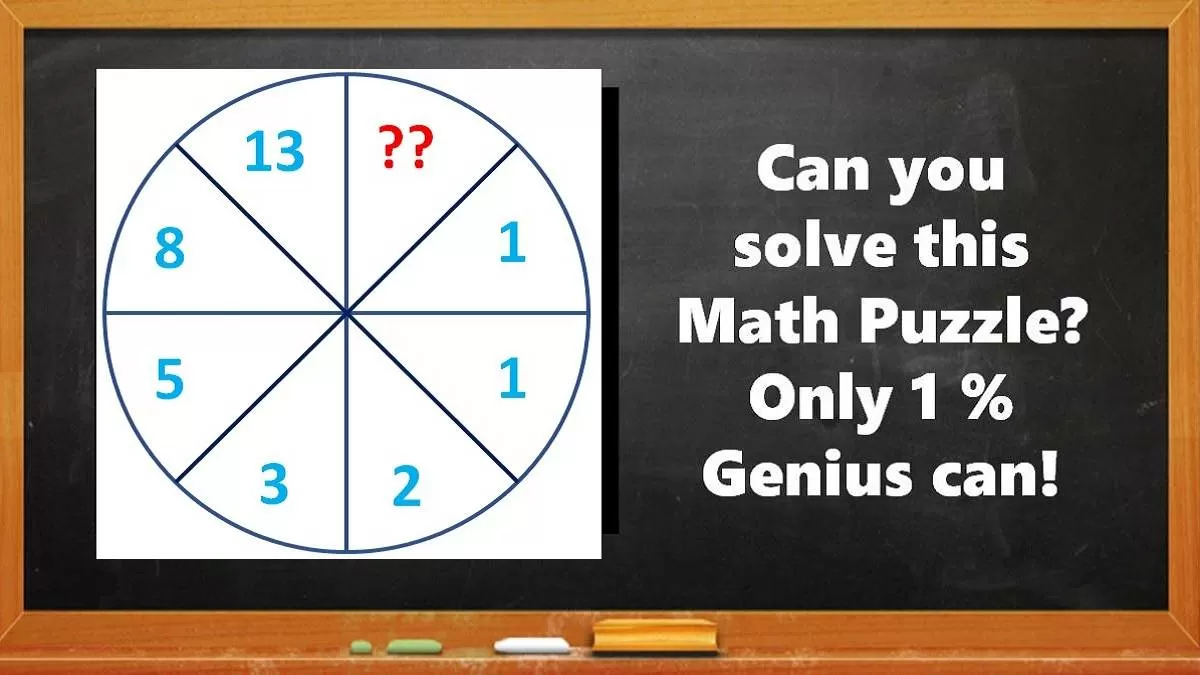
Round 7: Word-Based Numerical Riddles
Combine vocabulary, reading comprehension, and counting with these clever math riddles.
Word & Logic Challenges
-
Question: I am a three-digit number. My tens digit is 5 more than my units digit, and my hundreds digit is 8 less than my tens digit. What number am I?
Answer: 194 (Units = 4, Tens = 9, Hundreds = 1).
-
Question: If you write out all whole numbers from 1 to 100, how many times will you write the digit 9?
Answer: 20 times (9, 19, 29, 39, 49, 59, 69, 79, 89, 90-99).
-
Question: What single number when multiplied by itself equals its own square root?
Answer: 1.
-
Question: A prime number is a number divisible only by 1 and itself. What is the smallest prime number?
Answer: 2 (and it is the only even prime number!).
-
Question: What is the sum of the prime numbers smaller than 10?
Answer: 17 ($2 + 3 + 5 + 7 = 17$).
Brain-Bending Word Math
-
Question: A store sells pencils for 5 cents each or 3 for 10 cents. How many pencils can you buy with 25 cents?
Answer: 7 pencils (6 for 20 cents, plus 1 for 5 cents).
-
Question: How many whole numbers contain the digit 0 between 1 and 100?
Answer: 11 numbers (10, 20, 30, 40, 50, 60, 70, 80, 90, 100 — note that 100 contains two zeros).
-
Question: If a grandfather clock takes 6 seconds to strike 4 o’clock, how long does it take to strike 8 o’clock?
Answer: 14 seconds (there are 3 intervals for 4 strikes = 2 sec per interval; 8 strikes have 7 intervals).
-
Question: What consecutive whole numbers add up to 45?
Answer: $1+2+3+4+5+6+7+8+9 = 45$ (or $7+8+9+10+11 = 45$).
-
Question: What number remains the same whether read forward, backward, or upside down?
Answer: 88 (or 888).
Round 8: Advanced Logic & Tricky Math Questions
Ready to test true math lovers? These tricky math questions require systematic problem-solving and rigorous logic.
Expert Logic Puzzles
-
Question: You have 8 identical-looking coins, but 1 coin is slightly heavier than the rest. Using a balance scale, what is the minimum number of weighings needed to find the heavy coin?
Answer: 2 weighings (divide into groups of 3, 3, and 2).
-
Question: A man has 5 chains, each consisting of 3 links. He wants to join all 15 links into one continuous circle. It costs $1 to cut a link and $2 to weld it shut. What is the minimum cost?
Answer: $9 (cut all 3 links of one chain, then use those 3 open links to join the remaining 4 chains).
-
Question: How can you measure exactly 4 liters of water using only a 3-liter jug and a 5-liter jug?
Answer: Fill the 5L jug, pour into the 3L jug (leaving 2L in the 5L jug). Empty 3L jug, transfer 2L into it. Fill 5L jug again, pour into 3L jug until full (1L poured). Exactly 4L remains in the 5L jug!
-
Question: What is the smallest positive whole number that is divisible by all numbers from 1 to 10?
Answer: 2,520.
-
Question: A candle burns completely in 1 hour. How can you measure 45 minutes using two identical candles that burn at non-uniform rates?
Answer: Light both ends of Candle A and one end of Candle B. When Candle A burns out (30 mins), light the second end of Candle B. When Candle B burns out, exactly 45 minutes have elapsed!
Advanced Number Theory
-
Question: What is the value of $x$ if $x^2 – y^2 = 21$ and $x + y = 7$?
Answer: $x = 5$ (Since $x^2 – y^2 = (x-y)(x+y) = 21$, then $x-y = 3$. Solving $x+y=7$ and $x-y=3$ yields $x=5, y=2$).
-
Question: What is the sum of the first 10 odd numbers?
Answer: 100 (The sum of the first $n$ odd numbers is always $n^2$).
-
Question: What digit is in the units place of $2^{10}$?
Answer: 4 ($2^{10} = 1,024$).
-
Question: How many factors does the number 24 have?
Answer: 8 factors (1, 2, 3, 4, 6, 8, 12, 24).
-
Question: If $3x + 7 = 22$, what is the value of $x$?
Answer: $x = 5$.
Round 9: Mixed Pattern Recognition & Sequences
Discover hidden numerical sequences with these analytical math brain teasers.
Sequence Challenges
-
Question: Find the next number: 1, 4, 9, 16, 25, 36, ___?
Answer: 49 (sequence of perfect squares: $7^2$).
-
Question: What comes next: 2, 3, 5, 7, 11, 13, 17, ___?
Answer: 19 (sequence of prime numbers).
-
Question: What is the next number in line: 1, 8, 27, 64, 125, ___?
Answer: 216 (sequence of perfect cubes: $6^3$).
-
Question: Solve the sequence: 3, 6, 12, 24, 48, ___?
Answer: 96 (doubling rule).
-
Question: What is the missing number: 100, 95, 85, 70, 50, ___?
Answer: 25 (subtracting 5, 10, 15, 20, then 25).
Visual & Mathematical Logic
-
Question: What number replaces the question mark: $2 + 3 = 10$, $6 + 5 = 66$, $8 + 4 = 96$, $9 + 7 = ?$
Answer: 144 (Pattern: add numbers, then multiply by first number: $(9+7) \times 9 = 16 \times 9 = 144$).
-
Question: Find the logic: $1 = 5$, $2 = 25$, $3 = 125$, $4 = 625$, $5 = ?$
Answer: 1 (Since $1 = 5$ was stated at the start!).
-
Question: If $11 \times 11 = 4$ and $22 \times 22 = 16$, what is $33 \times 33$?
Answer: 36 (Add digits first: $(3+3) \times (3+3) = 6 \times 6 = 36$).
-
Question: Complete the pattern: 81, 27, 9, 3, ___?
Answer: 1 (dividing by 3 each step).
-
Question: What comes next: 1, 2, 6, 24, 120, ___?
Answer: 720 (factorial sequence: $1!, 2!, 3!, 4!, 5!, 6!$).
Round 10: Ultimate Math Trivia & General Brain Teasers
Finish strong with these entertaining math puzzles covering famous constants, historic facts, and surprising numerical properties.
Mathematical Wonders
-
Question: What mathematical constant is defined as the ratio of a circle’s circumference to its diameter?
Answer: Pi ($\pi \approx 3.14159$).
-
Question: What is the only even prime number?
Answer: 2.
-
Question: What famous theorem states that $a^2 + b^2 = c^2$ for right-angled triangles?
Answer: The Pythagorean Theorem.
-
Question: What symbol is used to represent infinity ($\infty$)?
Answer: The lemniscate.
-
Question: Who is considered the father of modern geometry?
Answer: Euclid.
Final Rapid-Fire Teasers
-
Question: What is the roman numeral representation for the number 50?
Answer: L.
-
Question: How many degrees are in a full circle?
Answer: $360^\circ$.
-
Question: What is the value of any non-zero number raised to the power of 0?
Answer: 1.
-
Question: What prefix means one quadrillionth ($10^{-15}$)?
Answer: Femto-.
-
Question: What polygon has 10 sides?
Answer: A decagon.
-
Question: How many seconds are there in one full hour?
Answer: 3,600 seconds ($60 \times 60$).
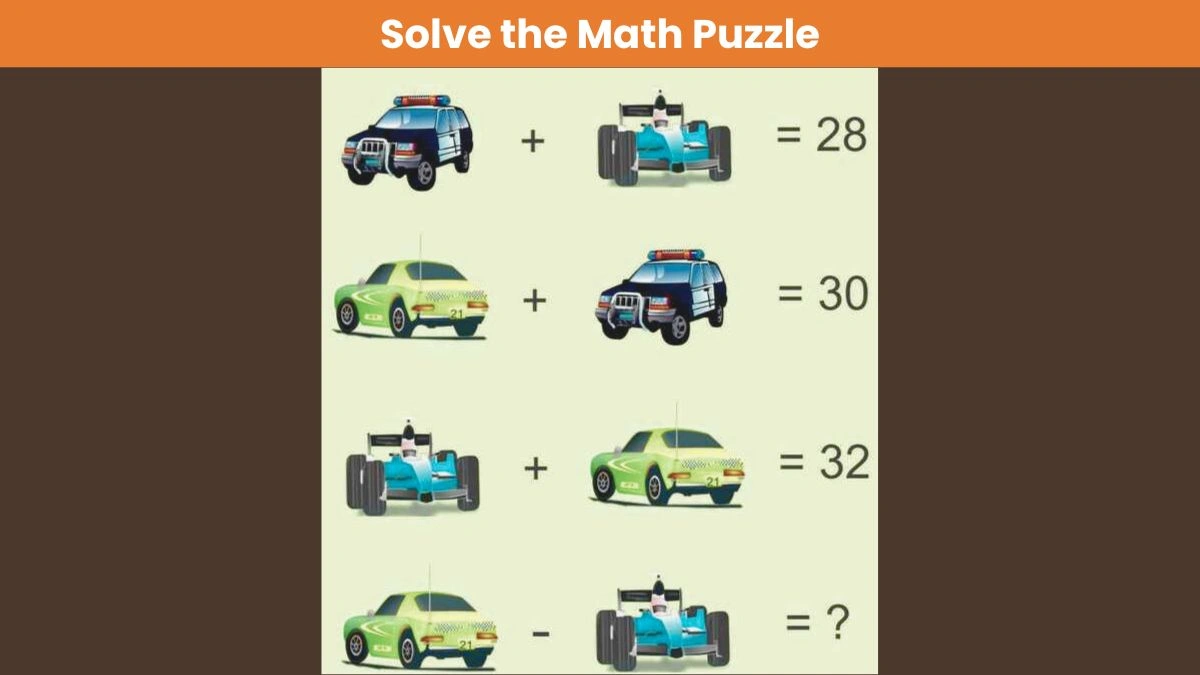
Quick Reference Summary Table
To help teachers, event hosts, and quizmasters select the right round based on audience age and difficulty, use this quick overview table:
| Puzzle Round | Total Questions | Difficulty Level | Recommended Target Audience |
| Puzzles for Kids | 10 Questions | Easy | Elementary Students & Kids |
| Classic Math Riddles | 10 Questions | Easy / Medium | Families & General Audiences |
| Math Brain Teasers | 10 Questions | Medium | Middle & High Schoolers |
| Tricky Math Questions | 10 Questions | Medium / Hard | Order of Operations Enthusiasts |
| Geometry & Spatial | 10 Questions | Medium | Visual Learners |
| Probability & Speed | 10 Questions | Medium / Hard | Fast Mental Calculators |
| Word-Based Riddles | 10 Questions | Medium | Riddlers & Word Lovers |
| Advanced Logic | 10 Questions | Extremely Hard | High School & Adult Experts |
| Sequences & Patterns | 10 Questions | Medium / Hard | Analytical Thinkers |
| Math Trivia & Facts | 11 Questions | Easy / Medium | Everyone |
Tips for Hosting an Engaging Math Puzzle Challenge
Running a classroom competition, family game night, or pub trivia event with math brain teasers takes a bit of planning. Keeping a few practical guidelines in mind will ensure your event runs smoothly:
-
Mix Up Categories: Avoid stringing together too many dry arithmetic problems in a row. Alternating between visual geometry, word riddles, and speed math keeps energy high.
-
Encourage Scratch Paper: For intermediate and tricky math questions, make sure participants have scrap paper and pencils ready so they can sketch shapes or test formulas.
-
Award Partial Credit for Logic: On complex word problems, grant partial points if a team demonstrates the correct algebraic setup or reasoning process, even if they make a tiny arithmetic slip.
-
Keep Tiebreaker Questions Ready: Prepare 2 or 3 numerical estimation tiebreakers (such as “What is the square root of 10,000?” or “How many digits are in $2^{20}$?”) to quickly settle score ties.
Conclusion
Working through a curated collection of math puzzles is a fantastic way to train your logical mind, explore surprising numerical properties, and keep your memory sharp. From simple warm-up riddles for young kids to brain-bending algebra and probability challenges, practicing math logic never stops being rewarding.
Share these math brain teasers and tricky math questions with your friends, students, or family members at your next game night to see who claims the ultimate title of Math Champion! For more engaging quizzes, brainteasers, and word games, check out our complete collection at riddlepuzzle.
Frequently Asked Questions
How can I make math puzzles accessible for kids?
Start with visual or story-based math puzzles for kids that rely on simple counting, shapes, or real-world objects like fruits or coins. Avoid overwhelming young learners with complex algebraic symbols early on.
What is the difference between a math riddle and a math brain teaser?
A math riddle usually relies on wordplay, clever phrasing, or lateral thinking alongside numbers. Conversely, a math brain teaser typically requires systematic deduction, algebraic equations, or step-by-step arithmetic to solve.
How do math puzzles improve learning retention?
By framing math concepts as interactive challenges, students engage active retrieval pathways in the brain. This contextual problem-solving builds stronger conceptual understanding than mechanical rote memorization.